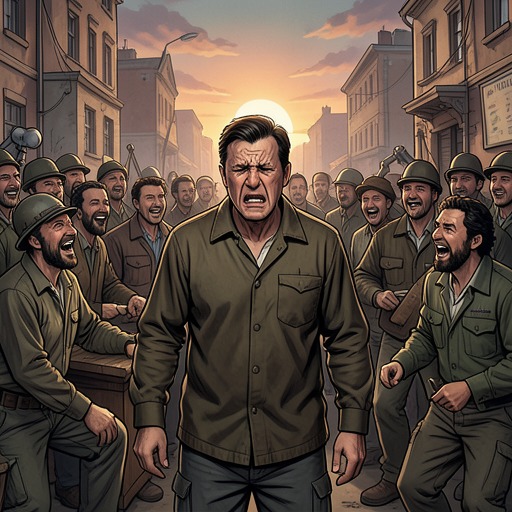
Fragmented Humanity
Thus Spoke ZarathustraFragmented Humanity is Zarathustra’s diagnosis of people divided into disconnected parts: bodies missing limbs, persons reduced to one oversized faculty, and lives scattered across a past that yields no coherent human figure. The image carries both despair and a task. What Zarathustra sees as fragments in the present and past may be brought together as fragments of a future, while the human capacity to interpret and create can redeem what has already happened.
From bodily lack to one-sided excess
Zarathustra first answers the Hunchback and those for whom he speaks by recalling what people say about bodily impairment. They claim that removing a hunchback’s hump would remove his spirit, that restoring sight would expose a blind man to too many evils, and that enabling a lame man to walk would let his vices run away with him. These sayings treat limitation as protection and cure as a new injury. Zarathustra presents them as the people’s teaching, then turns from its account of particular bodies to a more disturbing figure of human incompleteness.
The loss of an eye, ear, leg, tongue, nose, or head is, he says, the least serious thing he has encountered among people. Worse are those who seem to lack everything except one thing, which they possess in excess. One person becomes a great eye, another a great mouth or belly; each is reduced to a single enlarged capacity rather than formed as a whole. Zarathustra calls such people inverse cripples. The reversal in the name matters: the problem is not simply a missing part but an imbalance so extreme that abundance in one respect accompanies poverty in nearly every other.
To make this imbalance visible, Zarathustra recalls the first time he crossed a bridge after emerging from solitude. He thought he saw an ear as large as a man. Looking more closely, he found the huge ear attached to a tiny, thin stalk that was itself a man; a magnifying glass disclosed a small, envious face and a swollen little soul. The people called this figure a great man and a genius. Zarathustra distrusted their judgment and saw instead an inverse cripple, too little in nearly everything and too much in one. The grotesque proportions turn an abstract criticism of one-sided greatness into a scene of misrecognition: public acclaim magnifies the conspicuous feature, while the diminished person beneath it disappears from view.
A present and past made of fragments
After speaking to the Hunchback and his advocates, Zarathustra turns to his disciples in profound ill-humour. He says that among people he walks among fragments and limbs, and that the sight which most horrifies him is people shattered and scattered as if across a battlefield of slaughter. The battlefield image gives fragmentation the force of damage and aftermath. Humanity appears not as a gathered community but as the remains of a dispersal, with no intact person visible among the pieces.
His perception reaches backward as well as outward. When his eye flees from the present into the past, he finds the same fragments, limbs, and dreadful chances, but no human beings. Past and present together become his most intolerable burden. The recurrence of the image makes fragmentation more than a temporary social impression: history, as he sees it, has repeatedly failed to compose its materials into a whole. His distress is consequently not eased by looking to what has been; the past offers no completed figure that could settle the present.
Yet Zarathustra says he could not live if he were not a seer of what must come. That qualification changes the meaning of his lament. He does not claim to have found wholeness in the people around him or in history behind him. His capacity to endure depends on anticipating a future in which the scattered material can be read differently. The future does not erase the fragments; it gives them a possible direction and makes their arrangement a problem still open to action.
Fragments of a future
Zarathustra tests what a person might become through a sequence of contrasts: promiser or fulfiller, conqueror or inheritor, harvest or ploughshare, physician or convalescent, poet or genuine man, liberator or subduer, good or evil. These alternatives do not identify a finished ideal. They make visible how uncertainly a person can be understood when the present supplies only partial signs and competing possibilities. A person may be an unfinished action, the bearer of a promise, or an instrument of a future harvest rather than a completed result.
Zarathustra therefore describes himself as walking among fragments of the future he scans. The phrase turns his earlier image of human wreckage toward possibility without pretending that the damage has already been repaired. The people he encounters can be both pieces of an unsatisfactory present and indications of something not yet assembled. His art and aim are to compose these fragments and bring together what is fragment, riddle, and dreadful chance. The work is interpretive as well as constructive: scattered lives and events must be read, and their relations made rather than simply discovered as an already finished whole.
Composition and redemption
Zarathustra’s project depends on the human being as more than an object to be observed. He asks how he could endure being human if humanity were not also capable of poetry, reading riddles, and redeeming chance. These capacities answer the image of fragmentation point by point. Poetry composes; reading a riddle seeks relation within what remains obscure; redeeming chance gives otherwise scattered events a place in a chosen account. None guarantees that every fragment will fit, but each makes composition an active possibility.
The sharpest form of that possibility is Zarathustra’s definition of redemption: to redeem the past and transform every “It was” into an “I wanted it thus!” The past cannot be made not to have happened. The transformation he describes instead changes the relation to what happened, making the past something one can affirm as part of a willed life rather than endure only as an alien burden. Fragmented Humanity thus names both a condition of dismemberment and the material of a future undertaking. Zarathustra’s vision remains severe about the present and the historical record, but its final movement is toward composition: not a claim that humanity is already whole, but an insistence that fragments can be gathered and chance creatively redeemed.