Laughter and Dance
Thus Spoke ZarathustraLaughter and Dance makes movement and laughter more than signs of cheerfulness: they become measures of whether a person can affirm a life that includes difficulty. A fitting step signals a path that is truly one’s own; approaching a goal becomes a dance; and wisdom that produces no laughter is rejected. The image culminates in a crown Zarathustra first places on himself and later throws to The Higher Men, turning laughter from a private achievement into a challenge they must learn to meet.
Dance as a Measure of Life
Zarathustra’s account begins with a pointedly gendered division: man is imagined as fit for war, woman for bearing children, while both are said to be fit for dancing with head and heels. The formulation assigns different roles to men and women, but the shared dance is its closing emphasis. It places both within a common physical expression that is not reducible to those roles. The passage does not explain or resolve the division; its force lies in the contrast between differentiated duties and a capacity for movement declared common to both.
Dance also sets a standard for the day and for wisdom. A day without even one dance is to be counted as lost, while wisdom that brings no laughter is to be considered false. These paired judgments make bodily movement and laughter tests of lived value, rather than decorative additions to it. The daily measure is deliberately modest—one dance—yet it asks whether a person’s life has made room for lightness at all. Wisdom, in turn, must have an effect on how life is borne; solemnity alone cannot certify it.
The Step, the Goal, and the Swamp
The passage on approaching happiness gives the dance a more intricate rhythm. Good things, Zarathustra says, approach their goal crookedly, arching like cats and purring inwardly as happiness draws near; all good things laugh. The image refuses a straight, solemn march toward achievement. Nearness to a goal instead produces an inward pleasure that bends the body and breaks into laughter. The crooked approach is not presented as failure to reach the goal: it is the distinctive manner in which good things arrive.
A person’s step, too, reveals whether that person is walking along their own path. Zarathustra invites attention to his own walk, then contrasts the dancer who approaches a goal with those who cannot move lightly. He rejects the image of himself as a stiff statue or pillar and describes his love of running fast. The contrast is not simply between standing still and moving: it is between rigidity and a movement responsive enough to run, turn, and dance.
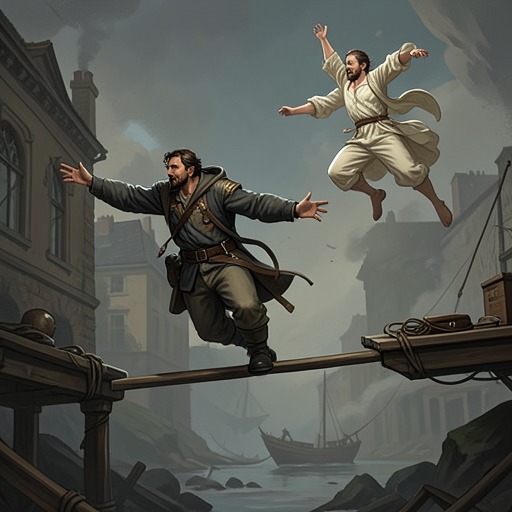
That responsiveness matters because the earth contains swamps and thick afflictions. Light feet do not make those conditions disappear; they make it possible to run across mud and dance as upon swept ice. The comparison holds difficulty and lightness together. Dance is thus not evidence that life has become smooth, but an image of how a person may move through what remains difficult. Zarathustra’s exhortation to lift the heart higher is immediately corrected by the body: dancers must not forget their legs, and he even urges them to stand on their heads. The reversal keeps aspiration physical, comic, and unstable rather than allowing it to become solemn uplift.
The Crown Zarathustra Claims
Zarathustra gives laughter a visible emblem in the laugher’s crown, a crown woven of roses. He says he has set it on his own head and canonized his laughter, finding no one else strong enough for it in that moment. The self-crowning makes his laughter an act of judgment: its authority is enacted by the one who wears the crown, not conferred by an unnamed outside judge. The rose wreath also makes this authority seem festive rather than severe. Its weight is borne through laughter, not through a posture of uncompromising gravity.
The names Zarathustra gives himself extend the image into a portrait of movement. He is Zarathustra the dancer and the light, beckoning with wings and ready for flight; he is also the laughing prophet, not impatient or uncompromising, but fond of jumping and escapades. These descriptions bind prophecy to bodily ease. His authority in these passages does not depend on standing immovably above movement; it appears in the speed, lightness, and laughter with which he presents himself. The repeated image of wings makes dance seem to verge on flight, while the running, jumping body keeps that possibility grounded in action.
The Crown Offered to The Higher Men
When Zarathustra turns to The Higher Men, the crown changes hands. Their worst failing, he says, is that they have not learned to dance as a person ought—to dance beyond themselves. Their status as failures is not treated as the final measure of their possibilities: what matters is that much remains possible. Zarathustra accordingly directs them to lift their hearts, but couples that command with a demand to laugh beyond themselves. The movement is an answer to limitation, not a claim that limitation has already been overcome.
He then throws the laugher’s rose-wreath crown to them and repeats that he has canonized laughter, telling them to learn to laugh. The shift from claiming the crown to offering it marks a transfer of responsibility. Zarathustra can model and commend laughter, but the others must acquire it for themselves; receiving the emblem does not mean that they have already learned the practice. In the sequence of exhortations, dancing beyond oneself and laughing beyond oneself name a capacity still to be developed. Laughter and Dance therefore ends its argument not with a celebration of easy happiness, but with an invitation to become light enough to move through failure without mistaking it for the end of possibility.