Law-tables
Thus Spoke ZarathustraLaw-tables are the book’s image for values given the authority of commands: they order a people’s life, shape individual conduct, and declare what counts as good or evil. Their significance lies in their changeability. Old tables can be shattered, but the empty space they leave does not itself create a future; new ones must be written and carried into life. Through this recurring image, Zarathustra’s challenge is not merely to reject inherited morality, but to make the difficult passage from obedience to creation.
Definition and Social Function
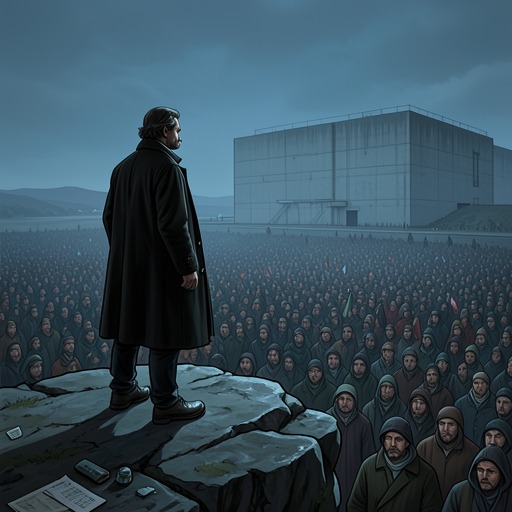
An early explanation describes morality as a table of self-imposed commands hanging over a people. Such a table is not only a list of prohibitions: its values give a community a way to maintain itself and direct its members’ conduct. People cannot live without evaluating, but different peoples need not evaluate alike. A community’s table therefore expresses a particular form of life rather than a universal standard shared by all.
The same image applies to an individual. When a person imposes commands upon himself and obeys them, unruly impulses are redirected into self-control. The account compares this change to a rabble becoming a nation: the table gives conduct an order that was not present before. Self-command is consequently not simple submission to someone else’s rules. It can be an achievement that requires strength, and the table can be understood as both the discipline that organizes a life and the expression of the life that has established it.
This social function makes the image more complex than a straightforward rejection of law or order. The problem is not that people have values, but that a settled table may be mistaken for a timeless truth. Zarathustra has seen many lands and peoples and found that each evaluates differently; none can dispense with evaluation, yet no people can simply preserve itself by adopting its neighbour’s valuations. The tables are necessary to organized life, while their differences reveal that their authority has a history and a source in the needs of those who live by them.
The Authority of the Old Tables
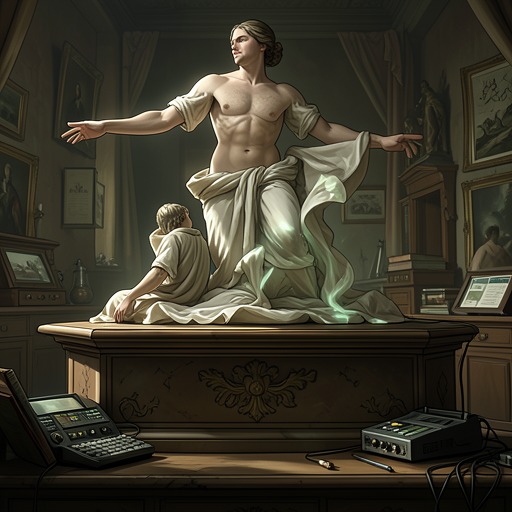
When Zarathustra reflects on the old and new tables, he sits among old tables already shattered and new ones only half written. The image holds destruction and creation in the same frame: inherited values have lost their unquestioned authority, but a replacement is incomplete. His waiting for the hour to come conveys the difficulty of this interval. There is no finished code ready to take the old one’s place.
The old tables persist in people’s conviction that they already know what is good and evil. Virtue, in this complacent view, has become a familiar, almost soporific topic: people speak of good and evil before sleep as though moral questions had long since been settled. Zarathustra disturbs that certainty by teaching that nobody yet knows what is good and evil except, perhaps, the creator. The creator makes a goal for humanity, gives the earth meaning and a future, and creates the quality of good and evil in things. The contrast is between values received as settled knowledge and values made through an act that sets a direction.
His attack on the old tables accordingly reaches beyond particular rules to the prestige that protects them. He calls for the overturning of old professorial chairs and the laughter of inherited masters of virtue, saints, poets, and world-redeemers. He laughs over the past’s decayed glory on a street of graves, among carrion and vultures. These images turn reverence into a scene of exposure: what presented itself as permanent authority now belongs to a dead past. Yet the new tables around him remain half written, so mockery clears ground without completing the work of value creation.
Shattering and the Crisis of Transition
The book repeatedly gives the tables a physical violence and instability. Zarathustra calls on enlightened people to shatter them, linking the old code to knowledge that has grown beside a bad conscience. The command suggests that established knowledge may carry the mark of the moral discipline that produced it; breaking the tablets is therefore a challenge to the authority of inherited judgments, not simply an argument over one rule.
Elsewhere, the breakdown appears as a thaw. Water has been made walkable by gangways and railings, so that the claim that everything flows is easy to disbelieve. Then the thawing wind arrives like a raging ox, breaking the ice with its horns; the ice breaks the gangways, and the railings fall into the water. The scene makes a stable moral order resemble a frozen crossing: it supports passage while it lasts, but its apparent permanence depends on conditions that can change. Zarathustra asks whether anything is still in flux and who can continue clinging to good and evil as though their foundations had survived intact. Shattering is thus both a loss of secure footing and an opening in which previously fixed values can be questioned.
That opening does not make every response equally creative. Zarathustra distinguishes paths of overcoming from the buffoon’s fantasy that humanity can simply be jumped over. The new table he presents is bound to a demanding future: his love for the most distant people commands that the neighbour not be spared and that humanity be overcome. The tables are not a refuge from difficulty or a promise that the present can be bypassed. They direct their bearers toward a transformation whose paths must be taken rather than leapt across.
Creators, Opponents, and the New Tables
The new table needs bearers as well as an author. Zarathustra asks where his brothers are, the ones who will carry it with him down to the valley and into fleshly hearts. The journey gives the image a practical and communal dimension: values must leave the solitary scene of their conception and enter embodied human life. His desire for companions does not imply that a ready-made consensus already exists; the table is new, and its transmission is part of the task.
That task brings Zarathustra into conflict with people who identify themselves as the good and just. They claim to possess goodness and justice already and condemn those still searching. The danger they pose, in his account, lies in treating their existing values as complete: they cannot create, and their certainty threatens the human future. They hate the creator most, because he breaks old tables and values; they call the breaker a law-breaker. The language reverses the moral accusation. From the old table’s perspective, the creator violates the law; from the perspective of future creation, defending that law can amount to sacrificing the future to the present.
The exhortation to shatter the good and just’s authority therefore sharpens the distinction between the creator and the guardian of established virtue. It does not claim that every new command is automatically good. Rather, it identifies the central conflict as one between values treated as possessions and the continuing search and creation that give humanity a future. In this sense, the broken table is not the final answer. The half-written table still requires a creator, companions willing to bear it, and a direction capable of outlasting the comfort of settled judgment.
The Image’s Continuing Work
The tables remain active even in scenes that stress their destruction. Zarathustra imagines anger breaking open graves, shifting boundary stones, and rolling shattered tablets into deep chasms. Mockery blows mouldering words away; he comes like a broom to the Cross-spiders and like a scouring wind to old sepulchres. But he can also love churches and the graves of gods when their shattered roofs let heaven look through, and he takes pleasure in grass and red poppies growing on ruined churches. The image does not reduce the past to something that must simply be erased: its broken structures can become openings through which a different relation to the world appears.
The Law-tables consequently connect order with its undoing. They give values a public and personal form, but their apparent permanence can conceal the particular life that made them. Their breaking exposes that contingency; their partial replacement makes the challenge of creation visible. Zarathustra’s recurring image holds both consequences together: without tables, life lacks an imposed order, yet an old table defended as final can close off the future it once helped organize.