Learn to Laugh and Dance
Thus Spoke ZarathustraLearn to Laugh and Dance is Zarathustra’s call for the Higher Man figures to turn failure from a verdict into a reason to try again. Its method is at once mental and bodily: learn to play with defeat, laugh at oneself, follow a path with light feet, and dance even across affliction. Zarathustra presents laughter not as denial of difficulty but as a strength capable of carrying the failed and unfinished forward.
Failure Without Final Judgment
Zarathustra begins with a physical image of retreat: he has often seen the Higher Man figures slink aside, timid and awkward, like a tiger whose leap has failed. The failed throw has left them ashamed. But the image does not define them; it names a moment from which they can learn. Zarathustra asks them to become dice-throwers who know how to play and mock, at a table where play and mockery are always possible. Failure is not exempt from that play.
The argument then widens from an unsuccessful attempt to a judgment about the person who made it, and from there to a judgment about humanity. Zarathustra refuses each easy equivalence. A great undertaking that fails does not prove that its undertaker is a failure; even if the person has failed, that does not establish that humanity itself is a failure. And if humanity has indeed failed, his response is still an invitation to continue. The movement of the reasoning matters: it does not erase disappointment, but blocks disappointment from becoming a final account of human possibility.
Zarathustra acknowledges that the higher the type, the less often success comes. He asks whether the Higher Man figures are failures, and answers not with reassurance that their attempts have all succeeded, but with a demand for courage and laughter. Their condition is described as half-broken, their efforts as failed or only partly successful. Yet the struggles within them contain humanity’s future: its farthest questions, its reach toward the stars, and its prodigious power. The broken pot becomes an apt image for the cost of holding such pressures together. Its shattering is no proof that nothing valuable was in it.
The Possibility of Small Perfections
The address does not make possibility depend only on distant achievement. Alongside humanity’s large, unresolved questions, Zarathustra points to the earth’s good, small, well-formed things. He urges the Higher Man figures to set such things around themselves: their golden ripeness can heal the heart, and their perfection can teach hope. This concrete scale checks the temptation to measure all life by grand success. The future remains open not only in immense undertakings but also in things already made well.
That turn also gives the speech’s encouragement a particular balance. Zarathustra does not tell his listeners that everything they attempt will succeed, or that their half-successes should be renamed victories. Instead, he places imperfect human striving beside small existing forms of goodness. The first keeps the prospect of transformation alive; the second provides evidence, in the present, that the earth is not barren of what can be affirmed. Hope is thus neither a guarantee nor an abstraction: it is taught by the good things that can be gathered around oneself.
The Body as Measure of a Path
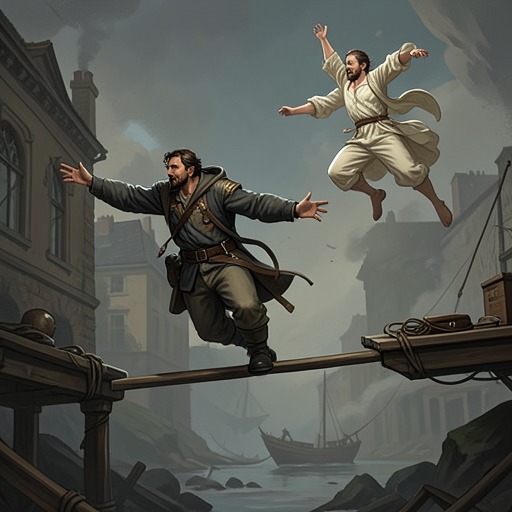
Dance makes the rule visible. Zarathustra says that good things approach their goal crookedly, arching like cats and purring inwardly as happiness draws near. The image replaces a straight, solemn march with an oblique approach, one that contains pleasure before the goal has been reached. A person’s step, he adds, betrays whether that person is walking along their own path. The body therefore gives a practical sign of relation to one’s aim: one who approaches a goal dances.
Zarathustra sets this movement against stiffness. He rejects the image of himself as a statue or pillar and describes his love of running fast. The contrast is not merely between motion and stillness; it is between a life burdened by heaviness and one able to answer its direction with agility. Swamps and thick afflictions remain part of the earth, but the light-footed runner can cross mud and dance as if on swept ice. The difficulty is not removed. What changes is the manner of moving through it.
The instruction to lift the heart higher is immediately paired with the reminder not to forget the legs. Spiritual elevation without bodily grounding would be incomplete; the dance requires both. Zarathustra intensifies the reversal by telling the fine dancers to stand on their heads. That inversion makes the teaching deliberately playful: the learner must loosen ordinary postures and expectations, not simply adopt a new solemn rule. Yet the repeated emphasis on legs and standing also keeps the image tied to balance, movement, and the capacity to support oneself.
Zarathustra’s Crown and the Gift of Laughter
Zarathustra presents himself as an example of the practice, not merely its instructor. He sets a rose-wreath crown on his own head and calls it the laugher’s crown; he says that he has canonized his laughter because he has found no one else strong enough for it at that time. He identifies himself as the dancing, light Zarathustra, beckoning with wings and ready for flight, and as a laughing prophet who is neither impatient nor uncompromising, but loves jumping and escapades. The crown converts laughter into an avowed principle, while the images of wings, flight, and jumping give that principle a mobile form.
The crown does not remain his private emblem. Later he throws it to the Higher Man figures and bids them learn to laugh. The gesture turns self-canonization into a transfer of responsibility: Zarathustra can display and offer laughter, but his listeners must acquire it themselves. His instruction insists that they laugh beyond themselves, just as they must learn to dance beyond themselves. The point is not simply amusement at their failures. It is to exceed the narrow self that treats a failed throw as its final identity.
Affliction, Self-Support, and the Rule’s Reach
Zarathustra recognizes that some creatures are heavy-footed even in happiness and clumsy from birth. He does not pretend that everyone dances easily; he compares their exertion to an elephant attempting to stand on its head. Even so, he ranks foolishness in happiness above foolishness in misfortune, and clumsy dancing above lame walking. The comparison preserves the difficulty of learning while refusing to let awkwardness serve as an excuse for permanent resignation.
His compact lesson is that even the worst thing has good dancing legs. The Higher Man figures must learn to stand on their own proper legs, not merely borrow Zarathustra’s confidence or repeat his gestures. He also tells them to unlearn the trumpeting of affliction and the sorrowfulness of the mob. In this contrast, grief performed as a public, habitual posture weighs against the freely moving spirit that dances across swamps and afflictions as across meadows. Laughter and dance answer suffering by changing how it is borne, not by claiming it does not exist.
The rule’s full reach appears in its repeated return to possibility: failed attempts do not settle the worth of the person, humanity, or what may yet be achieved. The final appeal gathers its images into a practice for the Higher Man figures: lift the heart, keep the legs, laugh well, and accept the crown only by learning to wear its laughter. Zarathustra’s teaching makes dance both a sign of one’s own path and a discipline of self-support; laughter becomes the strength to outlive the judgment of failure and begin again.