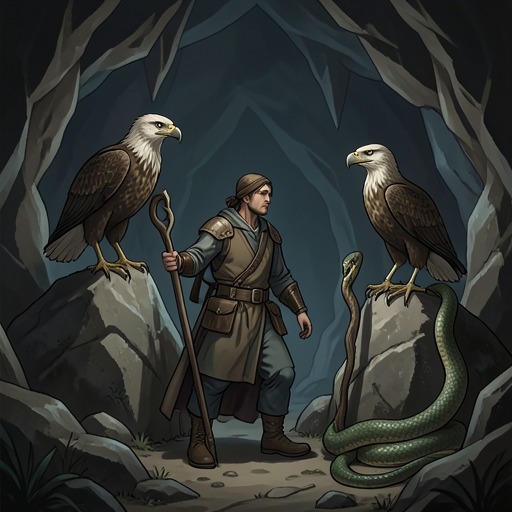
Lions
Thus Spoke ZarathustraLions have a double role in Thus Spoke Zarathustra: they are emblems through which Zarathustra articulates courage and a future beyond the human, and they appear as living animals whose unscripted behavior changes the course of the final scene. The expected laughing lion arrives not as an image alone but as a powerful, affectionate creature. Its coming confirms that Zarathustra’s hour has arrived, while its roar drives the Higher Men away and leaves him alone with the sign he has awaited.
Courage and the Overcoming of the Human
In Zarathustra’s first sermon to the people assembled to watch a tight-rope walker, animal life supplies the measure for humanity’s unfinished condition. All creatures, he says, have created something beyond themselves; people must decide whether to continue that movement or become its ebb. The ape is to humanity what humanity will be to the Superman: an object of ridicule or painful embarrassment. The comparison unsettles human exceptionalism. Humanity is not the final measure of life but a passage in a process of overcoming, still bearing what Zarathustra calls its wormlike inheritance.
Lions later become an image for the kind of strength that could carry this movement forward. Waiting in the mountains, Zarathustra rejects the present company of people marked by longing, disgust, satiety, and the remnant of God. He says he is waiting instead for men who are higher, stronger, more victorious, and more joyful, square-built in body and soul; he calls for laughing lions to come. The image joins strength to joy. These lions are not presented as merely dominant or fearsome: laughter distinguishes the future type from a strength defined only by grim struggle.
The lion also belongs to Zarathustra’s account of courage. As he challenges the dwarf who has oppressed him with silence, Zarathustra describes courage as the force that destroys discouragement and attacks rather than yields. It can confront the abyss of suffering and even death. Its culminating affirmation is, “Was that life? Well then! Once more!” Here the lion’s force is not a claim that pain disappears. It is the capacity to meet life again, including its deepest pain, without turning away. The animal image therefore connects the projected future of the Superman with a present test of affirmation.
The Sign Zarathustra Awaits
The lion’s appearance has been prepared as a sign of a change in Zarathustra’s task. Sitting among old, shattered law-tables and new, half-written ones, he waits for the hour of his descent because he wants to go to people again. But he will not set out until his sign comes: a laughing lion accompanied by a flock of doves. The expected pairing is striking. The lion brings physical power and a roar; the doves bring the gentleness and affection that will dominate the encounter. The sign is not simply a summons to command. It arrives through a meeting that makes Zarathustra receptive and emotionally exposed.
This expectation resonates with the earlier whisper that Zarathustra lacks a lion’s voice for command. He has been told that he possesses the power to command but will not rule, and answers that he does not have that voice. The reply comes in the image of still words that arrive on doves’ feet yet guide the world. The later sign brings lion and doves together, joining the force of command to the quiet, tender approach already associated with Zarathustra’s influence. The text does not make the lion speak or issue an order; its arrival answers the waiting through presence and action.
The Lion at the Cave
When the sign comes, Zarathustra is first surrounded by birds, whose wings crowd around his head. As he reaches out to ward off the tender creatures, his hand finds a thick, warm mane. A lion roars before him—not with an attack, but with a gentle, prolonged sound. Zarathustra recognizes the sign. The powerful animal presses its head against his knee and stays close, behaving like a dog reunited with its old master. The doves show the same eager affection; when one passes across the lion’s nose, the lion shakes its head in wonder and laughs.
The scene turns the emblem into a particular animal with weight, warmth, movement, and responses of its own. Zarathustra falls silent and says only that his children are near. Tears run down his hands; the doves settle on his shoulders and fondle his white hair, while the lion repeatedly licks his tears, roaring and growling shyly. The lion does not merely stand for the future children or confirm a prediction in abstract terms. Its tenderness is the immediate event through which Zarathustra’s heart is loosened. The narration dwells on this contact and suspends ordinary measures of duration, saying the meeting lasts either a long time or a short one, since there is properly no earthly time for such things.
The Higher Men and the Ending
Meanwhile, the Higher Men awaken in the cave and arrange themselves in a procession to greet Zarathustra. Discovering that he is no longer with them, they follow the sound of approaching footsteps toward the entrance. The lion reacts violently to their arrival: it turns from Zarathustra, leaps toward the cave, and roars fiercely. The Higher Men cry out together and flee, disappearing at once. The animal’s response breaks the human gathering at the very moment it approaches its leader. The sign that confirms Zarathustra’s future does not bring the Higher Men into the scene’s intimacy; instead, its roar exposes their inability to remain before it.
Zarathustra is left bewildered, then remembers the events of the previous day and recognizes the place where the prophet had come and where he first heard the cry of distress. The lion’s arrival has answered the waiting expressed among the broken law-tables, but it has not furnished the human following Zarathustra once sought. He says that he still lacks his rightful men; the birds and lion have appeared, while the Higher Men have fled. The ending keeps these outcomes in tension: the animals offer an unmistakable sign of love and a future, yet Zarathustra stands alone. Lions thus mark both the affirmation he can receive and the distance that remains between that affirmation and the people he hopes will follow him.