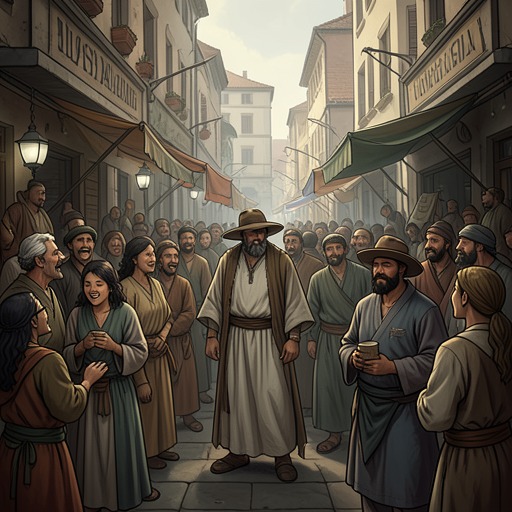
The Great City
Thus Spoke ZarathustraThe Great City is a destination Zarathustra reaches on his circuitous return to his mountain and cave, and a threshold he chooses not to cross. Through the warning of Zarathustra’s Ape and Zarathustra’s own final judgment, the city appears as a place where thought is diminished, emotion withers, and public virtue circles around wealth. Its significance lies not in a narrated transformation of the place, but in the decision to leave it behind: Zarathustra names passing by as the proper response where love can no longer act.
Setting and Approach
Zarathustra comes to the city unawares while making his way among many people and through various towns on his indirect journey home. The encounter takes place at its gate, where a frothing fool with outstretched hands springs at him and blocks his path. The entrance becomes a literal point of interruption: before proceeding farther, Zarathustra must hear an argument against entering at all.
The fool is known to the people as Zarathustra’s Ape. He has learned something of Zarathustra’s language, including its composition and syntax, and may also borrow from its store of wisdom. That resemblance gives the warning a pointed complication. The Ape speaks in a recognizable idiom, but Zarathustra later objects that even a teaching that is right can be used falsely. The city’s first spokesman is therefore both an imitator of Zarathustra and a guide whose warning cannot simply be accepted as his master’s own judgment.
A City That Diminishes Thought and Feeling
The Ape calls the city a hell for hermits’ thoughts: there, he says, great thoughts are boiled alive and cooked small. The image makes intellectual diminishment a process rather than a mere absence. Ideas enter a hostile environment and emerge reduced, as though the city’s conditions act upon them until they can no longer retain their force. The contrast between the hermit’s thought and the city also sets solitary reflection against crowded social life without suggesting that Zarathustra’s route has avoided people altogether; he has travelled among them before arriving here.
The same reduction governs feeling. The Ape says that great emotions decay and that only little, dry emotions remain to rattle. His images move from cooking to decay and finally to a dry, faint sound: what was once powerful becomes small, lifeless, and barely audible. He also asks whether the city already smells of slaughterhouses and cookshops of the spirit. The accusation turns spiritual damage into an imagined urban atmosphere, making the city seem to consume what is vital and leave behind diminished remnants. These descriptions belong first to the Ape’s speech, but Zarathustra’s later response confirms that his disgust is not confined to the fool.
Shopkeepers, Princes, and Public Virtue
The Ape’s account connects the city’s spiritual condition to its hierarchy of power. Courtly life has its own moon and its own mooncalves, while paupers and adroit pauper-virtues pray to what comes from the court. The repeated formula, “I serve, you serve, we serve,” presents virtue as a performance directed toward the prince, with service rewarded by a star pinned to a narrow breast. Recognition is pictured as a small badge, not as the expression of an independent achievement.
Yet the prince is not the ultimate power in this arrangement. The moon still revolves around what is earthly, and the prince in turn revolves around what is most earthly: shopkeepers’ gold. The contrast between the God of Hosts and a god of golden ingots sharpens the Ape’s charge that commercial wealth governs the city beneath its courtly display. His declaration that “the prince proposes, but the shopkeeper – disposes!” makes the apparent ruler’s authority secondary to the merchant’s power. The city’s social order thus joins calculated virtue, hoped-for recognition, and material influence in a single chain of dependence.
Judgment and the Decision to Pass By
Zarathustra does not simply adopt the Ape’s role as spokesman. He rebukes him because his teaching can do harm even when correct, and because Zarathustra’s own teaching might be misused through it. Then Zarathustra looks at the city, sighs, and remains silent for a long time. The pause separates his judgment from the Ape’s torrent of warning: he has heard the denunciation, but the final response comes from his own encounter with the place.
His judgment is severe and notably final. Both the city and the fool disgust him; in neither does he see anything to make better or worse. He wishes he could already see the pillar of fire in which the city will be consumed, but adds that such pillars must precede the great noontide and that this has its own time and destiny. The image introduces a future destruction without turning it into an immediate action or claiming that Zarathustra brings it about. His farewell instead takes the form of a precept: “Where one can no longer love, one should – pass by!” He then passes both the Ape and the city. The ending makes departure the concrete consequence of his judgment, while leaving the city’s prophesied fate to its own time.