The Shadow
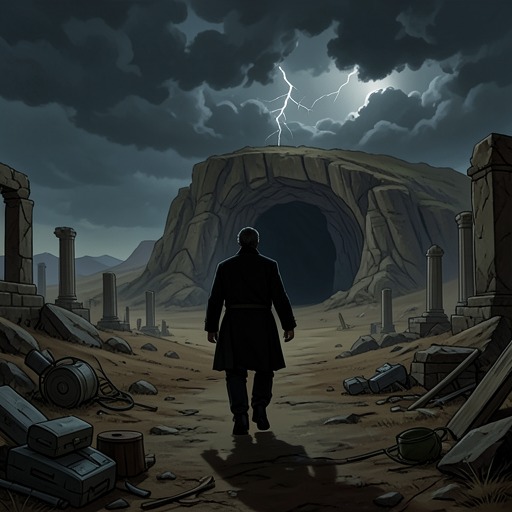
Thus Spoke ZarathustraThe Shadow is a homeless, depleted wanderer who has followed Zarathustra through remote and forbidden places but cannot discover where he belongs. His appearance makes the metaphor of the shadow literal, while his account of endless movement gives it a deeper force: he is both Zarathustra’s closest trailing companion and a figure worn thin by a life without direction. His arrival on the mountain brings the problem of solitude into view, and his eventual presence among the cave’s gathered company helps reveal the collective distress behind Zarathustra’s search for the Higher Man.
Identity and First Appearance
The Shadow appears after the Voluntary Beggar has run away from Zarathustra’s stick. A voice calls for Zarathustra to wait, identifying its speaker as his shadow, but Zarathustra, irritated by the crowding on his mountain, keeps moving and wonders where his solitude has gone. The encounter begins, then, as a collision between the solitude Zarathustra wants and the company that keeps finding him.
When Zarathustra turns and sees the follower close behind, The Shadow is so weak that he nearly falls. Zarathustra describes him as slight, dark, hollow, and spent, and asks angrily who he is and why he calls himself Zarathustra’s shadow. The Shadow answers without demanding acceptance: if Zarathustra dislikes him, he says, that merely confirms Zarathustra’s good taste. His self-effacing reply contrasts with the urgency of his pursuit; he has come seeking recognition from the very person whose displeasure he is prepared to accept.
A Companion Without a Destination
The Shadow describes himself as a wanderer who has travelled far at Zarathustra’s heels, “always going but without a goal and without a home.” His movement has no clear destination or arrival. He compares himself to an “eternal Wandering Jew,” then immediately qualifies the image, saying that he is neither eternal nor a Jew. The qualification keeps the comparison from becoming a literal identity: what matters is the condition of ceaseless travel and the exhaustion it produces.
His account gives the shadow image a history. He says that he has sat on every surface and fallen asleep on mirrors and window-panes like weary dust. Everything takes from him and nothing gives; he has become thin, almost like a shadow. The image of the mirror makes his relation to Zarathustra more than simple proximity: he has followed where Zarathustra sat, as if his own place were determined by another’s movements. Yet the likeness is incomplete. The Shadow shares Zarathustra’s paths, not the strength or direction that might make them a home.
He says that he has followed Zarathustra longest and was his “best shadow,” though he also admits that he hid himself from him. He has accompanied Zarathustra into the remotest, coldest worlds and joined him in approaching what was forbidden, worst, and most remote. If he possesses a virtue, he says, it is that he feared no prohibition. This history makes him a genuine companion in extremity, but not a settled disciple with a clear destination: the same fearlessness that took him far has not answered his need to belong somewhere.
The Search for Home
The Shadow’s wandering has become an affliction rather than a freedom. He names what remains to him as a weary, insolent heart, a restless will, infirm wings, and a broken backbone. The sequence joins inward restlessness to images of failed movement: he still wills and seeks, but the means of flight and support seem damaged. His search for home, he tells Zarathustra, is consuming him.
His question about home ends not in a place but in a series of negations: “Where is – my home? I ask and seek and have sought for it, I have not found it.” He then addresses an “eternal Everywhere” and an “eternal Nowhere,” before ending on “Vanity!” The paired opposites capture the trap of his wandering. Everywhere offers no particular place to remain; nowhere offers no arrival at all. The Shadow’s account makes the absence of home more than a missing shelter: it is the failure of all his movement to become a destination.
Zarathustra’s response changes when he hears this. His face lengthens, and he at last says sorrowfully, “You are my shadow!” He warns that the danger facing such a free spirit and wanderer is serious, and that even prison can eventually seem blissful to people so restless because captured criminals sleep peacefully in their new security. The warning recognizes how exhaustion can turn confinement into relief. The Shadow’s freedom has not protected him from suffering; without a place to rest, continual movement has become its own form of distress.
The Shadow Among the Cave’s Guests
Later, after a long and fruitless search of his own, Zarathustra returns to his cave and hears a many-voiced cry of distress coming from inside. The Shadow is there with the company Zarathustra has encountered during the day: the King on the Right, the King on the Left, the Sorcerer, the Abdicated Pope, the Voluntary Beggar, the Conscientious Man of the Spirit, the Prophet of the Great Weariness, the Ass, and the Ugliest Man. Zarathustra’s Eagle is agitated, with the Serpent around its neck. The Shadow’s presence among this company confirms that he has not merely called after Zarathustra and disappeared; he has become part of the gathering at the cave.
Zarathustra examines the assembled figures and recognizes their shared despair. He identifies the one he had sought in vain that day as the Higher Man. The scene gives The Shadow’s private homelessness a collective setting: he is one among several distressed visitors who have come together in Zarathustra’s cave. The evidence does not resolve his search for a home or show what becomes of him afterward. Instead, it leaves him at the gathering, still marked by the contrast that defines him: he has travelled at Zarathustra’s heels into the farthest places, yet remains unable to find a place of his own.