The Sign of the Lion
Thus Spoke ZarathustraBackground and Setting
The scene concludes Zarathustra’s stay with the Higher Men in his cave. In the broader design of Part Four, these visitors are people whom Zarathustra’s instruction has made conscious of their inadequacy; they gather around him but have not thereby become the future companions he longs for. The event follows a night whose song has affirmed that joy wants eternity. Morning now gives that affirmation a visible, living form, and makes it the point from which Zarathustra must depart.
The setting is the cave’s threshold, between shelter and the world beyond it. Zarathustra rises from bed, girds himself, and emerges glowing and strong, compared to the morning sun coming from behind dark mountains. His first address is to the great star, whose happiness, he says, depends on those for whom it shines. The image joins his renewed strength to a purpose beyond himself: radiance matters because there are others to receive it. Yet, even as he welcomes the promise of an audience, he distinguishes the animals already beside him from the people he still lacks.
The Animals Arrive
Zarathustra’s eagle is awake and reaches toward the new light. He calls the eagle and the serpent his rightful animals, but says that he still lacks his rightful men. At that moment, countless birds swarm around him. Their wings crowd his head so densely that he closes his eyes; at first their gathering feels like a cloud of arrows falling upon a new enemy. The impression reverses: the apparent assault is a cloud of love, directed toward a new friend. The sign begins not as a message explained from outside, but as an overwhelming encounter that Zarathustra must recognize.
As he lowers himself onto the great stone beside the cave’s exit and tries to ward off the tender birds, his hand catches a thick, warm mane. A long, gentle roar sounds in front of him. When the scene clears, a powerful, sallow lion is lying at his feet, pressing its head affectionately against his knee and staying close like a dog reunited with its old master. The doves share its eagerness. When one glides across the lion’s nose, the lion shakes its head in surprise and laughs. The lion is formidable, but this meeting is marked by affection rather than attack; the doves’ tenderness and the animal’s playful response make the omen at once majestic and intimate.
Recognition and Reversal
Zarathustra understands the arrival as the sign. He says that his children are near, then falls silent. His heart loosens, tears run down his face and onto his hands, and he ceases to resist the birds. They perch on his shoulder and caress his white hair; the lion licks his tears while roaring and growling shyly. This exchange makes the animals’ welcome bodily and mutual. Zarathustra receives their affection without turning away from it, and the lion tends to his grief with the same closeness with which it pressed against his knee.
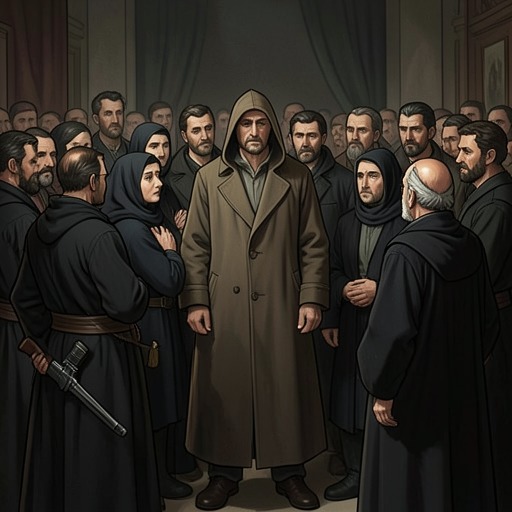
The narration says that the encounter lasts a long time, or a short time, since earthly time does not properly apply to such things. That suspended interval is interrupted by the movement of the Higher Men. They have awakened in the cave, arranged themselves in a procession, and set out to greet Zarathustra, discovering only when they rise that he is no longer among them. As their footsteps approach the entrance, the lion starts, turns away from Zarathustra, and bounds toward the cave, roaring fiercely. The Higher Men cry out together and vanish in flight. The intended procession collapses before it reaches him: the men who came to offer a morning greeting cannot face the sign that has come to Zarathustra.
Departure and Significance
Left bewildered, Zarathustra rises and looks around. He remembers the previous day’s events at the stone, including the Prophet’s visit and the first cry of distress, and then grasps what has happened between yesterday and today. The animals’ arrival has not erased the suffering that preceded it. Instead, it sharpens the question of what his final obstacle might be. He suddenly names it as pity for the Higher Man, and his countenance changes. He sets that pity aside as something whose time has passed: his suffering and compassion are no longer the measure of his purpose, because he does not aspire to happiness but to his work.
The lion’s arrival, the nearness of his children, and Zarathustra’s ripeness converge in his declaration that his hour has come. He calls for the great noontide to rise and leaves the cave, again glowing like the morning sun emerging from dark mountains. The departure is therefore more than an exit from the place where the Higher Men have gathered. Their flight makes plain the distance between the people at hand and the companions he awaits; the lion and doves, by contrast, give him a sign he accepts as readiness for renewed action. The scene closes with Zarathustra moving outward, not with the Higher Men following him, but with his sense of purpose restored and his work placed above the consolation of pity.