The Spirit of Gravity
Thus Spoke ZarathustraThe Spirit of Gravity is the personified force that weighs against Zarathustra’s movement, freedom, and affirmation of life. It draws upward striving toward the abyss and makes heaviness seem the truth about existence; Zarathustra counters it with flight, dance, and laughter. The conflict is not resolved through an argument alone: it is staged in images of walking, rising, and learning to move without being pushed, then renewed in the Higher Men’s uncertain but consequential laughter.
Identity and Defining Image
The Spirit of Gravity appears as Zarathustra’s devil and arch-enemy: a figure for whatever makes life feel serious, burdensome, and fixed. Zarathustra discovers that his devil is grave and profound, and judges that this solemnity ruins things. The opposition is not simply between sadness and cheerfulness. Gravity names a whole orientation toward life in which weight seems final and movement is constrained; laughter matters because it can unsettle that apparent necessity.
The text places this conflict in an atmosphere where danger and joy can coexist. Thin, pure mountain air, nearby danger, and a joyful wickedness are presented as mutually fitting conditions. Against such alertness, the Spirit’s heaviness looks less like wisdom than a drag on possibility. The contrast also explains why Zarathustra’s response is not solemn counter-doctrine: courage, he says, can make room for phantoms because it wants to laugh rather than merely drive them away.
Dance gives this challenge a religious edge. Zarathustra says he could believe only in a God capable of dancing, making movement a measure of what deserves affirmation. In the forest, while walking with his disciples, he encounters girls dancing in a meadow. He asks them not to stop and presents himself as no enemy to their dance: he is an advocate for God with the Devil, who is the Spirit of Gravity. The scene sets spontaneous bodily movement against the constricting seriousness associated with his adversary, while Zarathustra’s friendly approach lets the contrast play out without turning the girls’ dance into a confrontation.
The Contest with Weight
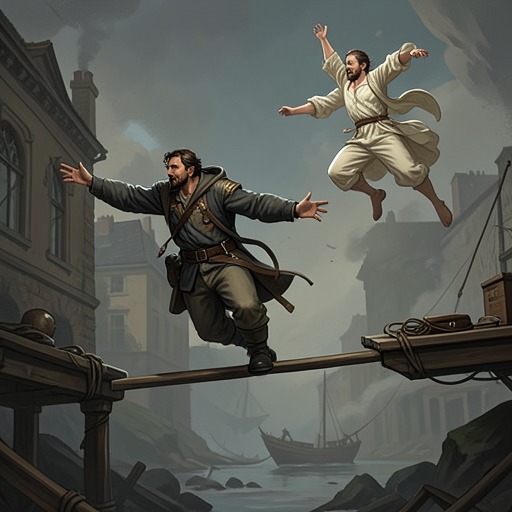
On the mountain path, the opposition becomes an immediate struggle over direction. Zarathustra climbs over boulders and rubble while the Spirit of Gravity draws him downward, toward the abyss. The adversary’s pressure is also mental: it loads his thoughts and mocks the premise of ascent by insisting that whatever is thrown upward must fall. The scene gives the expression a precise dramatic function. Gravity is the counterclaim that every rise is temporary and that falling, not striving, is the final measure of movement.
Zarathustra’s answer develops through images of walking, running, and flight. He describes learning to walk and then running; having learned to fly, he no longer needs to be pushed in order to move. He becomes nimble, sees himself beneath himself, and imagines a god dancing within him. These changes make freedom more than escape from an external weight: movement has become self-initiated, and the elevated perspective allows him to regard what once pressed upon him from below.
The bird image extends the conflict from Zarathustra’s own ascent to his teaching. He calls himself an enemy of the Spirit of Gravity, and imagines a future teacher of flight who will displace boundary-stones and baptize the earth anew as weightless. The image does not require abandoning the earth. Instead, it contests the description of earth and life as inherently heavy, a description Zarathustra attributes to the Spirit. Becoming light and birdlike is connected to learning self-love, so release from gravity entails a changed relation to oneself as well as a different way of seeing the world.
Dance, Laughter, and Lightness
Dance is the Spirit’s most direct opposite because it makes movement an affirmation rather than an effort to escape. Zarathustra repeatedly links a person’s step with whether that person follows an individual path, and imagines one approaching a goal as dancing. Good things, too, approach their goals crookedly, with an inward playfulness that culminates in laughter. The crooked approach resists a rigid, straight-line picture of progress: lightness can persist even where the path is indirect.
The test is not whether obstacles have vanished. Zarathustra acknowledges swamps and afflictions on earth, yet presents light feet as able to cross them with the ease of dance. He urges the Higher Men to raise their hearts without forgetting their legs, keeping aspiration joined to actual movement. Against this image he sets uncompromising people with heavy feet and sultry hearts, who do not know how to dance and therefore cannot experience the earth as light. The contrast makes bodily practice part of the teaching: a changed outlook appears in how one moves, not only in what one declares.
Laughter completes that practice. Zarathustra’s formula is that anger does not kill the Spirit of Gravity; laughter does. Later, he pictures a free storm-spirit rushing from mountain caves and dancing to its own pipe, an image of force that moves on its own terms and crosses affliction without treating it as a final boundary. To the Higher Men, he says their failure is not the end of possibility: they have yet to learn to dance beyond themselves and laugh beyond themselves. The rose-wreath crown of laughter turns the challenge into a form of recognition, but it remains a charge to learn, not proof that the work is finished.
The Higher Men and the Adversary’s Retreat
The Spirit of Gravity returns near the end as the measure of what has changed among the Higher Men. Zarathustra hears their laughter in the cave and calls the day a victory because his old arch-enemy is wavering. The day began gravely and ends otherwise; the contrast gives the adversary’s retreat a temporal shape, registered in a change of mood rather than in a declared, permanent conquest.
Zarathustra does not mistake the men’s laughter for his own. They may have learned to laugh from him, but he doubts that they have learned his particular laughter. Their recovery belongs to them and takes its own form. Still, he hears signs of movement: the Spirit of Gravity is wavering before them too, and they are beginning to laugh at themselves. He credits his discourse with awakening new desires and hopes, expressed in the image of their hearts stretching and their arms and legs becoming newly available to possibility. The ending therefore presents the Spirit’s weakening as a beginning in the Higher Men, not a completed transformation. Dance and laughter have become learnable responses, but the demand to move beyond oneself remains open.