The Ugliest Man’s Murder of God
Thus Spoke ZarathustraThe Ugliest Man’s Murder of God is revealed not through a staged account of the killing but through the killer’s confession and Zarathustra’s recognition. God’s offense, as the Ugliest Man describes it, was to see human beings completely: his unblinking gaze entered concealed depths, and his limitless pity became intolerable. The revelation makes God’s death an act of revenge against an unbearable witness, and later scenes complicate the apparent finality of that act by asking whether God has awakened again.
Recognition and Confession
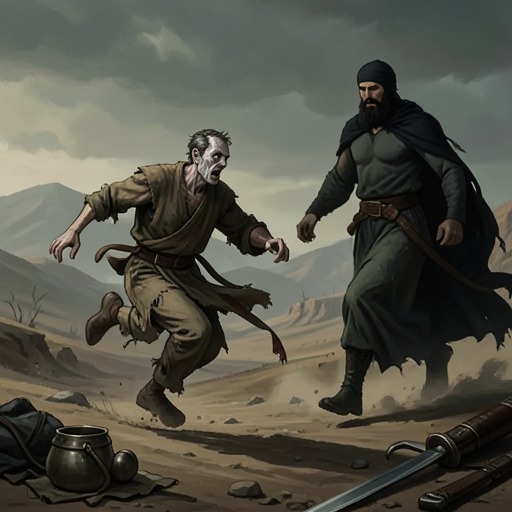
When the Ugliest Man challenges Zarathustra to solve the riddle of who he is, Zarathustra first collapses under the force of pity. He rises again, his expression stern, and identifies the man as God’s murderer. His recognition turns an obscure encounter into a disclosure about the death announced at the opening of the book: the supposedly abstract fact that God is dead has a human agent, and that agent stands before Zarathustra.
The Ugliest Man confirms the identification by explaining what drove him. God saw him through and through, including the disgrace and ugliness he kept hidden. The man could not bear to remain exposed to such a witness; he desired revenge, or else an end to his own life. His account makes the killing a response to being seen, rather than a contest over doctrine or power. God’s all-seeing knowledge is not presented as distant judgment alone: it reaches into the private places from which the Ugliest Man cannot escape.
The confession also makes pity part of the conflict. The Ugliest Man calls God’s pity shameless and excessively intrusive, because it followed him into his dirtiest corners. In his telling, compassion does not relieve the exposure produced by God’s gaze; it intensifies it. The man therefore treats the combination of seeing and pitying as an invasion from which killing the witness offered release. The scene does not make this account a general proof that compassion is always oppressive. It does show why this particular figure experiences divine pity as a force he cannot endure.
Zarathustra as Witness
Zarathustra’s response joins recognition to a physical and emotional reversal. Pity first brings him down like an oak felled after long resistance; then he stands, becomes stern, and names the murderer. The sequence matters: the disclosure does not leave him simply overwhelmed by the Ugliest Man’s suffering. He attempts to depart, but the man catches the corner of his garment and presses him to stay. The exchange makes Zarathustra both the person who identifies the crime and a witness whom the murderer is unwilling to let go.
The Ugliest Man also warns Zarathustra about his own pity and about the many suffering, doubting, despairing, drowning, and freezing people who may come to him. He claims to know the force that can fell Zarathustra, having himself presented his murder as an answer to God’s limitless compassion. Zarathustra, chilled by the encounter, does not answer with another attempt to console him. Instead, he directs him toward Zarathustra’s cave. The relationship thus shifts from accusation toward an uneasy referral: Zarathustra recognizes what the man has done, refuses simply to remain in the encounter, and offers him a route onward.
Christian Inheritance and Reversal
The episode’s conflict gains further resonance from the book’s account of its Christian inheritance. Its discussion of Lutheran Pietism associates the divinely willed events of life with acceptance of life as it is; in that account, Amor fati affirms life as a product of divine will and makes hatred of life impious. The Ugliest Man’s confession places a severe counterpressure beside that affirmation. The God he describes is not merely the ground of life’s acceptance but an inescapable observer whose pity exposes what the human subject would conceal.
This contrast is not a simple rejection of Christian language. The scene retains the figure of God as the one who sees and judges human beings, but turns that divine knowledge into the cause of an intolerable confrontation. The Ugliest Man’s act answers the witness with revenge; it does not erase the shame or ugliness that the witness saw. Set beside the book’s reinterpretation of Christian acceptance, the confession makes the death of God a crisis in the relation between divine scrutiny and human capacity to bear life, rather than a detached declaration that belief has disappeared.
The Ass Festival and the Unsettled Aftermath
The later Ass Festival returns to the murder through a question of survival. Zarathustra discovers the Ugliest Man on the ground, raising an arm toward the ass and giving it wine to drink. The man appears changed: Zarathustra notices his glowing eyes and the mantle of the sublime over his ugliness, then asks whether he has awakened God again and why he has changed. The exchange reconnects the earlier crime to the company’s worship, but it does not establish that God has literally returned.
The Ugliest Man answers that he does not know whether God still lives, lives again, or is truly dead. What he does claim to know is a lesson he associates with Zarathustra: killing most thoroughly is done through laughter, not anger. His response makes the festival’s worship difficult to read as a straightforward restoration of the God he killed. It may instead expose the instability of the distinction between killing, reviving, and making an object of worship; the scene leaves that instability unresolved.
Zarathustra interrupts the ritual when he can no longer master himself, cries louder than the ass, and springs among the guests to pull the worshippers from the ground. His reaction gives the Ugliest Man’s earlier confession a later, comic echo: the killing of God has not ended religious gestures, but the new performance is so ridiculous that Zarathustra intervenes. The Ugliest Man’s murder therefore remains consequential without settling what has taken God’s place. The confession explains why the witness had to die for its perpetrator; the festival refuses to provide a final answer about whether that death can be reversed.