The Vision of the Shepherd and the Snake
Thus Spoke ZarathustraThe Vision of the Shepherd and the Snake is a dreamlike episode in which Zarathustra confronts the prospect of Eternal recurrence and then witnesses a Shepherd’s violent transformation. Its movement from a mountain path, through a gateway named Moment, to a choking figure and an unprecedented laugh makes a philosophical riddle into a bodily ordeal. Zarathustra calls the scene a vision and premonition, but leaves its meaning open; what remains unmistakable is the change from helpless horror to an astonishing affirmation of life.
The mountain path and the challenge
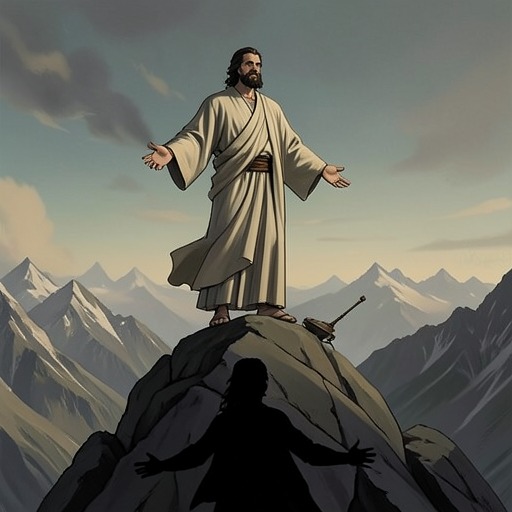
The vision begins with Zarathustra forcing his way up a solitary mountain path, where rubble and slipping stones make every step an effort. His ascent is opposed by the Spirit of Gravity, imagined as a dwarf who sits upon him and weighs down his thoughts. The dwarf mocks Zarathustra as a stone thrown high that must fall. The physical climb thus gives form to a contest over whether ascent and striving can escape a force that drags everything downward.
Zarathustra answers that he is stronger and that the dwarf could not endure his abysmal thought. The claim does not settle the contest so much as introduce what will make it difficult: a thought so severe that even its speaker fears it. When the dwarf jumps from Zarathustra’s shoulder, they halt before a gateway. The release is temporary; the burden shifts from the body to the question posed at the threshold.
The gateway named Moment
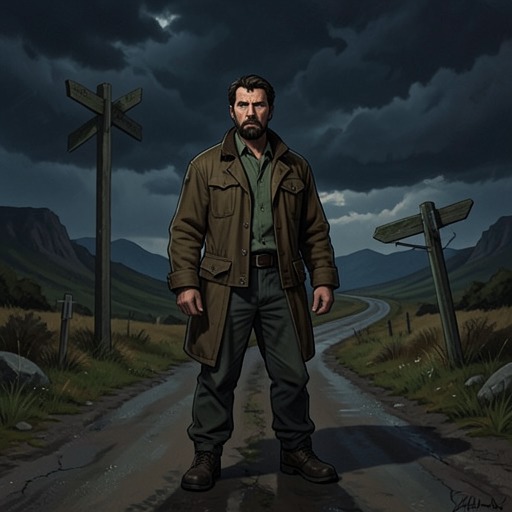
Zarathustra describes two long paths meeting at the gateway. One stretches behind into eternity, the other ahead into eternity; their point of meeting is named Moment. He asks whether paths that seem opposed might, if followed far enough, converge. The dwarf replies that time itself is a circle. The exchange turns the mountain encounter into a compact dispute about time: the gateway is both a specific place in the vision and the point from which past and future are imagined as joined.
Zarathustra presses the thought beyond a general claim about circular time. If the present moment draws future things after it, he reasons, it must also draw itself, and all things capable of running must pass again along the path ahead. In moonlight, he includes the slow spider, the moonlight, himself, and the dwarf in the question of whether they have all been there before and must return. The intimate details of the scene are not incidental to the argument: the thought reaches everything present at the gateway, not only human lives or abstract events.
As he speaks, Zarathustra grows quieter and admits fear of his own thoughts and reservations. A howling dog suddenly breaks the meditation. The vision’s shift is abrupt: the speculative question gives way to a cry for help, and the apparently private exchange at the gateway opens into a scene of immediate suffering.
The Shepherd and the black Snake
In a desolate moonlit place between wild cliffs, Zarathustra finds a man lying on the ground and a dog leaping, bristling, whining, and howling as he approaches. The man is a young Shepherd, convulsed and choking, his face distorted by disgust and pallor. A heavy black Snake hangs from his mouth; Zarathustra imagines that it may have crawled into the Shepherd’s throat while he slept and bitten itself fast there.
Zarathustra tries repeatedly to pull the Snake out, but cannot. His hands fail where force alone might seem the obvious remedy. Then a cry rises from him: the Shepherd must bite. The command brings together Zarathustra’s horror, hatred, disgust, and pity in one response. Rather than rescue the man by removing the threat himself, he urges the suffering figure to act against what has lodged within him.
The Shepherd follows the cry, bites hard, and spits the Snake’s head far away. The action reverses the scene’s helplessness: the man who had been choking and unable to free himself becomes the agent of the decisive break. Zarathustra’s hands could not pull the Snake loose; the Shepherd’s bite succeeds. The vision marks the change through action, not explanation, and makes the reversal both brutal and liberating.
Transformation without an explanation
After biting off the Snake’s head, the Shepherd springs up. Zarathustra says he is no longer a Shepherd and no longer a man, but a transformed being surrounded with light and laughing. The laugh is described as unlike any human laugh Zarathustra has heard. The change is therefore not presented as a simple recovery from choking: the figure who rises has crossed into a state the vision can show only through light, laughter, and the declaration that he is no longer what he was.
Zarathustra asks his listeners to interpret the vision and wonders who the Shepherd is, or who may one day become the man into whose throat everything heaviest and blackest crawls. He does not identify the Snake with a single settled meaning, nor does he name the Shepherd’s future identity. The questions keep the image open while binding it to the earlier meditation: the vision follows the possibility of recurrence with an ordeal of suffocation and a transformation achieved through a decisive act.
The ending belongs to Zarathustra’s response as much as to the Shepherd’s change. He says that a thirst and an unstilled longing consume him: he longs for the laughter he has heard and cannot imagine enduring either continued life without it or dying now. The vision offers no return to ordinary calm and no explanatory key. It leaves Zarathustra seized by the sound of a laughter that exceeds the human, making that sound the event’s final measure of transformation.