The Voluntary Beggar
Thus Spoke ZarathustraThe Voluntary Beggar is a former rich man who renounced his wealth in order to give his abundance and affection to the poor, only to find that they would not receive him. He then sought companionship and a model of happiness among animals, especially cows. His meeting with Zarathustra gives this renunciation a distinctive shape: he is not simply a giver, but someone who has discovered that generosity cannot be imposed on its recipients, and who turns from human society toward a slower, less contentious life.
Identity and First Appearance
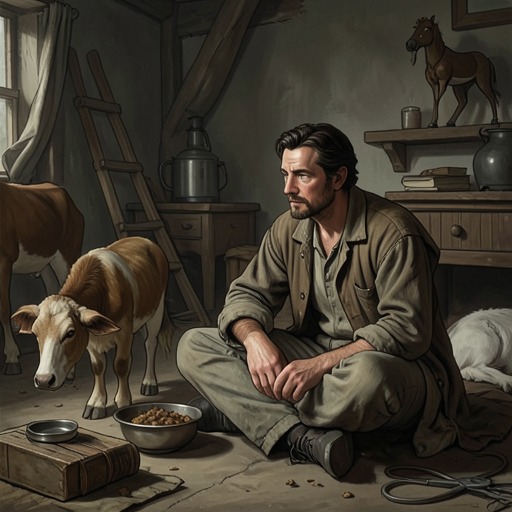
The Voluntary Beggar appears in the mountains as a peaceable man and preacher, seated on the ground among cows. Their attention is fixed on his human voice; when Zarathustra approaches, the cows have turned their heads toward him and seem to be listening eagerly. Zarathustra initially fears that someone has suffered an accident and rushes up the hillock to move the animals aside. Instead, he finds a man apparently trying to persuade them not to fear him. The mistaken alarm introduces a contrast that defines the scene: Zarathustra expects a human emergency, while the man has deliberately made the animals his audience.
The narrator describes goodness as seeming to preach from the man’s eyes. This first impression is borne out by his peaceable manner, but his gentleness is not merely passive. He is there with a purpose: he seeks happiness on earth and believes the cows may teach him something about it. His encounter with Zarathustra begins with a reciprocal challenge. Zarathustra asks what he is seeking; the man answers that he seeks what Zarathustra seeks, then explains that he has been talking with the cows for half a morning and was waiting for them to reply. The comic incongruity of a sermon addressed to cattle also expresses his willingness to learn outside human company.
Renunciation and Rejection
Zarathustra recognizes him as the man who once threw away great riches. The Voluntary Beggar had been ashamed both of his wealth and of the rich, and had fled to the poor so that he could give them his abundance and his heart. They rejected his offer. He confirms that they would not receive him, and says that at last he went to the animals and to the cows.
This history makes his turn toward animals a consequence of failed human generosity, not simply a preference for solitude. His intended gift included both material abundance and personal affection; neither could create a welcome where the recipients did not accept him. Zarathustra draws a lesson from that failure: giving well is harder than taking well, and giving is an art. The exchange distinguishes the wish to give from the skill of giving. The Voluntary Beggar has experienced the limits of benevolent intention firsthand, while Zarathustra names the difficulty as a demanding form of kindness rather than treating generosity as automatically successful.
The scene does not say that the beggar regrets his renunciation or seeks to regain his former place among the rich. Instead, his account moves from the poor who rejected him to the animals he now approaches. His changed company is the visible outcome of the failed gift: he continues to seek happiness, but looks for instruction in a setting where he can remain among creatures without repeating the same appeal to human recipients.
The Cows and His Idea of Happiness
Zarathustra reads the man’s tastes from his body and manner. He judges that the man’s stomach resists raging, hatred, and over-frothing; he calls him no butcher, but a man of plants and roots, perhaps one who grinds corn, and supposes that he loves honey. The Voluntary Beggar responds with a lightened heart, confirming that he loves honey and grinds corn. He says that he has sought what tastes good and gives sweet breath, as well as food that takes a long time: a day’s work and a day’s chewing for gentle idlers and sluggards.
His account gives the cows a concrete place in his search for happiness. They have, he says, attained the greatest proficiency in this slow practice: they ruminate and lie in the sun. He admires not an abstract doctrine but a bodily routine of taking time, chewing, and resting. Their example is also defined by what they abstain from: heavy thoughts that inflate the heart. The beggar’s attention to rumination makes the cows more than a picturesque audience for his sermon. They are his chosen teachers, and their habits supply the practical model he hopes to understand.
The episode sets this ease against the emotional and social strain of his earlier life. The man who once carried wealth and a wish to give now finds warmth and instruction in simple food and the cows’ unhurried behavior. The text does not claim that their way resolves his experience of rejection; it shows why he turns to it. His search for earthly happiness proceeds through attention to taste, labor, chewing, and rest rather than through a new scheme for persuading people to accept his gifts.
Meeting Zarathustra and Joining the Guests
When the Voluntary Beggar recognizes Zarathustra, he responds with overwhelming affection. He identifies him as the man who has overcome the great disgust, and kisses his hands with overflowing eyes, as though a precious gift had unexpectedly come to him. The cows look on in amazement. Zarathustra restrains this display and asks the friendly stranger to speak first about himself, redirecting attention from his own reputation to the beggar’s history.
The recognition is significant because the beggar’s earlier failure to give is met here by an encounter in which his affection is received. Zarathustra does not let the scene remain a celebration of himself: he asks after the person before him and recalls the rejected attempt to give wealth and love. Their exchange therefore brings together two different forms of attention: the beggar’s devoted recognition of Zarathustra and Zarathustra’s effort to understand the beggar’s experience.
Later that day, the Voluntary Beggar is among the company gathered in Zarathustra’s cave after Zarathustra hears a many-voiced cry of distress. The visitors include the two kings, the old sorcerer, the pope, the shadow, the conscientious man of the spirit, the sorrowful prophet, the ass, and the Ugliest Man, who wears a crown and two purple sashes. The Voluntary Beggar’s presence among them links his mountain encounter with Zarathustra to the larger gathering of troubled figures. The evidence establishes his place in that company, while leaving his subsequent actions there unstated.
Narrative Role
The Voluntary Beggar’s short appearance joins an account of failed charity to an alternative practice of attention. His renunciation does not guarantee that his generosity will be welcomed; the poor’s refusal sends him elsewhere, and his chosen response is to learn from animals rather than to press his gift upon them. Zarathustra’s remark that giving well is an art sharpens this distinction between abundance and the manner of giving.
The cows, meanwhile, make his search unusually concrete. Their rumination and sunbathing embody a patient, bodily rhythm that contrasts with the heavy thoughts and emotional excess he associates with human life. Yet the beggar is not simply isolated from people: he is moved by Zarathustra, approaches him with tenderness, and later appears among the gathered guests. His character is shaped by this tension between rejected human connection and continued attachment. The episode leaves him not as a triumphant benefactor but as a seeker who has changed teachers and companions while retaining his desire for happiness on earth.