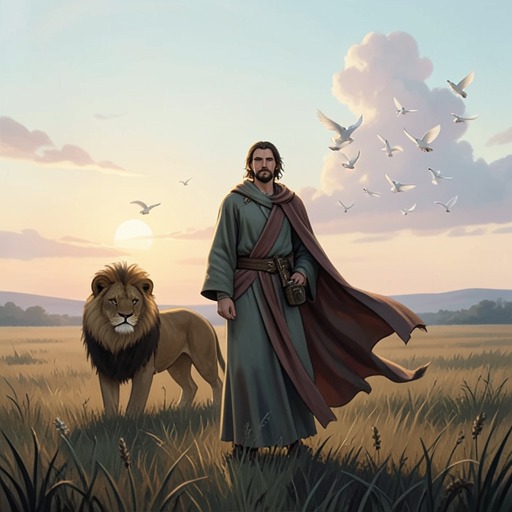
Zarathustra Preaches the Superman at the Marketplace
Thus Spoke ZarathustraZarathustra’s marketplace speech introduces the Superman as an earthly ideal of self-overcoming, but its immediate reception exposes the distance between his teaching and his audience. Speaking to a crowd gathered for a tightrope performance, he asks what people have done to overcome themselves and urges them to remain true to the earth. They answer not with engagement but with laughter and a demand for The Ultimate Man. The episode thus makes the mismatch between a future-oriented challenge and the crowd’s modest conception of happiness part of the event itself.
A Speech Before the Performance
Zarathustra arrives at a town near the forest and finds a gathering in the market square. The announced attraction is a tightrope walker. The setting gives his address an audience assembled for spectacle, not necessarily for instruction: he speaks to people waiting to watch a performer cross a rope stretched between towers. Against that practical entertainment, he announces that he teaches the Superman and asks what his listeners have done to overcome humanity.
The question establishes the speech’s central demand. Zarathustra presents human beings not as a finished achievement but as something to be surpassed. He compares humanity’s relation to the Superman with the ape’s relation to humanity: what once appears as a source of amusement or embarrassment becomes an image of what humanity may be to a future form of life. The comparison makes the teaching deliberately unsettling. Rather than flattering his audience with a picture of human importance, it asks them to accept that they, too, may be an intermediate stage.
He extends this challenge by rejecting the idea that the wisest person is already a unified ideal. Such a person remains a discordant hybrid of plant and ghost, Zarathustra says, but the proposed alternative is not to become either ghost or plant. His answer is the Superman. In the speech, this figure is not an appeal to leave earthly existence behind; it supplies a purpose within it.
Earth as the Measure
Zarathustra names the Superman the meaning of the earth and urges his listeners to will that meaning into existence. The formulation makes the Superman a horizon for earthly transformation, rather than a reward in a world beyond this one. His appeal to remain true to the earth follows directly: those who speak of superterrestrial hopes, he warns, poison life, whether knowingly or not. He describes them as despisers of life, diminished and self-poisoned, and says that the earth is weary of them.
The speech therefore sets two orientations against each other. One looks for hope beyond the earth; the other takes earthly life as the ground on which meaning must be made. Zarathustra presents the Superman as the figure of that second orientation. His prophetic image of lightning and a heavy drop from a cloud intensifies the announcement: the lightning is called Superman. The imagery suggests an impending event, but in the evidence of the speech it remains a declaration, not an accomplished transformation. Its force depends on listeners being able to hear the promise as a demand addressed to the present.
That demand is also directed against complacency disguised as distinction. When Zarathustra considers the crowd’s pride in culture, he treats its claimed difference from goatherds as something the listeners value about themselves. The contrast sharpens the gap between their self-image and his teaching. Culture, as they invoke it, does not by itself answer his question about overcoming humanity.
Laughter and Misunderstanding
After speaking, Zarathustra looks at the people and falls silent. He recognizes that they are laughing and concludes that they do not understand him; in his inward reflection, he doubts that he is the mouth suited to their ears. His questions about whether he must shatter their ears, sound like drums, or preach like a Lenten preacher register the problem as one of communication. The speech has been delivered, but its audience has not received it in the sense he intends.
The crowd makes that failure explicit when it calls for Zarathustra to give it The Ultimate Man, asking to be made into that figure while surrendering the Superman instead. Its response reverses the hierarchy of the address. Zarathustra has presented the Superman as the meaning toward which humanity must move; the crowd prefers an image that fits its own wishes. The contrast is not merely between two labels. It turns the speech’s call to overcome the human condition into a request for the audience to be affirmed as it is.
The narrator identifies this address as Zarathustra’s first discourse, also called the Prologue, and says that shouting and mirth interrupt it. Zarathustra grows sad and again reflects that he is not the mouth for these ears. He imagines that life in the mountains, among trees and streams, may have made him speak to these townspeople as if they were goatherds. Although he describes his own soul as unmoved and bright as morning mountains, he recognizes that the crowd takes him for cold and mocking. Its laughter, he observes, contains ice and hate. The public response is therefore more than simple amusement: it leaves the speaker isolated from the people he has addressed.
The Crowd and the Tightrope
The scene’s structure places the speech beside the performance that first gathered the crowd. Once the address has ended in shouting and laughter, the tightrope walker begins his work. He emerges through a small door and proceeds onto a rope stretched between two towers, high over the market square. The arrangement makes the performer’s literal passage across a dangerous gap an immediate counter-image to Zarathustra’s account of humanity as something to be overcome.
As the walker reaches the middle of his course, another small door opens. A brightly dressed figure like a buffoon leaps out and follows him rapidly, shouting insults and calling him forward. The pursuer closes the distance until he is only a pace behind. At that point a dreadful occurrence begins, silencing the crowd and fixing every eye. The account supplied here stops before fully describing what happens, so the speech’s ending should not be confused with a completed description of the tightrope walker’s fate. What is clear is the abrupt change in the crowd: its laughter gives way to concentrated attention as the spectacle becomes dangerous.
That turn gives the episode a double movement. Zarathustra’s words fail to command the crowd’s understanding, while the physical spectacle commands its eyes. His earlier question about teaching people to hear with their eyes acquires an immediate, literal resonance when the performance silences every mouth and fixes every eye. The Prologue’s first public address thus closes not with agreement but with misrecognition, and the market’s promised entertainment takes over the scene.