Zarathustra and his disciples
Thus Spoke ZarathustraZarathustra and his disciples are bound by a relationship that must culminate in separation. At the close of his teaching, Zarathustra accepts their affection and the staff they give him, then insists that they go away from him and learn to stand alone. The apparent farewell is therefore also his final lesson: discipleship is valuable only if it ends in independence, making possible a different friendship and a shared future oriented toward the Superman.
The Farewell at the Crossroads
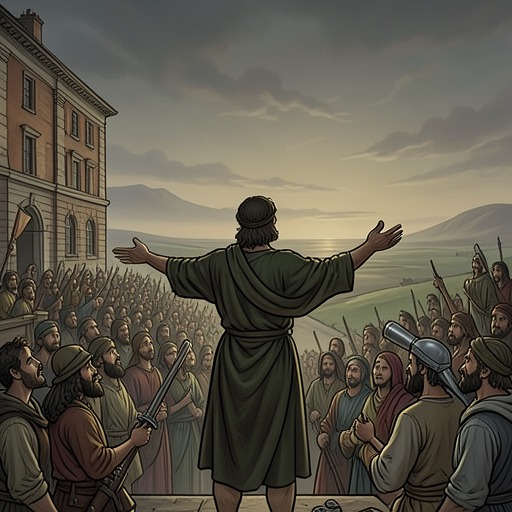
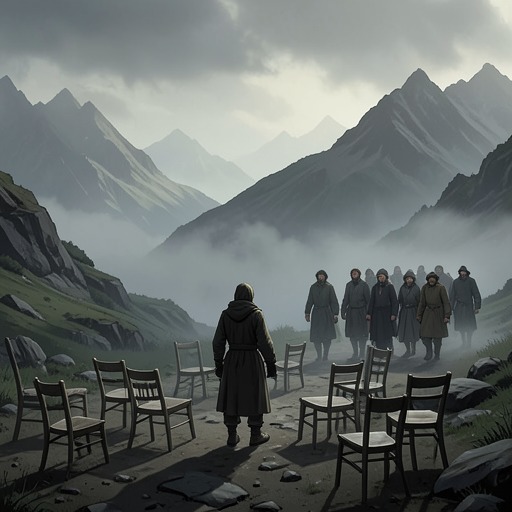
After leaving Pied Cow Town, a place to which his heart is attached, Zarathustra is followed and escorted by people who call themselves his disciples. Their movement together ends at a crossroads, where he says he wants to continue alone because he is a friend of going alone. The setting gives the departure a literal direction: a shared road reaches a point at which each must choose what follows. His wish to leave is not prompted by a quarrel described in the text. It comes from his commitment to solitude and from the need for his followers to stop treating proximity to him as their destination.
The disciples answer his announcement with a gift rather than an argument. They give him a staff whose golden haft bears a serpent coiled around a sun. Zarathustra is delighted, leans on it, and uses its gold to explain the highest virtue. Gold is precious not because it is useful, but because it is rare, shining, and mellow, and because it gives itself. Its value becomes an image of the giver: generosity proceeds from fullness, not from a demand for repayment. The gift thus makes the relationship visible in two ways. The disciples give to their teacher, while Zarathustra turns their parting present into a lesson about the virtue he hopes they will embody.
Teaching Against Dependence
The farewell changes tone after Zarathustra has spoken about giving. He pauses, balances the staff doubtfully, and then tells his disciples to go away and be alone. He advises them to guard themselves against him and even to feel ashamed of him, since he may have deceived them. This warning places a limit on the authority his teaching might acquire: devotion to the teacher can become another form of belief that prevents a person from seeking independently.
Zarathustra makes that danger explicit by asking what importance he himself can have to people who believe in him. His answer is that they had not yet sought themselves when they found him. Their attachment may therefore mistake finding a teacher for finding a self. He does not ask them to preserve his influence by repeating his doctrine or remaining near him. Instead, he bids them lose him and find themselves, making the loss of their immediate guide a condition of genuine discovery. In this relationship, loyalty is tested not by obedience but by the ability to continue without the teacher’s presence.
Separation, Friendship, and Return
The demand for distance does not cancel affection. Zarathustra promises that only after they have denied him will he seek his lost followers with other eyes and love them with another love. The movement is from belief to loss, and from loss toward a friendship no longer organized around dependence. He imagines them becoming friends and children of one hope, rather than believers gathered around a single authority. His projected return is described as a third time, when he will be with them to celebrate the Great Noon; it is a promise of renewed encounter, not an episode in which that encounter is shown to occur.
This ideal of friendship includes a difficult capacity: the person who knows must be able both to love enemies and to hate friends. The warning refuses to make closeness identical with unquestioning approval. A disciple may need to resist, judge, or reject the teacher in order to become an independent companion. Zarathustra therefore asks for a bond strong enough to survive separation and disagreement, rather than one secured by constant agreement.
The Shared Hope of the Great Noon
The promised reunion is framed by the journey between animal and Superman. Zarathustra describes the Great Noon as the midpoint of that course, when humanity can regard its onward passage toward evening as its highest hope because the passage leads toward a new morning. The movement of going under is given a positive meaning: humanity can bless itself in descending because it is going over to the Superman. This future-facing image clarifies why the disciples must not make Zarathustra himself the endpoint of their hope.
The broader account of the teaching’s conclusion links this farewell to the death of God and the need for the Superman to give significance to the earth. It also presents the magnanimous person as so abundant in strength and well-being that gifts are bestowed from necessity, not scarcity. Zarathustra’s parting lesson joins that generosity to release: he gives the disciples a future in which they must cease to be merely his followers. Their relationship reaches its purpose not in permanent attendance on him, but in the possibility that they will become independent friends capable of sharing a hope beyond him.