Zarathustra and humanity
Thus Spoke ZarathustraZarathustra’s relationship with humanity is shaped by a decisive failure of communication: he descends from solitude to announce a future beyond existing human values, but the crowd at The Market-place hears spectacle rather than a summons to transformation. Its response leads him away from addressing people as a mass and toward seeking living companions and fellow-creators. The change is not a retreat from humanity so much as a new account of whom his teaching can reach and what kind of relation it requires.
Descent and Public Address
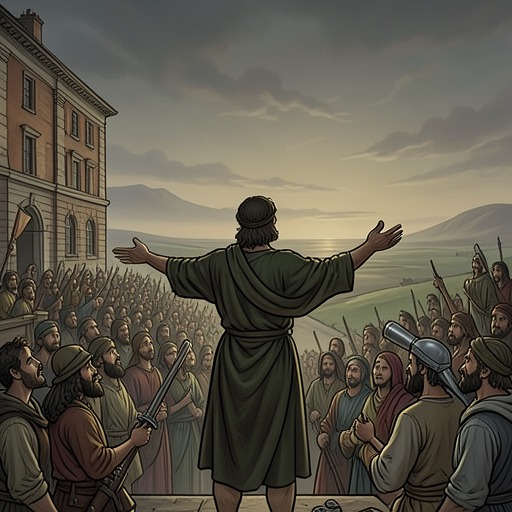
Zarathustra begins by leaving solitude and entering the public world with a message about humanity’s future. He announces the Death of God and presents the Superman as the successor to the vanished divine order. The teaching does not ask the listeners simply to preserve what they are: it places humanity in a passage toward something beyond itself. This makes the address both a proclamation and a test of whether the crowd can imagine a future that unsettles its present assumptions.
At The Market-place, Zarathustra tries several ways to make that future intelligible. He expounds beatitudes and appeals to the people’s pride by setting the Superman against the Ultimate Man, who sacrifices the future for the comfort of the present. The contrast is pointed: the crowd is offered a choice between risking transformation and settling for a life narrowed to immediate satisfaction. Yet the argument does not win their attention. Its very appeal to pride fails to turn their concern toward the future Zarathustra wants them to see.
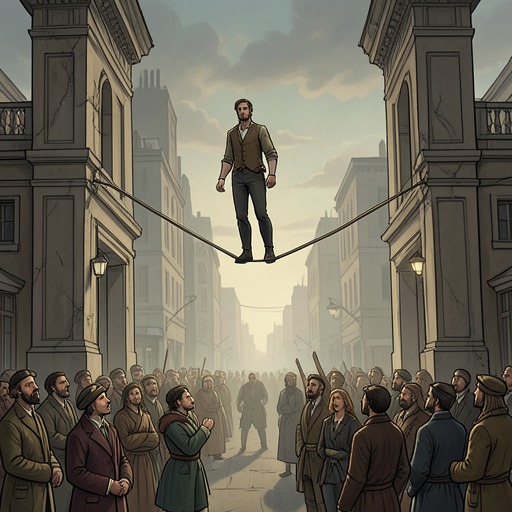
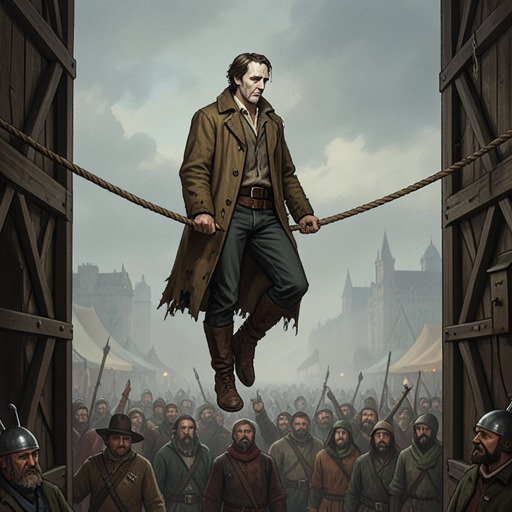
The public address unfolds amid a spectacle already in progress: a tightrope walker is to perform above an abyss. The image makes human existence precarious, a balance rather than a secure destination. But the crowd interrupts Zarathustra’s teaching with a demand to see the tightrope walker, and laughter replaces engagement with the message. The walker, believing that Zarathustra’s words apply to him, sets to work. The scene thus brings the abstract claim about humanity into contact with a dangerous public performance, without persuading the audience to attend to the claim itself.
The Marketplace and the Failure to Understand
The crowd’s laughter marks more than disagreement. After speaking, Zarathustra looks at the people and falls silent, recognizing that they do not understand him and that he is not a mouth for their ears. His inward response frames the problem as a mismatch between speaker and audience: repeating the message more loudly, he considers, may not make the listeners capable of hearing it. The failed address is therefore not repaired by greater force or theatricality.
The tightrope episode deepens this failure. The crowd treats Zarathustra’s warning as an interruption to its entertainment; it wants the performer, not the teaching about what humanity might become. The walker’s mistaken belief that the words concern him shows that the address can be misheard even by someone directly implicated in its central image. In the broader account of the episode, the tightrope walker’s overtoppling by the buffoon brings home to Zarathustra the uncanny character of human existence. The encounter turns his first descent into a recognition: humanity cannot be approached as a receptive audience merely because it has gathered to listen.
After a bad night, Zarathustra resolves to leave the marketplace and speak to individuals instead. That decision does not mean the initial message has been withdrawn. Rather, its manner of delivery changes. The scene distinguishes between the physical presence of a crowd and the possibility of an actual intellectual or creative companionship: people may stand before him, hear his words, and still remain outside the relation he seeks.
From the Herd to Companions
Zarathustra recasts his mission as a search for companions, not an effort to become the shepherd and dog of the herd. He wants living companions who follow because they also wish to follow themselves, and who choose a direction aligned with his without surrendering their own agency. The contrast with dead companions and corpses makes the requirement stark: he does not want passive bearers of a teaching, but people capable of movement and independent commitment.
He expects this change of audience to provoke hostility. To lure people away from the herd, he says, is to invite the anger of both the people and their herdsmen. Those who call themselves the good and the just, or the faithful of the true faith, are described as guardians of established values. Their names for themselves do not alter the function Zarathustra assigns them: they keep others within inherited forms of allegiance, while the creator threatens those forms.
The creator, in Zarathustra’s account, is hated for smashing tables of values and breaking the law, yet that destruction is joined to the work of creation. He seeks fellow-creators who can inscribe new values on new tables. The relation is therefore not simply teacher and followers: Zarathustra needs collaborators in revaluation, not believers who preserve his words as another fixed doctrine. His image of companions as fellow-harvesters extends the idea into shared labor. With everything ripe for harvesting, he lacks the hundred sickles he needs; he tears off ears of corn himself and is vexed. He seeks people able to whet their own sickles, whose work can answer the task rather than merely witness it.
A Relation Recast
Those who take up this work may be called destroyers and despisers of good and evil, but Zarathustra identifies them also as harvesters and rejoicers. The paired descriptions keep the cost and purpose of the mission together: breaking inherited moral tables can look like negation, while the new values it makes possible require active, affirmative labor. His desired companions are not defined by agreement alone, but by their capacity to participate in both sides of that work.
The relation to humanity consequently remains divided between a broad address and a selective hope. Zarathustra first speaks publicly because his message concerns humanity’s direction, but the crowd’s response exposes the limits of treating humanity as a single audience. He turns toward individuals who can become companions, and beyond them toward fellow-creators who can give new values form. The public’s laughter does not resolve the relation; it forces Zarathustra to distinguish the mass that hears him from the people he hopes to find. His mission continues, but its measure of success shifts from being heard by everyone to finding living partners capable of carrying creation forward.