Zarathustra and the Higher Men
Thus Spoke ZarathustraZarathustra’s relationship with the Higher Men turns hospitality into a test of what kind of future they can represent. He shelters them when they arrive in distress and rejoices when they begin to laugh again, but he does not mistake their recovery for transformation. They are welcome guests, even signs that others are approaching; they are not yet the strong, joyful companions or heirs he awaits. Their eventual flight from the lion brings that distance into view, while Zarathustra’s recognition of pity for them marks the emotional cost of leaving them behind.
Arrival and Hospitality
When Zarathustra returns to his cave after a long, fruitless search, he hears the cry of distress again, this time coming from inside. The apparent single cry resolves into many voices. There he finds the people he had passed during the day assembled together: the King on the Right and the King on the Left, The Sorcerer, The Abdicated Pope, The Voluntary Beggar, The Shadow, The Conscientious Man of the Spirit, The Prophet of the Great Weariness, The Ass, and The Ugliest Man. The Ugliest Man has put a crown on his head and wound two purple sashes around himself, dressing up even in this company of despair. Zarathustra’s Eagle and Serpent are there too: the eagle is agitated, its feathers ruffled, while the serpent hangs around its neck.
Zarathustra responds first with amazement, then with a gentle curiosity that allows him to read the guests’ inward condition. He recognizes their cry as the collective cry he has heard and identifies the one he had searched for in vain: the Higher Man. He also sees that he has helped draw these visitors to his cave with honey offerings and the calls of his happiness. The gathering is therefore both an arrival he did not expect and, in part, the consequence of his own invitation.
His welcome is generous and concrete. He tells the guests that his kingdom and domain are theirs for the evening and night; his animals will serve them, and his cave will give them rest. He promises security from the wild animals in his preserve, then offers his little finger, his whole hand, and finally his heart. This warmth is not a declaration that they have become his equals or his chosen company. It establishes a distinction that governs the relationship: he can shelter the despairing without treating their present condition as their final stature.
Welcome Without Fellowship
The King on the Right responds to Zarathustra’s presence as a source of renewed hope. He takes Zarathustra’s hand to kiss it and speaks for those who do not want to live unless they can learn to hope again from him. Zarathustra resists the adoration and steps back, startled and silent. His retreat interrupts a bond that the king understands as grateful devotion: Zarathustra will offer help, but he will not accept the role of revered savior that the gesture assigns him.
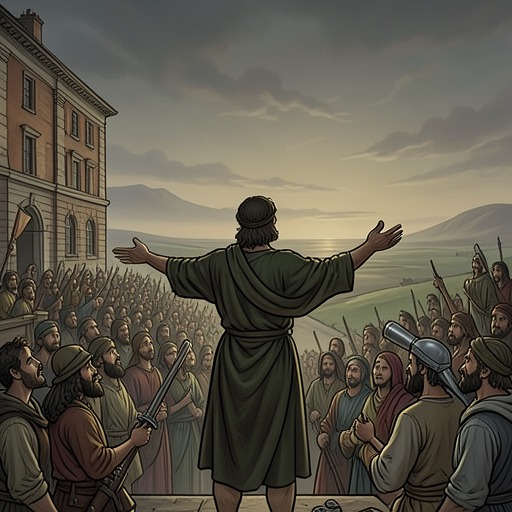
He then addresses the visitors plainly, telling them that he has not been waiting for them in the mountains. Although they may all be Higher Men, he judges them not high or strong enough for what is silent within him and will not always remain silent. If they belong to him at all, he says, they do not belong as his right arm. Their sick and tender legs make them wish above all to be spared; burdens, memories, and an inward presence of the mob weigh against their elevated status. He sees what they are as well as what they might become, and refuses to confuse a higher type with a completed one.
The distinction is sharpened by the image of a bridge. Zarathustra tells them that they are only bridges, steps over which higher men may pass. They should not resent being climbed over on the way to a greater height. From their seed, he allows, a genuine son and perfect heir may someday grow, but that future is far off, and the visitors themselves do not inherit his name or heritage. Their significance lies partly in what can come after them, not in a status they have already achieved.
The Future Zarathustra Awaits
Zarathustra describes the guests as omens that Higher Men are already on their way. But they are not the people with the great longing, great disgust, and great satiety for whom he is waiting. He will not leave the mountains for his final descent without those others: stronger, more victorious, more joyful, square-built in body and soul, and like laughing lions. He asks the guests why they do not speak of his gardens, the Blissful Islands, and the beautiful new race, or of his children who are on their way to him.
This contrast makes his hospitality an interim relation rather than a settled community. The visitors can occupy his cave and receive his protection, while the language of gardens, children, and a new race points beyond them. His welcome does not erase the difference between present guests and anticipated companions. Nor does he present the guests’ weakness as useless: the bridge image gives them a place in a passage toward what exceeds them. But that place is not the destination, and Zarathustra will not pretend otherwise to spare their feelings.
Laughter, Alarm, and Recognition
After the song of the wanderer and Shadow, the cave fills with noise and laughter. The guests speak together, and even The Ass joins in. Zarathustra feels a little repugnance and scorn, but also rejoices because their gaiety seems to him a sign of recovery. He slips outside to speak with his animals and reflects that the guests have unlearned their distressful crying, although not crying itself. Their laughter changes the atmosphere, but it does not prove that the underlying habit of distress has disappeared.
Later, Zarathustra leaps back to the cave door and calls the guests clowns and buffoons for pretending and dissembling before him. He identifies the mischievous joy with which they have become like little children again. The reproach reveals a limit in his response: he can welcome their gaiety as healing and still distrust the performance surrounding it. Their return to childlike play is real enough to delight him, but it does not make their relation to him the one he seeks.
At dawn, Zarathustra says that the Higher Men are still asleep in his cave and are not his rightful companions. He wants to go to his work and his day; they do not understand the signs of his morning, and their dreams still drink at his songs. The ear that listens and obeys is missing. The distinction is not simply between wakefulness and sleep: it is between being moved by Zarathustra’s words and being ready to answer their demand through action.
The Lion and the End of the Encounter
The sign arrives in the form of a powerful, sallow lion that presses its head lovingly against Zarathustra’s knee, while doves crowd around him. Zarathustra says that his children are near, falls silent, and weeps as the doves fondle his white hair and the lion licks the tears from his hands. The scene gives physical form to the joyful future he has been awaiting. It does not depict the Higher Men becoming those children; instead, the lion’s arrival coincides with their failure to meet the moment.
The Higher Men wake, arrange themselves in a procession, and set out to greet Zarathustra. The sound of their approaching steps makes the lion turn suddenly toward the cave and roar. They cry out together and flee, vanishing in an instant. Zarathustra, left alone, slowly recollects the events of the previous day and recognizes that he has been sitting at the same stone where the Prophet came to him and where he first heard the great cry of distress.
He then identifies the danger in his own response: “Pity! Pity for the Higher Man!” His countenance changes, and he declares that this has had its time. He does not say that the guests’ distress was unreal, or that their brief recovery meant nothing. Rather, the episode shows how pity could keep his attention fixed on their need, when he believes his work and the approach of his children now demand it. The relationship ends neither in reconciliation nor in a formal repudiation of the guests. It ends with their flight, Zarathustra’s solitude, and his conviction that he has become ripe for the work ahead.