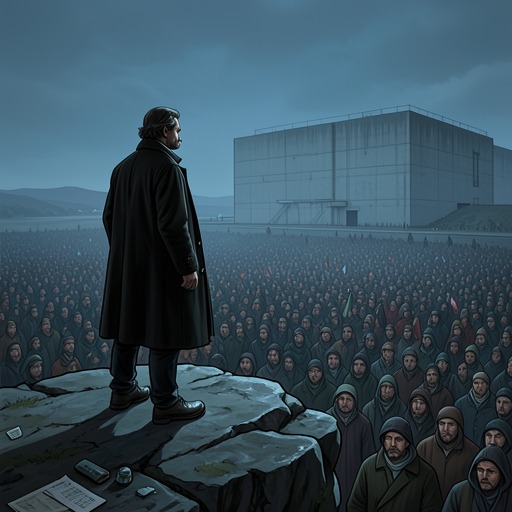
Zarathustra and the Rabble
Thus Spoke ZarathustraZarathustra presents the rabble not simply as people he dislikes but as a presence that seems to alter the conditions under which life can be shared. In his account, wells, fire, and fruit stand for sources of vitality and pleasure; when the rabble approach them, those sources lose their freshness. His response is therefore a conflict over proximity: he turns away from common life as he imagines it under their influence, then seeks a height where delight can again be experienced without their participation.
The Rabble as a Threat to Shared Delight
In Zarathustra’s account, the rabble’s defining effect is contamination. Life is figured as a fountain, yet the water seems poisoned wherever the rabble drinks. The image makes his objection more than a complaint about manners: the shared resource itself appears changed by the act of sharing. His emphasis on cleanliness and the well’s reflection makes the encounter one of perception as well as contact. What he sees in the water confirms his sense that the rabble’s presence has entered and altered what should have remained clear.
The same pattern recurs through fire and fruit. The flame loses its capacity to burn when those approaching it bring damp hearts; the spirit bubbles and smokes, while fruit becomes overripe in their hands and the tree grows unstable under their gaze. These images extend the well’s logic across different forms of nourishment and energy. In each case, something that should sustain or kindle life becomes compromised. Zarathustra thus casts the rabble as a force that frustrates vitality even without describing a particular confrontation or a single act of damage.
That figure also explains why others in his account turn from life. Some, he says, withdrew not from life itself but from the prospect of sharing its well, flame, and fruit with the rabble. Others went into the desert and endured thirst rather than sit at a cistern among camel-drivers. Even the figure who arrives as a destroyer is interpreted as wanting to silence the rabble, not necessarily to reject life in its entirety. These examples broaden Zarathustra’s complaint into a diagnosis of retreat: what can appear to be hostility toward existence may, in his account, originate in refusal of a particular social company.
Disgust, Power, and Withdrawal
Zarathustra describes his own response as disgust rather than hatred, and says that this disgust consumed his life. The distinction matters to the passage’s account of his estrangement. Hatred would keep him engaged with an opponent; disgust instead makes proximity itself exhausting. He grows weary of spirit when he finds that the rabble, too, has been endowed with it, suggesting that his alienation reaches beyond material sharing to the presence of the very quality he values among people he rejects.
His turning away also has a political object. He withdraws from rulers when he sees ruling reduced to bargaining and haggling for power with the rabble. The passage therefore does not portray the rabble as standing outside power: Zarathustra sees rulers making terms with them. His disdain for the rabble and his rejection of these rulers meet in the image of political life as a transaction. To avoid hearing its language, he lives among peoples whose speech is strange to him; he describes this distance as a way to keep the bargaining and competition for power from becoming familiar.
The withdrawal becomes nearly total in the image of a cripple who has lost sight, hearing, and speech. Zarathustra says he has lived this way for a long time so as not to live with the power-rabble, the scribbling-rabble, and the pleasure-rabble. Those three labels give his abstraction distinct social dimensions: the pursuit of power, the production of writing, and the pursuit of pleasure. The passage does not supply biographies or identify a single organized group behind them. Instead, its accumulating labels show how extensively his rejection reaches across the kinds of public life he associates with the rabble.
From Exhaustion to Ascent
This self-imposed distance is not presented as effortless triumph. Zarathustra’s spirit mounts steps warily and wearily, and small gifts of delight refresh it; his progress resembles the slow advance of a blind man relying on a staff. These details qualify the apparent severity of his refusal. He has not simply risen above the conditions he condemns: he describes a long period in which disgust restricted his life and left him dependent on modest sources of refreshment.
The turn comes when he asks how he was freed from disgust and what restored his sight. The passage’s answer is not a reconciliation with the rabble. Instead, disgust itself becomes the force that gives him wings and the capacity to find water. He says that he had to fly to the utmost height to discover the fountain again. The reversal is central to their relation: the aversion that first narrows his existence becomes a means of reaching a place where the rejected source of delight can be found anew.
At that height, the fountain gushes up for him and he finds a form of life at which the rabble does not drink with him. Yet delight is not a settled possession: its abundance can overflow the cup and empty it again. The image preserves a measure of instability within his escape. Separation makes renewal possible, but the force of what he finds can exceed the vessel meant to contain it.
Solitude and the Future
Zarathustra describes the height as home, a summer at its noon, with cold fountains and stillness. He says that he and his companions live too nobly and boldly there for the unclean and their thirsts. This language draws a firm boundary between his chosen circle and the rabble, but the relation has changed from mere flight to a deliberate arrangement of distance. He invites friends to look into the well, where their presence will not dim its sparkle. Unlike the earlier scenes of corrupted sharing, this is a form of communion he believes can preserve what is shared.
The closing image shifts that protected life toward the future. Zarathustra and his companions build their nest in the tree of Future, while Eagles bring food to the solitaries. The ending joins separation to dependence on a wider world: the companions remain apart from the rabble, yet their solitude is sustained through what comes to them. The passage consequently frames Zarathustra’s rejection as both a withdrawal from a present he experiences as corrupting and a bid to preserve delight for a different, future-facing community. It does not resolve the conflict through mutual understanding; it ends with a home, a circle of friends, and an image of life continuing beyond the rabble’s reach.