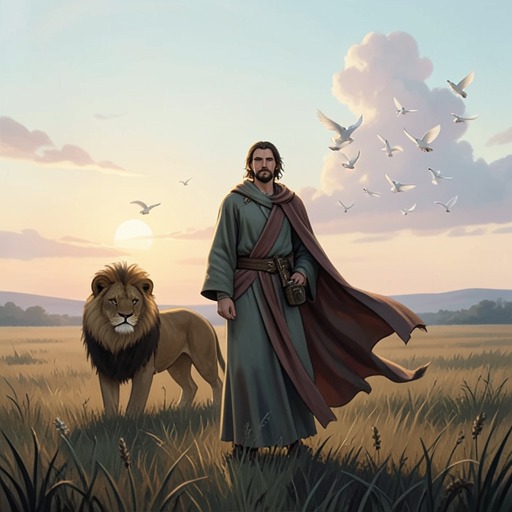
Zarathustra and the Superman
Thus Spoke ZarathustraZarathustra’s relation to the Superman is the governing purpose of his teaching: he presents the Superman as the meaning of earthly existence and calls humanity to become something that can be overcome. The ideal therefore names neither an accomplished condition nor a refuge beyond the earth, but a future-oriented demand. Its force is sharpened by the gap between Zarathustra’s confidence in the message and the failure of its first audiences to receive it; its eventual test is whether he can affirm life without needing an audience to confirm his teaching.
The Superman as an Earthly Aim
Zarathustra announces the Superman after emerging from ten years of solitude. His proclamation begins with a challenge to the human present: humanity is not a finished end but something to be surpassed. The Superman gives that surpassing a direction. Zarathustra’s declaration that the Superman is the meaning of the earth makes the ideal explicitly earthly: he asks his hearers to will a future on earth, rather than to treat earthly life as a passage toward a higher realm. In the same address, the death of God is joined to the wish that the Superman may live. The two claims form a hinge in his message: the old divine guarantee has ended, and the question of what humanity will create and value becomes urgent.
That future-facing emphasis distinguishes the Superman from a promise of immediate improvement or comfort. Zarathustra describes humanity as something to be overcome, so the ideal unsettles any account of human nature as complete or permanently authoritative. The distance between present humanity and the Superman is not incidental to the teaching; it is what makes striving, creation, and transformation necessary. The message asks its hearers to measure life by what it can bring into being, not merely by what it preserves for itself.
Values, Overcoming, and the Counterfigure
Zarathustra connects the possibility of the Superman to the values by which a people lives. A table of values, he says, is the record of that people’s overcomings and the voice of its Will to power. Values are thus not presented as a timeless set of commands detached from life. They express a force that ranks, creates, and moves beyond what has already been established. The Superman is bound to this process because a future form of humanity requires a transformation in what people esteem, not simply the continuation of inherited standards.
The opposition becomes concrete in the contrast with The Ultimate Man, the figure who sacrifices the future to his own present. Against that contraction, the Superman represents the risk of willing beyond immediate ease and making the future consequential. The contrast clarifies the stakes of Zarathustra’s appeal: the alternative to overcoming is not necessarily dramatic ruin, but a humanity content to close off what it might become. His teaching therefore has a critical edge as well as an affirmative one. It condemns present-minded satisfaction insofar as it blocks the creation of new aims, while locating meaning in an as-yet-unrealized possibility.
Rejection and the Problem of Teaching
The book makes the Superman’s importance visible through the failure of Zarathustra’s first effort to communicate it. He descends from solitude to address humanity, but people do not understand him. Even when he expands the message through beatitudes and the contrast with The Ultimate Man, the public encounter does not become a successful conversion. The plot accordingly places an obstacle inside the ideal’s very mode of transmission: a teaching about surpassing the present cannot assume that its audience already wants to be surpassed.
After this rejection, Zarathustra turns away from the marketplace and resolves to address individuals. The twenty-two discourses that follow are directed to his disciples, though the change of audience does not settle the difficulty. He later leaves even the chosen few who have remained with him and returns to solitude. The Superman is therefore not made secure by a community that receives and carries the doctrine without remainder. Zarathustra’s movement between public address, instruction, and withdrawal dramatizes the precarious relation between a future ideal and the people capable—or incapable—of hearing it. His solitude marks both the source of his independence and the cost of a message whose addressee is not yet present as a receptive collective.
The Teaching’s Culmination
In Part Three, Zarathustra’s relation to the Superman develops alongside his own intellectual and spiritual education. The book’s account of the part describes its final sequence as a re-exposition of his teachings followed by the full and unreserved statement of Eternal recurrence, which he joyfully accepts. That culmination does not replace the Superman with a separate otherworldly goal. Rather, it places Zarathustra’s affirmation of life under its most demanding test: he must embrace existence as recurring, not appeal to an escape from earthly life to make it meaningful.
The form of the ending reinforces the solitary character of that achievement. At the climax, Zarathustra is alone; his expressions of joy and gratitude are addressed in turn to his soul, to the life he feels within him, and to himself in a future reincarnation. His acceptance of Eternal recurrence is described as the completion of his self-education. The relation to the Superman thus reaches beyond a speech delivered to others: Zarathustra must become capable of affirming the conditions of life that his teaching places at stake. Yet the resolution remains distinct from a triumphant public victory. The message’s significance lies in the future it demands and the transformation its speaker undergoes, even though the people to whom he first offered it did not understand.