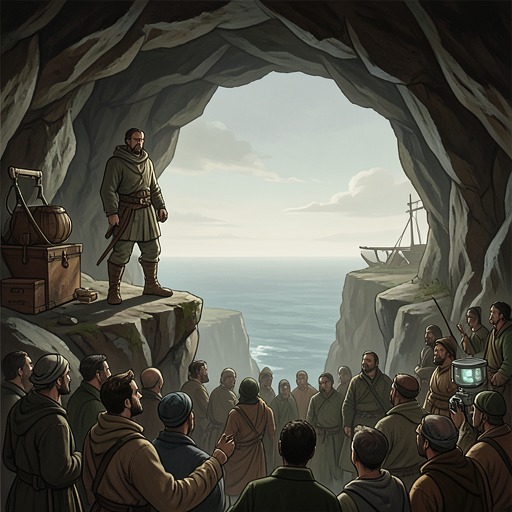
Zarathustra’s Departure from His Disciples
Thus Spoke ZarathustraZarathustra’s Departure from His Disciples begins as a confession of a departure he does not welcome. Troubled and unwillingly obedient, Zarathustra tells his friends that he must return to solitude, then recounts the encounter that has made leaving necessary. The Stillest Hour appears in his account as a terrible mistress and a voiceless authority: it demands that he speak and lead, while insisting that he has not yet become equal to what he has brought forth. The episode turns separation into a test of maturity, and its final action is not a triumphant exit but Zarathustra’s solitary departure after grief overwhelms him.
The Demand to Return to Solitude
Zarathustra introduces the encounter to his friends because he fears that a sudden departure might harden their hearts against him. He names the preceding evening as the moment when The Stillest Hour spoke. His language makes the authority intimate and unsettling at once: he calls it his mistress, yet describes its speech as voiceless. This is not presented as an ordinary conversation with another person. Instead, the scene gives dramatic form to an inward command that Zarathustra experiences as binding, even when he does not want to obey it.
The command sends him back to solitude, but the return is marked by reluctance rather than relief. Zarathustra compares himself to a bear unhappily going back to its cave. That image makes the journey a withdrawal from his friends, not a simple homecoming. He also frames his account as an explanation: by telling them what happened, he hopes to make the suddenness of his leaving intelligible. The narration therefore holds two audiences in view. The friends hear why he is departing; readers hear the private challenge that makes the departure part of his development rather than an unexplained change of place.
A Challenge to Speak and Command
The voiceless voice presses Zarathustra to speak his teaching even if doing so breaks him. He resists by questioning his own standing: he does not claim the teaching as fully his, and says he awaits someone more worthy to bear its cost. The exchange makes the question of authority central. Zarathustra has a teaching, but possession of it is not yet the same as being ready to give it publicly or accept the consequences of giving it.
The challenge then turns from speaking to command. Zarathustra recalls that others mocked him when he found and followed his own way, and that his feet trembled as he did so. The voice treats that mockery as irrelevant to the task ahead: one who has unlearned obedience must now command. It distinguishes performing great things from commanding them, presenting the latter as harder. Zarathustra is asked to become the shadow of what must come and, by commanding, to lead the way. In this account, leadership is not established by winning approval. It is an obligation Zarathustra has not yet accepted with confidence.
Resistance, Laughter, and Unfinished Growth
When the voice tells Zarathustra that he must become a child without shame, he answers with embarrassment. The demand is not simply to recover youth: he is told that someone who would become a child must overcome even the pride of youth. Zarathustra considers this at length, trembles, and refuses. His resistance keeps the scene from becoming a straightforward lesson in obedience. He understands the demand well enough to feel its force, but he cannot yet assent to it.
Laughter follows his refusal and wounds him emotionally; he describes its effect as tearing at his body and opening his heart. The voice’s final judgment supplies the episode’s sharpest reversal: Zarathustra’s fruits are ripe, but he himself is not ripe for them. What he has produced is therefore ahead of his capacity to carry it. The prescribed response is further solitude, where he must grow mellow. Laughter then recedes, and a doubled stillness surrounds the scene. Rather than resolving the conflict, this ending leaves Zarathustra physically spent and the demand unanswered in any simple sense: he has refused, yet the need to withdraw remains.
Departure and Narrative Consequences
After recounting the encounter, Zarathustra tells his friends that there is more he would like to say and give, but does not. The admission connects the inward challenge to the immediate relationship at stake. His departure separates him from the people to whom he has been speaking, while his inability to offer more makes the separation painful rather than merely practical. The narrative does not show the friends finding a response that can comfort him; when his grief and the nearness of departure overwhelm him, no one knows how to console him.
That night Zarathustra goes away alone and forsakes his friends. The action fulfills the command to return to solitude, but the scene preserves the cost: his departure follows resistance, grief, and an unsuccessful attempt to explain himself. By placing the account immediately before his leaving, the narrative makes the spoken explanation both a disclosure and a farewell. The Stillest Hour does not certify Zarathustra as ready to lead; it exposes the gap between his ripe fruits and his own unfinished growth. His solitude is consequently presented as the condition he must enter, not as proof that the trial has already been mastered.