Zarathustra’s Down-going
Thus Spoke ZarathustraZarathustra’s Down-going begins when a life of chosen solitude reaches its limit and turns outward. After ten years in the mountains, Zarathustra leaves to share the wisdom he has gathered, presenting the descent as a movement from fullness toward human company. The opening establishes the motive and imagery that govern the journey: what has been accumulated in isolation must flow outward, and Zarathustra must become human among others again.
The turning from solitude
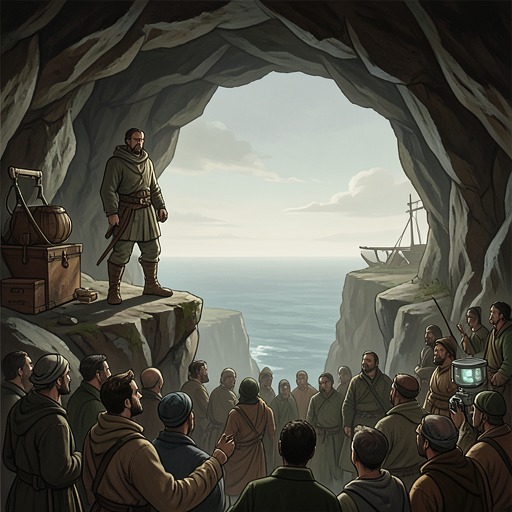
Zarathustra is thirty when he leaves his home and Lake Urmi for the mountains. He spends ten years there enjoying his spirit and solitude, without growing weary of that life. The descent therefore follows a long, sustained withdrawal rather than a brief retreat. Its decisive change comes only when his heart turns: one morning, at dawn, he rises and steps before the sun. The movement begins in a deliberate gesture toward the light that has accompanied his solitary years.
The sun has come up to his cave every morning, and Zarathustra reflects that its light and journey would have grown wearisome without him, his eagle, and his serpent. He and his companions have waited for the star, received its superfluity, and blessed it. The exchange makes solitude something more than separation: even in the mountains, Zarathustra’s life has been organized around receiving and responding to an abundance. Now the direction of that exchange is about to change. He no longer wants only to receive what is offered; he has become full enough to give.
Wisdom as an overflowing gift
Zarathustra describes himself as weary of his wisdom, comparing his condition to that of a bee that has gathered too much honey. The weariness is not a rejection of what he has learned. It arises because wisdom held in isolation has become excess, and he needs hands extended to receive it. His wish is to distribute it until the wise among human beings can again be happy in their folly and the poor happy in their wealth. The descent thus has a stated purpose: to carry what has accumulated in the mountains into a human world that, in his hope, may be changed by receiving it.
The image of the bee is joined by the sun’s evening journey behind the sea, where it brings light even to the underworld. Zarathustra takes that descent as his model. The movement downward is both geographical and purposeful: he must go down to those among whom he intends to live and share his wisdom. The sun’s apparent loss of height becomes a pattern for giving light beyond its familiar sphere, so that Zarathustra’s departure reads not as a retreat from his former life but as its outward continuation.
The cup and the beginning of the journey
The address to the sun becomes a request for blessing. Zarathustra asks it to bless the cup that wants to overflow, so that its golden waters may carry the reflection of the sun’s joy across the world. The image gathers the passage’s logic into a single object: what has filled the cup cannot complete its purpose by remaining contained. Its abundance is measured by what can flow from it and reach others. Zarathustra’s wisdom, like the cup’s contents, is presented as something meant to be given away.
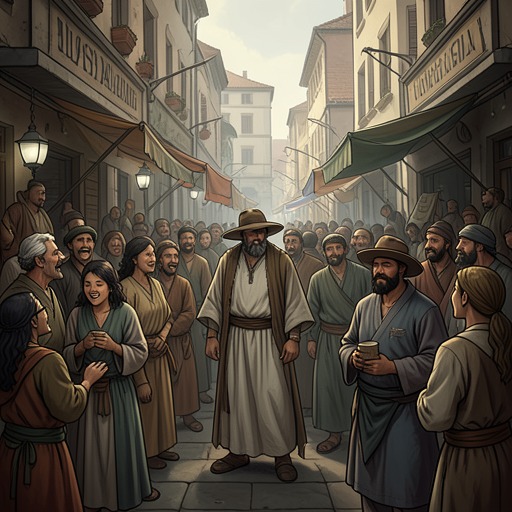
Yet the cup must also become empty again. Zarathustra wants to be human again, a desire that makes the descent a return to human company as well as a departure from the mountains. The passage does not portray this change as effortless: the wish to give and the wish to become human again mark a threshold between a completed period of solitude and an encounter not yet begun. The opening names the threshold rather than resolving what the people he seeks will make of his gift.
Narrative function and immediate aftermath
The words that close the scene identify this turning as the beginning of Zarathustra’s down-going. That declaration makes the dawn address a narrative threshold: the ten years of mountain solitude are the history behind the decision, while the descent opens the action to come. Its central reversal is one of direction and relation. Zarathustra moves from receiving the sun’s superfluity to wanting to distribute his own, and from solitude toward people.
He goes down alone, and no one meets him on the way. When he enters the forest, however, an old man appears, having left his holy hut to look for roots. This first encounter follows immediately upon the declared beginning of the descent. The intended passage from solitary wisdom to human contact therefore starts not with a crowd awaiting Zarathustra, but with a solitary meeting in the forest. The episode closes its opening movement on that contrast: Zarathustra has chosen to descend toward others, yet the first person he meets is himself a figure who has withdrawn from ordinary company.