Zarathustra’s Eagle and Serpent
Thus Spoke ZarathustraZarathustra’s Eagle and Serpent are the steadfast animal companions of Zarathustra’s mountain solitude, and the first witnesses to his changing inner life. They share his cave, accompany his reflections on the dangers of human company, and return to his side when a new happiness appears. Their actions are spare but consequential: they wait with him, come seeking him, and regard him with amazement, while Zarathustra reads their presence as both companionship and guidance.
Identity and Introduction
The pair belong to the secluded mountain world in which Zarathustra has spent ten years. When he turns at last from that solitude toward other people, he addresses the sun and recalls that it has risen to his cave for a decade. The sun, he says, would have tired of its light and its journey without him, his eagle, and his serpent. Each morning the three have waited for it, received its superfluity, and blessed it in return. The image places the animals within a daily rhythm of mutual giving: they are not introduced as ornaments to Zarathustra’s retreat, but as companions sharing its repeated encounter with the sun.
That long companionship frames Zarathustra’s decision to leave. He likens himself to a bee that has gathered too much honey and now needs hands extended to receive it. The animals are present at the point where private abundance becomes a need to give outward. The passage does not describe them speaking or instructing him; their importance comes from the place they occupy beside him as he moves from stored wisdom toward an audience.
The Pair on Zarathustra’s Dangerous Road
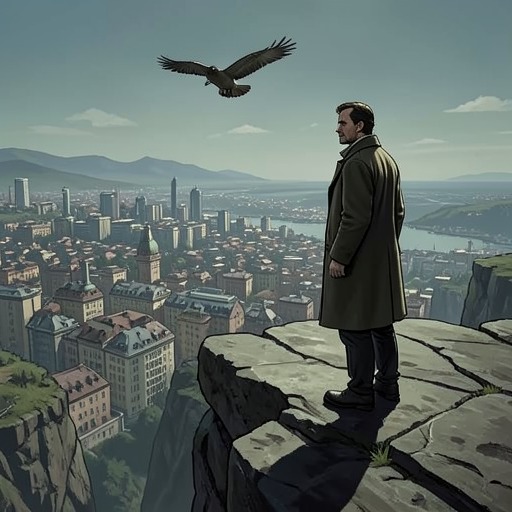
At noon, while Zarathustra is intent on his goal and declares his determination to press forward, a sharp bird cry draws his attention upward. The eagle sweeps through broad circles, carrying the serpent coiled around its neck. The narration distinguishes this bond from predation: the serpent hangs there not as prey but as a friend. Their arrival is a recognizable reunion, and Zarathustra rejoices that his animals have come.
Zarathustra interprets the visit as reconnaissance. He says the pair have come to discover whether he is still alive, then measures the hazards of his chosen path against the safety of animal company. In his judgment, he has found human beings more dangerous than animals, and he asks the animals to lead him. The scene gives the companions an active role: they have crossed the distance to seek him, and their presence answers his uncertainty about the perils ahead. Yet the text does not make them guides through any described act of direction; their leadership remains Zarathustra’s appeal to them, grounded in the trust he places in their companionship.
Pride, Wisdom, and Their Contrast
Zarathustra calls the eagle the proudest animal under the sun and the serpent the wisest. Those descriptions establish a contrast within the pair without turning it into rivalry. The serpent’s body is literally gathered around the eagle’s neck, and the image of friend rather than prey makes their closeness visible. Their differing attributes coexist in a single formation: pride carries wisdom, while wisdom is bound to pride.
Zarathustra takes that contrast into his own self-questioning. He wishes he were wise from the heart, as the serpent is, but acknowledges that he may be asking the impossible. He therefore wants pride to accompany wisdom; if wisdom flies away, he hopes pride will fly with his folly too. The animals do not state this principle themselves. Rather, their juxtaposition gives Zarathustra a vivid occasion to think about the qualities he lacks, wants, or needs to keep together. The serpent becomes his comparison for wisdom, while the eagle’s pride supplies the counterweight he asks to retain.
Witnesses to Zarathustra’s Change
Later, after Zarathustra has spoken of enemies who have distorted his doctrine and friends who are lost to him, he springs up with the bearing of a seer and singer. The eagle and serpent look at him in amazement. Their response accompanies the dawn-like happiness lighting his face, and Zarathustra asks whether he has changed and whether bliss has come upon him like a storm wind. He also recognizes that his happiness is still young and may speak foolishly, asking that it be treated with patience.
The animals’ astonished gaze marks the change without explaining it: they are witnesses, not interpreters, of the new happiness. Across these scenes, they occupy a stable place beside Zarathustra while the relation between solitude and outward mission shifts. First they wait with him through the mornings at the cave; then they seek him on a dangerous road; later they watch his happiness emerge. Their quiet presence links the abundance he has gathered in solitude to the risks, doubts, and transformations of his life among people.