Zarathustra’s First Sermon at the Marketplace
Thus Spoke ZarathustraZarathustra’s First Sermon at the Marketplace stages the collision between Zarathustra’s call to overcome humanity and an audience that has come for a spectacle and prefers a promise of easy happiness. He presents the Superman as the meaning of earthly existence, yet his address does not win the crowd: laughter and interruption expose the distance between his vision and the listeners’ desires. The sermon’s failure is not incidental to its meaning; it becomes the event’s decisive outcome.
Setting and Occasion
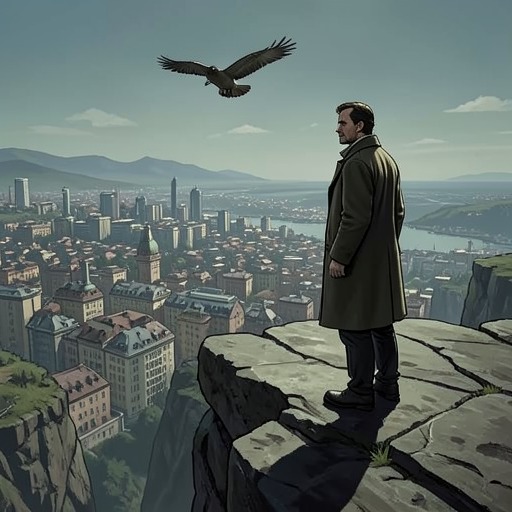
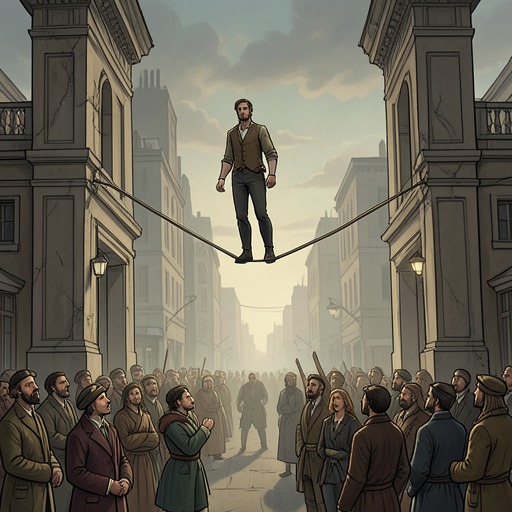
After reaching the nearest town beside the forest, Zarathustra finds a crowd assembled in the marketplace. A tight-rope walker has been announced, and the people are waiting to see him. Zarathustra speaks into this gathering, but its attention already belongs to a public performance. The setting gives his address an immediate contrast: he asks the crowd to consider humanity’s future, while the crowd expects entertainment in the present.
He begins by teaching the Superman and asking what the people have done to overcome humanity. His argument places human beings within a succession of creatures that have created something beyond themselves. To turn back toward the animals instead of surpassing humanity, he warns, would be to become the ebb of that tide. The ape supplies his pointed comparison: as the ape is a laughing-stock or painful embarrassment to humanity, so humanity may become to the Superman. The image makes overcoming neither a comfortable improvement nor a matter of self-congratulation; it subjects the audience itself to the prospect of being outgrown.
The Earthly Meaning of the Superman
Zarathustra insists that the Superman is the meaning of the earth and urges his hearers to will that meaning into being. This claim gives his teaching a direction within earthly life rather than beyond it. He tells the crowd to remain true to the earth and rejects the hopes of those who promise a superterrestrial destination. In his account, such hopes express contempt for life and poison the people who embrace them, whether or not they recognize what they are doing.
His imagery intensifies the demand. Zarathustra describes himself as a prophet of lightning and a heavy drop from a cloud, then names the lightning as the Superman. He also asks where the lightning is that will lick the audience and where the madness that will cleanse it can be found. The Superman is thus presented not as a placid ideal but as a disruptive force, bound to a transformation that the hearers must endure. These images make the speech sound like a summons to rupture; they do not, however, give the crowd a language in which it can receive the summons.
A Sermon Misheard
When Zarathustra finishes this part of his address, one of the people calls for the tight-rope walker, saying that the crowd has heard enough and wants to see him too. Everyone laughs. The tight-rope walker, taking Zarathustra’s words as if they applied to him, begins his work. The moment turns the speaker’s comparison into a misunderstanding enacted before the audience: Zarathustra’s account of humanity being surpassed is heard as though it referred to the performer about to cross the rope.
Zarathustra looks at the people and falls silent. He recognizes, in words addressed to his own heart, that they are laughing and do not understand him; he is not the mouth suited to these ears. His questions about whether he must shatter their ears or thunder like a preacher register the communicative impasse, not a change in his teaching. The people take pride in what they call culture, a distinction they draw between themselves and goatherds. But this self-assurance has not prepared them to understand the challenge he has brought. The address exposes a gap between the audience’s confidence in its own standing and Zarathustra’s demand that humanity become something beyond itself.
Interruption and Aftermath
The scene ends not with agreement but with a shouted alternative. The people ask Zarathustra to give them the Ultimate Man and make them into that figure, while telling him that they can do without the Superman. They laugh and shout, interrupting the discourse. The contrast is exact: Zarathustra asks for a transformation that would overcome the human, while the crowd chooses a future it can imagine as its own settled happiness. Earlier, the Ultimate Men are associated with small pleasures by day and night, respect for health, and the claim that they have discovered happiness. Against that vision, the Superman represents risk and upheaval rather than comfort.
The crowd’s response leaves Zarathustra sad. He again concludes that he is not the mouth for these ears and wonders whether his long solitude among mountains, trees, and streams has left him speaking to the townspeople as if they were goatherds. The narrator identifies the passage as Zarathustra’s first discourse, also called the Prologue, and the interruption supplies its ending. The event therefore introduces both his central teaching and the difficulty of communicating it: the audience does not merely fail to grasp the Superman but openly prefers the Ultimate Man. The marketplace’s laughter is the first public measure of the distance between Zarathustra’s hope for human overcoming and the crowd’s appetite for an attainable, modest happiness.