Zarathustra’s Mission to Humanity and His Alienation from It
Thus Spoke ZarathustraZarathustra’s Mission to Humanity and His Alienation from It turns on a contradiction that never resolves into simple withdrawal: Zarathustra recoils from the human world as he finds it, yet remains oriented toward humanity as a future possibility. He sees people as fragments rather than complete beings and regards the present and past as an intolerable burden. His answer is not to abandon humanity, but to become a seer and bridge to what may come, gathering scattered fragments toward a future whole. Even this mission leaves him burdened by his position on the bridge: he is both creator of a future and, in his own image, a cripple upon the way to it.
Seeing Humanity as Fragments
After speaking to the Hunchback and those for whom he speaks, Zarathustra turns to his Followers and describes his experience among people as movement among broken pieces and limbs. The image is not confined to the present. When his attention turns backward to human history, he sees the same fragments, limbs, and dreadful chances, but no whole human beings. The continuity between past and present makes the sight a burden rather than a passing disappointment: history has not, in his view, overcome its fragmentation.
That perception also shapes his own uncertain identity. Zarathustra asks what his Followers might call him, setting possible roles against one another: promiser or fulfiller, conqueror or inheritor, physician or convalescent, liberator or subduer. The sequence offers no settled title. His relation to humanity is correspondingly unsettled: he is not simply its healer or its judge, but a figure whose work is directed toward a future that does not yet exist. The questions make the distance between his purpose and the present visible without reducing him to a single function.
A Bridge Toward the Future
Zarathustra locates his capacity to endure the present and past in his vision of what must come. He describes himself as a seer, a creator, and a bridge to the future, while acknowledging that the bridge is also a place of impairment. His image holds promise and limitation together: he can look beyond the broken condition of humanity, but he does not claim to stand outside it untouched.
His stated art and aim is to compose what is fragmentary, enigmatic, and governed by dreadful chance, bringing it together rather than merely lamenting it. He also attributes to humanity the capacity to be poet, reader of riddles, and redeemer of chance. This makes his future orientation more than prediction. The hoped-for change depends on acts of interpretation and creation: what appears scattered or accidental may be given a new relation and meaning. The mission is therefore aimed at transformation, not simply escape from the human world.
The Conflict over Virtue and Happiness
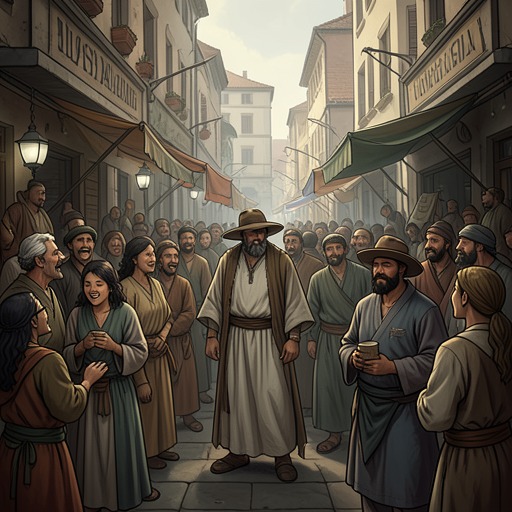
Zarathustra’s estrangement becomes social and immediate when he walks among a people whose virtues do not inspire his envy. He says that they peck at him because he tells them that small people require small virtues, while he finds it difficult to understand why small people should be necessary. His comparison of himself to a cockerel in a strange farmyard, pecked even by hens, makes his position vivid: he is an outsider among the people he addresses. Yet he adds that he is not unfriendly to them, a qualification that keeps criticism distinct from simple hostility.
The disagreement is also embodied in a contrast between movement and ease. The people would draw him toward small virtue and the tick-tock rhythm of small happiness, but that measured beat neither moves his foot to dance nor lets it stand still. Zarathustra judges their doctrine of happiness and virtue to be making them smaller. Because they want ease, they remain modest even in virtue; their way of striding forward becomes, in his account, a limp that obstructs anyone in a hurry. The conflict is thus not merely over which virtues deserve praise. It concerns the kind of life their ideals encourage, and whether comfort can serve as a sufficient measure of human flourishing.
The Return and the Gift
Despite his alienation, Zarathustra does not treat separation as his final aim. He awaits his redemption so that he may go to people once more, and wants to descend among them for the last time in order to give them his richest gift. The language of waiting makes the return conditional: the mission has not yet reached its moment of completion. His intended departure among people is also cast as giving, not as winning their approval or securing reciprocity.
The sunset supplies an image for that generosity. Zarathustra recalls a star pouring its gold into the sea from inexhaustible riches, so that even the poorest fisherman rows with golden oars. He says that witnessing this once moved him to tears. The image connects abundance with a gift that reaches the poor without diminishing its source, and gives concrete shape to his wish to go among humanity again. His relation to people therefore remains divided but not severed: he sees their present condition as diminished and unbearable, yet imagines a future-oriented gift as the means of returning to them. The bridge between estrangement and renewed approach is the hope that what is given can help transform what is fragmented.