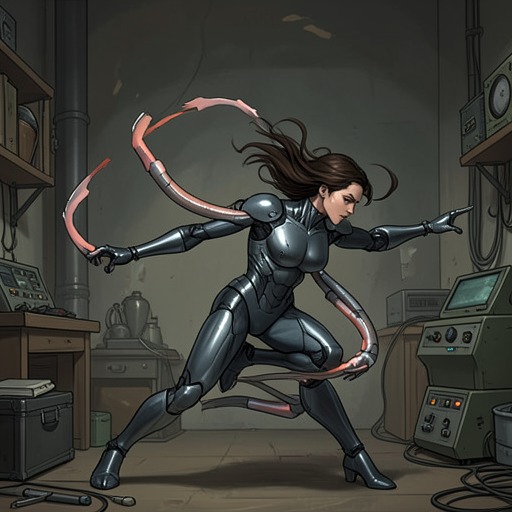
“A body that tells a story”
Tinea and Leah: [Cyberpunk, Alien Incursions, Murder and Mayhem, Girl's Love (WLW)]“A body that tells a story” names Tinea’s attempt to make physical transformation into an intelligible autobiography. Her completed form is not treated as mere equipment or decoration: its eyes, hands, mouth, chest, hips, limbs, and distinctive nail are chosen to preserve competing parts of her history while directing the person she hopes to become. The body therefore records vulnerability, affection, sexuality, care, violence, and the effort to find balance among them.
Design as Self-Interpretation
Tinea begins from the premise that samurai are extraordinarily resilient, yet even a samurai can crack under enough pain and pressure. Against that background, her transformation becomes an inquiry into what a body can say when ordinary explanation is insufficient. Looking in the mirror, she had previously reminded herself that there was no reason to hate herself; vanity had apparently found nothing to grasp. The new process is different. She discovers an unfamiliar desire to become more beautiful, and that discovery itself keeps her moving through exhaustion rather than merely serving as an ornamental project.
The design process makes appearance inseparable from identity. Tinea does not select features only for attractiveness or combat efficiency. She asks which version of herself each feature should embody: the lonely child, or the idealistic and chronically depressed adult who may eventually find happiness. The body must hold contradictory histories without pretending that one has erased the other. Its beauty is consequently interpretive: it is meant to be read as a record of what Tinea has endured, wanted, feared, and chosen.
The Hands and the Question of Action
The hands cause Tinea the greatest difficulty because they are the part of herself she sees most and therefore a major part of how she perceives herself. Their design forces the central practical question of the transformation: what does she want to do? They could be hands made for hugging and petting, safe and strong enough to hold a baby for hours, or hands suited to slaughtering Antithesis with spears. They could comb the hair of a lover and daughter, or express the capacity for violence required by her life as a fighter.
Tinea recognizes that her wish to give others everything and hold them tightly could become a sick dependency. She therefore rejects both indiscriminate self-sacrifice and the fantasy of possessing another person through care. The hands are meant to remind her to find the right balance: to give only as much as she is permitted to take, to remain capable of being alone, and still to hold love and share it with someone special. Their adult grace, small scale, long fingers, and piano-like appearance embody neither childish softness nor crude force. They are designed as a disciplined compromise between tenderness and strength.
The Golden Path
The most explicit emblem is placed on the nail of the right ring finger. Tinea considers a colored nail as a metaphorical knot in a handkerchief, a small visible reminder that can survive distraction. Recalling an old saying from Germany, where she grew up, she turns the search for a happy medium into the image of the golden path. The nail bears a wavy gold line, like a meandering path, surrounded by black.
The mark carries several linked instructions. It should remind Tinea to remain balanced even when balance is difficult, to accept wavering without treating it as permanent failure, and to find her way back to where she ought to be. The path ends in a bright light, connecting equilibrium with candor: she is to keep speaking her thoughts. The symbol does not promise a straight or effortless route. Its waviness gives instability a place within the design while preserving return, direction, and the possibility of illumination.
The Completed Body and Its Limits
When Tinea finishes, the body is presented as a composition whose parts speak across one another. The hands speak for themselves; the eyes invite love and kindness; the lips return affection. The hips are imagined as capable of carrying a shared future, while the chest is associated with nurturing that future. Her butt, legs, and arms are retained as features that had already been remarkable, and the whole design is packed into a height of one hundred and sixty centimeters.
This catalog of parts is more than a list of idealized anatomy. Each feature is assigned a relational or ethical function. Seeing is connected to inviting kindness, the mouth to answering affection, the chest to nurture, and the lower body to a future shared with others. Even the attractive elements are made answerable to a story rather than allowed to stand as empty perfection. The completed body can be understood only by someone willing to listen to it, because its meaning lies in the connections among its features and in the commitments they preserve.
Trauma, Care, and the Meaning of Embodiment
The phrase also gains force from later scenes in which bodies reveal experiences that language cannot immediately control. When Leah enters a flashback, she does not respond to Tinea’s attempts to reach her; there are only empty sobs. Tynea identifies the episode and warns that touching someone in a flashback can ordinarily trigger bad memories, while observing that the existing contact does not appear to be doing so. Tinea is told not to seek additional contact, to avoid sudden movement, and to speak gently while reminding Leah that she is experiencing a flashback and encouraging slow, deep breathing. Leah’s body thus tells a story before she can narrate it, but that story must not be seized or interpreted through force.
The same principle shapes the later discussion of prevention. Tinea asks how to stop such episodes from happening again, and Tynea explains that she cannot solve Leah’s health by becoming Leah’s entire support system. Leah must build herself up until she can rely on her own person; a relationship may help, but it must not turn her into a dependent extension of her partner. Professional care, rather than total romantic rescue, is required. This gives “A body that tells a story” an ethical boundary: embodied signs deserve attention and compassionate response, but recognizing a story does not grant another person ownership of it.
Leah can later warn Tinea when an episode is coming. During an episode, questions take much longer to penetrate and answers take longer still, so the appropriate response is to keep her safe and comfortable, talk patiently, and mostly let the episode run its course. The body’s testimony is therefore neither a decorative metaphor nor a simple code that another person can instantly decipher. It is a demanding, sometimes delayed form of communication. Tinea’s transformed body answers that difficulty by making its own story deliberately legible, while her care for Leah teaches that legibility must remain compatible with autonomy.