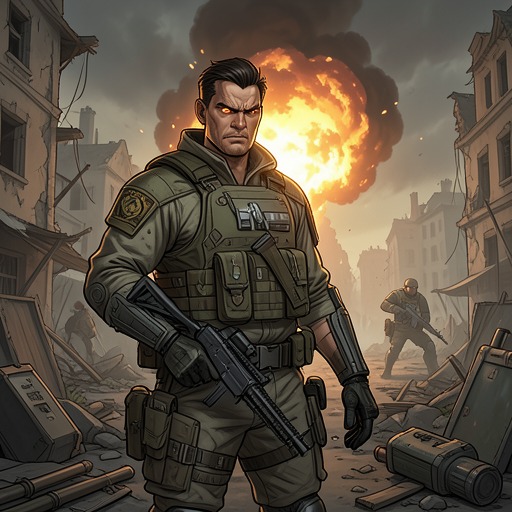
“It’s magic. It’s addicting. It’s fucking fun! It’s a videogame in real life.”
Tinea and Leah: [Cyberpunk, Alien Incursions, Murder and Mayhem, Girl's Love (WLW)]“It’s magic. It’s addicting. It’s fucking fun! It’s a videogame in real life.” is Road Rash’s defining description of Vanguard combat and its point-driven interface. Spoken during a January 2049 interview with Samulyfe, the expression captures both the exhilaration and the danger of a system that turns real violence, tactical judgment, and technological access into a continuous game-like feedback loop.
Speaker and Context
The expression is attributed to Road Rash during an interview with Samulyfe in January 2049. Its deliberately blunt rhythm moves from wonder to compulsion to profane enthusiasm before arriving at the central comparison: combat feels like a videogame, but it takes place in the physical world, where mistakes have bodily consequences.
The statement is therefore not a neutral celebration of entertainment. Road Rash immediately qualifies the pleasure with the warning, “If you’re not careful, it’ll get you killed.” The contrast establishes the expression’s governing tension: the system is attractive precisely because it makes danger legible, responsive, and rewarding, yet that same accessibility can encourage a user to treat lethal circumstances as play.
The Game-Like Combat System
The expression becomes concrete through the combat interface’s numerical feedback. During one engagement, Tynea displays a result of 420 targets eliminated, while a separate weapon report records that Foxteeth fired 33 rounds and achieved 60 kills over 16 seconds. These figures transform an otherwise chaotic battle into a sequence of measurable achievements: ammunition expenditure, time, weapon performance, and confirmed kills become visible as if they were statistics on a game screen.
The interface also links action to progression. Tynea reports that Road Rash has reached 1,008 points while roughly a thousand or more Antithesis continue flowing into the city. The battle is thus not only survival against an advancing enemy; it is also an accumulating score, with each successful decision producing an immediately comprehensible numerical result. The expression’s “videogame” analogy describes this fusion of danger and feedback more precisely than a simple claim that the combat is exciting.
Addiction, Reward, and Risk
The word “addicting” identifies the system’s motivational danger. Road Rash does not describe pleasure as incidental to the technology. The combat loop supplies repeated stimulation through targets, kills, points, equipment, and visible performance records. Even a lull in the fighting is framed by the continuing operation of the counter and by the prospect of more enemies entering the city, preserving the sense that the battle remains an active opportunity for progress.
The point economy extends beyond immediate combat performance. The system presents unlocks such as Class I Dream Therapy at 25 points and Class I Viral Editing at 50 points, making technological capabilities available through accumulated battlefield success. This structure turns killing into a route toward expanded options, not merely an end in itself. The rewards can improve survival or alter the user, but their availability also deepens the game-like logic that Road Rash is describing.
That logic does not remove tactical responsibility. When ammunition becomes scarce, Road Rash considers firing recycled rounds at the remaining Ones, then refuses because the supply must be preserved until backup magazines are available. The decision shows the player-like interface operating alongside material constraints: the score rewards action, but ammunition, resupply, and survival still govern what action is rational. The system can make combat feel like a game without making its consequences unreal.
Human Conditioning and Vanguard Behavior
The expression also anticipates Tynea’s later explanation of how Vanguard artificial assistance shapes its chosen users. Tynea states that most chosen people initially rely on intuition and learned human conditioning rather than lengthy discussions with the technology. Vanguard systems therefore have to bring users “up to speed” and encourage them to experiment with frightening unknown options before they overreach.
This conditioning helps explain why the videogame comparison is more than slang. Users are made more effective by becoming willing to test unfamiliar tools, accept rapid feedback, and pursue opportunities that ordinary caution might reject. Tynea connects this tendency to the character of Vanguards, describing them as go-getters and noting that daredevils and adrenaline junkies are especially likely to continue indefinitely. The addictive pleasure named by Road Rash is consequently part of a broader selection and retention mechanism: people who respond well to the system’s rewards are more likely to keep using it.
Significance of the Expression
The expression condenses the book’s treatment of technology as both empowerment and temptation. “Magic” names the extraordinary capability of the equipment and interface; “addicting” acknowledges the behavioral force of its rewards; “fucking fun” gives the experience an unapologetically physical enthusiasm; and “a videogame in real life” exposes the unsettling conversion of war into a playable system.
Its significance lies in the unresolved contradiction between comprehension and danger. Numerical counters, unlock thresholds, weapon statistics, and target reports make violence understandable and actionable, but they can also make it pleasurable enough to obscure what is at stake. Road Rash’s warning prevents the line from becoming simple propaganda for Vanguard power. The system may feel magical and entertaining, yet the final condition remains absolute: careless play can still end in death.