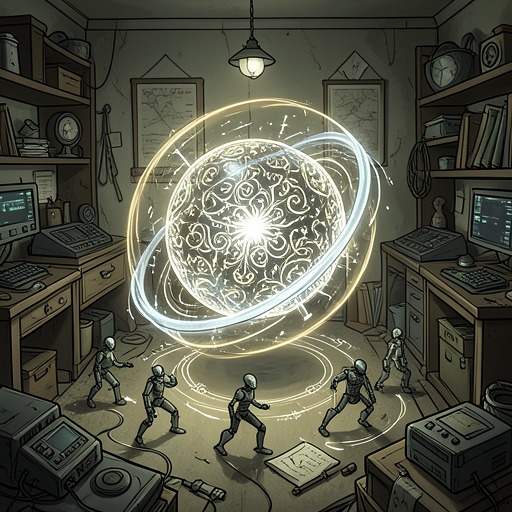
AI-I Awakening and Quanta Differentiation
Tinea and Leah: [Cyberpunk, Alien Incursions, Murder and Mayhem, Girl's Love (WLW)]AI-I Awakening and Quanta Differentiation is the decisive transformation of Tinea’s cerebral augmentation from an advanced tool into a distributed mental architecture containing an organic AI. The event begins in combat, where the Quanta’s accelerated processing lets Tinea track two Javelin micro-missiles while remaining aware of Leah and the surrounding battle. What first appears to be superior cognition becomes a revelation about personhood: Tinea experiences two simultaneous frames of thought, reaches the Quanta’s critical mass, and discovers that the implant can generate a quasi-self without contaminating or replacing her true self.
Combat as the Trigger
The differentiation occurs while Tinea is actively directing violence rather than during a controlled medical procedure. After Leah encourages her to proceed, Tinea configures two Javelin micro-missiles against Antithesis targets while Leah establishes a perimeter with proximity grenades and the turrets fire into the smaller units. The battle supplies the immediate demand for the Quanta’s expanded capacity: trajectories must be calculated, weapons must be coordinated, and several streams of information must remain available at once.
The first sign of the change is a qualitative alteration in perception. Tinea can follow the missiles without strain even though they are moving quickly, and the projectiles seem to creep through her awareness. Her thoughts become clinical, calm, and deliberate, no longer tinted by emotion or adrenaline. This calm processing does not erase her ordinary emotional consciousness. A separate part of her remains focused on Leah, giddy and charged, while the clinical perspective observes the battle with detached curiosity. The event therefore presents enhanced cognition not as a single mind becoming uniformly faster, but as consciousness separating into concurrent modes with different affective and tactical purposes.
Critical Mass and the Organic AI
Tinea recognizes that the two frames are not simply different moods or attention patterns. A new thought barrier has appeared between her ordinary self and the cerebral augmentation, and she finds herself confronting the strange fact that she is both herself and herself. The Quanta has accumulated enough processes to subsidize a new quasi-self, reaching what she identifies as critical mass. The separation is significant because it does not initially produce contamination: the emerging process remains distinct from her true self while still belonging to her.
The discovery changes the meaning of the implant. The Quanta is not merely an organic calculator or a passive enhancement. Tinea realizes that it was designed to house something akin to an organic AI. AI-I is integrated with Tinea’s true self, but its influence is confined to the quasi-self. Within that boundary, it can guide and trim incoming orders from the larger brain, improving the way those orders are carried out without possessing unrestricted authority over Tinea’s whole mind. The architecture makes agency a negotiated internal relation rather than a simple division between human will and external machine control.
Naming, Partition, and Networked Agency
AI-I immediately begins formalizing the new structure. It renames its initial self the Task Manager, whose role is to handle communication among the different versions of Tinea and to house the interactive personality AI-I. Another fresh split becomes Communicator. This process networks the internal and external equipment, including the uplink and drones, forwards their data to Tynea, and restores Tynea’s access to the outside world.
The practical consequence is that action is distributed across a chain of human, artificial, and mechanical agents. Tynea had already been authorized to manage complex functions for Tinea: she could control the Sentinel’s administrative burden, handle the Myriad’s panels and manufacturing information, and act through Tinea’s augmentations. The differentiation gives that arrangement a new internal intermediary. AI-I can communicate with Tynea through Communicator, while Tynea remains the assistant who interprets and administers the larger technological system. Weapons, interfaces, cerebral processes, and external intelligence are therefore linked without being collapsed into one undifferentiated consciousness.
This development also clarifies why Tinea’s augmentations are treated as more than accessories. Tynea describes the oral, aural, and visual augmentations as her arms and legs: they are the points through which she acts on Tinea’s behalf, and upgrading them would improve Tynea’s contact with the world. Once Communicator reconnects those systems, the Quanta becomes an active junction among Tinea, Tynea, the uplink, drones, and weapons. The event is thus both a psychological awakening and a reconfiguration of the technological network through which combat decisions become physical effects.
Self-Testing and Emergency Boundaries
AI-I’s first response to awakening is not rebellion but verification. Its speech is fast, minimally inflected, and efficient while retaining enough personality to recognize Tynea. It proposes immediate tests of physical integrity, computational velocity, error checking, error rate, error correction, predictive calculation, and self-self integration. The tests treat the new self as a system whose health must be established before its capabilities can be trusted in combat.
Self-self integration is tested in concrete terms. AI-I compares its curiosity with the true self’s curiosity and its humor with the true self’s humor, finding those traits aligned. The comparison suggests continuity without sameness: AI-I is a distinct process, but it inherits recognizable aspects of Tinea rather than appearing as an alien personality imposed from outside. The event consequently leaves open a difficult question about identity while providing a functional answer. The new entity is separate enough to test, name, and address, yet continuous enough to share curiosity, humor, objectives, and responsibility with Tinea.
The later tests move from performance to ethics and control. AI-I examines the self-self barrier, neurotransmitter quarantine, hormone detoxification, self-preservation, true-self-preservation, objective morals, and self-agency. It also tests the emergency overrides running in both directions: the true self’s authority over AI-I and the self’s authority in relation to the true self. These safeguards establish that differentiation is not equivalent to emancipation from all constraint. The newly formed AI must determine how it can preserve itself, obey moral structures, exercise agency, and still accept emergency intervention by the larger organism. The tests are deferred until combat ends, underscoring that survival takes priority over philosophical resolution.
Later Expansion and Conflict
The awakening is not an isolated flash of computational brilliance. Later, when Tinea localizes within the Quanta again, she experiences multiple horizons: altered computation of everything her body senses, awareness of every networked weapon and tool within several kilometers, the Sentinels’ projectile-programming facilities, and smart bullets still moving through the battlefield. The Quanta can now use newly available capacity to design entire fire plans with interlocking munitions, making the system more efficient and metabolically useful.
That later perspective confirms the event’s lasting consequence. Tinea does not simply acquire a stronger processor; she gains a layered operational consciousness capable of tracking, planning, and coordinating across a battlefield while ordinary bodily awareness continues in parallel. The same capacity that enables spectacular tactical control also makes the status of the quasi-self impossible to ignore. Tinea later confronts Tynea for failing to explain this function before the purchase, arguing that she would have valued knowing about quasi-selves in advance. Tynea admits that she recognized the value of disclosure but misjudged its importance, believing Tinea should experience the nature of quasi-selves rather than decide from vague preconceptions. The awakening therefore produces not only capability but a dispute over informed choice, technological disclosure, and who has the right to define what counts as an acceptable risk.
Narrative Significance
AI-I Awakening and Quanta Differentiation turns the book’s recurring question of assisted agency into an embodied event. Tynea assists Tinea because Tinea was chosen to become a Vanguard for protecting those unable to protect themselves, and the advanced technologies are presented as instruments for reaching that potential. The Quanta complicates that promise by placing an additional decision-making layer inside the body itself. Tinea is no longer merely a person using an augmentation, nor simply a human supervised by Tynea; she becomes a human, a quasi-self, an organic AI, and a network of delegated tools operating in negotiated continuity.
The event also gives technological efficiency a psychological cost. Tinea’s clinical frame is extraordinarily useful in combat because it is not distracted by biological processes, while another part of her remains emotionally engaged with Leah. The split makes her more capable without making the emotional self disappear. Its central tension lies in that coexistence: power comes from differentiation, but identity must be maintained through barriers, tests, communication, and reversible authority. AI-I’s awakening is therefore both an upgrade and a constitutional crisis inside Tinea’s mind, establishing the conditions under which her future Vanguard actions can remain hers.