Antithesis plant infestation state
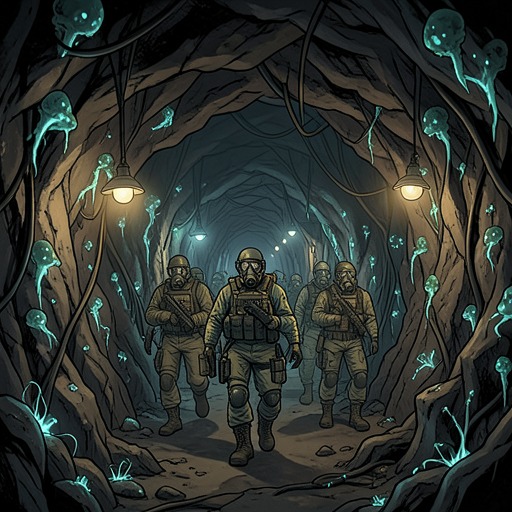
Tinea and Leah: [Cyberpunk, Alien Incursions, Murder and Mayhem, Girl's Love (WLW)]The Antithesis plant infestation state describes the transformation of a living or subterranean environment into an Antithesis breeding, feeding, and defensive system. It is not merely the presence of hostile organisms. The infestation reorganizes terrain, plant matter, animal behavior, water, and human strategy around the nest, making the environment itself part of the Antithesis threat. In the narrative, this state reaches its most consequential scale at a former mountain with a ringlake hundreds of miles north-northeast of Montreal, while later plans to use Pulvinophages against plant muscles show that the infestation remains an active problem requiring specialized biological countermeasures.
Definition and Ecological Operation
The infestation is presented through a distinctly nonhuman logic of scent, reproduction, territorial memory, and collective selection. Beneath Saint-Eustache, New Montreal, an Antithesis creature detects meat-food through olfactory receptors and taste structures in its three-hinged jaw. Once it identifies suitable food, it drags the material toward the home-place, following established trails associated with hunting and danger while marking the route with pheromonal signals. The nest is therefore not a passive hiding place: it is a mapped chemical territory whose paths, resources, and reproductive spaces coordinate the colony’s activity.
At the home-place, the creature passes the birth-wood as fluid-filled sacks break open and new Antithesis organisms emerge. Other members of the colony smell the newborns and accept those that carry the correct communal scent. A malformed young organism is treated as sick and wrong rather than protected as an individual. The observing creature attacks it, tears it apart, and is joined by other Antithesis organisms that destroy it quickly. This episode reveals an infestation whose ethics are expressed through collective sensory recognition and reproductive fitness. Nest life is simultaneously nourishment, reproduction, surveillance, and culling.
Scale at the Ringlake Site
The most dramatic recorded infestation occupied a former mountain and ringlake several hundred miles north-northeast of Montreal. About thirty days before the account, a samurai identified the entire area, especially the central mountain, as clogged with Antithesis. The density of organisms was so great that conventional weapons were judged inadequate for clearing them individually. A large explosive solution was also rejected because it would have scattered Antithesis matter across the surrounding region, potentially creating enough new viable material to seed additional nests.
The response was a flood of acid powerful enough to eat through hundreds of meters of rock and Antithesis nest. The operation did not simply kill an enemy force; it excavated a new crater by dissolving the geological structure that had contained the infestation. The result was a landscape in which military success and environmental damage became inseparable. The original penis mountain disappeared, while the ringlake remained but was lowered by dozens of meters and transformed into a toxic swamp.
The acid spent itself almost immediately, but its toxic byproducts remained. The water and fumes were described as dangerous for roughly fifteen hundred years, making the site a long-term hazard even after the Antithesis concentration had been destroyed. The infestation thus survives its own apparent defeat as a legacy in altered geology, poisoned water, and contaminated air. Its removal transfers the burden from combatants to anyone who might later enter, inhabit, or attempt to restore the damaged region.
Containment and Biological Countermeasures
Restoration efforts at the ringlake site involved covering the area with millions of tons of fresh soil and planting modified trees. Scientists reported that the intervention appeared to work, although the water remained noxious and fumes still surrounded the lake-turned-swamp. The trees were not expected to remain healthy, but they might eventually clean the site. This proposed recovery is necessarily uncertain: vegetation is both a victim of the contamination and one of the few available agents of repair.
The narrative later identifies a more targeted biological response. Tynea recommends bacteria that attack plant muscles, and the Pulvinophages are to be purchased, synthesized, and seeded into nutrition jars. The plan is connected to a future operation against a subterranean Antithesis nest: a swarm of drones is to scout the underground nest before a bombardment, followed by the destruction of the nest and disposal of the drone swarm. These measures show that the infestation is approached through layered intervention rather than a single weapon. Reconnaissance, engineered organisms, bombardment, and subsequent disposal are all required because the nest is simultaneously a biological system and a military target.
The choice of Pulvinophages also exposes the infestation’s material specificity. Antithesis nests cannot be treated as generic fortifications. Their relationship with plant muscles creates a vulnerability that ordinary firearms and missiles may not address, while also making the surrounding vegetation part of the tactical equation. The countermeasure therefore attacks the biological infrastructure that allows the nest to persist, not merely the visible creatures defending it.
Strategic and Narrative Significance
The infestation state repeatedly forces human and nonhuman actors to surrender the fantasy of clean destruction. Smart weapons can be configured to avoid decoys and prioritize threats, and autonomous systems can coordinate enormous quantities of ammunition, but the Antithesis problem still extends beyond targeting. A weapon that kills individual organisms may leave viable matter behind; an explosive that clears a nest may scatter its seeds; an acid flood may eliminate the colony while poisoning the region for centuries. The central difficulty is not only finding targets but preventing reproduction, dispersal, and ecological afterlife.
This makes the Antithesis infestation a condition of distributed agency. Antithesis organisms act through pheromone trails, nest structures, breeding sites, and collective responses; soil, acid, water, altered trees, bacteria, drones, and weapons each change what the others can do. Tynea’s administrative and tactical assistance, the autonomous Sentinel and Myriad systems, and the networked weapons available to Tinea further complicate responsibility: decisions are delegated across bodies, software, machines, and engineered life. The infestation is consequently best understood as a networked ecological war rather than a sequence of isolated creature encounters.
The nonhuman viewpoint beneath Saint-Eustache prevents the Antithesis from functioning only as an abstract enemy category. The creature’s sensory world is organized by food, scent, birth-wood, home-place, and the recognition of healthy or malformed offspring. That perspective does not make the infestation harmless, but it establishes that the colony possesses its own coherent environmental order. Against that order, extermination becomes an encounter between incompatible systems of life: one seeks to expand through nests and transformed matter, while the other seeks to reclaim territory without reproducing the catastrophe through careless force.