Earth
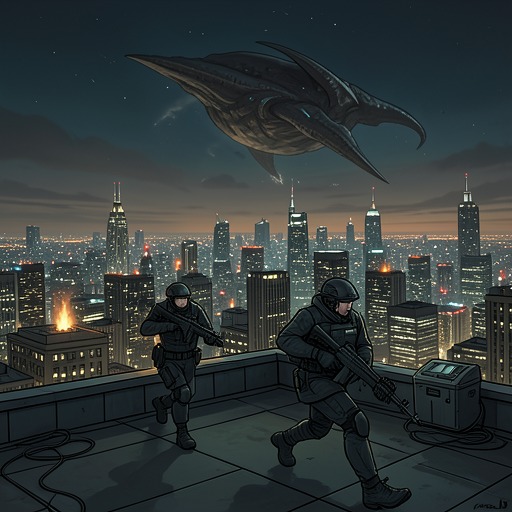
Tinea and Leah: [Cyberpunk, Alien Incursions, Murder and Mayhem, Girl's Love (WLW)]Earth is the setting in which the book’s human, artificial, and alien forms of life collide, and its decisive significance lies in how thoroughly the planet has become both habitat and weapon. Earth can still be named through familiar geography, especially Montreal and New Montreal, yet its surfaces and ecosystems have been altered by Antithesis expansion, advanced technology, biological engineering, and weapons capable of converting mountains into craters or molten ground into glass. The result is a world where survival depends on negotiating matter as much as on defeating an enemy.
A Familiar Planet Made Strange
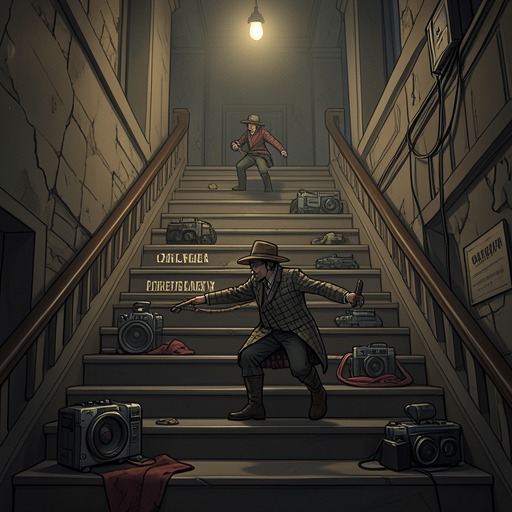
Earth remains legible through recognizable places, but the scale of transformation makes ordinary geography unstable. Beneath a ramp leading into New Montreal’s megacity proper, the suburb of Saint-Eustache contains an Antithesis environment whose inhabitants experience the location through scent, food, birth, trails, and nest security rather than human civic geography. The same planet therefore contains a megacity and an underground biological world, with the boundary between urban infrastructure and alien ecology reduced to a crack beneath a ramp.
The Antithesis perspective gives Earth a form of nonhuman place-memory. One creature recognizes good food by its association with home, birth wood, safety, and eating pools, then drags the food along established trails while marking the route with pheromones. At the nest, it passes birth wood as new Antithesis emerge from broken birth-fluid sacks; the colony smells each newborn, accepts those that smell right, and kills one that smells sick and badly grown. Earth is thus not merely the territory occupied by Antithesis. It is apprehended as a network of reproductive sites, inherited paths, chemical signals, and collective judgments.
Antithesis Ecology and Human Threat
Earth’s altered ecology creates dangers that cannot be addressed through conventional military assumptions. In the northern ringlake crater several hundred miles north-northeast of Montreal, a mountain once stood at the center of a ringlake. Antithesis filled the area, making direct destruction impractical. A samurai rejected the idea of simply detonating the whole site because scattering Antithesis matter across miles could have seeded new nests. The eventual solution was a vast flood of acid that consumed hundreds of meters of rock and nest material, excavating a new crater instead of dispersing the infestation.
This episode makes environmental consequence part of military calculation. The objective is not only to destroy an enemy concentration but to prevent its biological residue from becoming a new source of reproduction. Earth’s geology, in turn, becomes an active participant in the campaign: rock, acid, nest matter, and crater formation determine which strategies are safe. The landscape records the violence while also constraining it.
The same logic appears in the attempt to create an Antithesis Killer. The proposed poison would be made convincing by leaving behind a contaminant that could explain how the lethal agent came to exist in the first place. Tynea identifies a suitable bacterial species whose first generation originated from altered Antithesis cells designed by the Moonsingers. On Earth, an investigator might therefore conclude that the Antithesis had somehow brought about their own destruction when the slurry activated the bacteria. Biology is treated as evidence, weapon, and narrative cover at once.
Technology in Earth’s Material World
Earth’s technological limitations are repeatedly exposed by imported or transformed devices. A projectile examined by Tinea is described as so advanced that Earth could not produce comparable technology for hundreds of years. Its tip possesses extraordinary hardness and internal tension, while its body contains fine electrical lines, diodes, lenses, and other unidentified components. The device’s operation is equally disproportionate to terrestrial capability: it gates a small quantity of matter from the local sun to its target, where the matter expands explosively, with the discharge shape selectable in advance.
The contrast between Earth and samurai technology is not abstract. It appears in Tinea’s bodily interaction with equipment. After the chrysalis transformation, she begins learning how to weave silk by bundling her former gear and using the spinneret’s dissolving-agent setting to undo an uneven first attempt. The silk falls apart under the touch of the appendage, and the second attempt gives her better control over her tail. Earth’s technological world is consequently absorbed into an altered organism’s new material practice: clothing, weapons, silk, and bodily mechanics become one field of experimentation.
A later device catalog shows how far this material recombination extends. The spinneret’s tanks contain powdered ferrite, carbon dust, oxygen, water, a sticky flammable substance identified as napalm, concrete held in stasis, and copper powder. These materials allow threads ranging from pure iron to graphene and steel. On Earth, substances normally associated with construction, combustion, and industrial manufacture are transformed into resources for a living body’s adaptive production system.
The wing-mounted missile system likewise has to be designed around transformed flesh. The launch batteries cannot be covered by the actual wing arms, but magnetic catapults can fire missiles through the wing membranes without seriously harming them because the membranes are built to withstand such injury. The missiles activate their motors only at a safe distance. Earth’s biological constraints therefore do not simply resist technology; they become parameters within which technology is redesigned.
Craters, Glass, and Altered Energy
Earth’s surface is repeatedly rewritten by weapons whose effects exceed ordinary warfare. After a localized meteor storm, roughly fifty Antithesis Third Models remain, along with several Fourth Models and two badly burned Eighth Models still moving in pain. Tinea proposes loading nanites into the Eighth Models to remove the threat of future nests. The aftermath is measured not only in surviving enemies but in the possibility of continued biological occupation, so the damaged landscape remains a future security problem rather than a completed battlefield.
The most extreme transformation occurs where a Sol plasmatic warhead has struck. Tinea decides to leave the weapon in its own crater, treating the crater as a fitting grave. The ground has become glassy and intensely cold; heat detection shows no warmth except Tinea herself. Lines of warmth travel from her shield and from the point where she touches the glass, forming a crystalline grid before slowly dissipating through the cold material.
The cold is itself a technological consequence rather than a natural condition. The warhead reverses its teleportation after the plasmatic explosion and transports most of the thermal energy within a fifty-meter sphere away, normally to prevent nearby ordnance from detonating in a chain reaction. By stripping the energy from the blast zone, it instantly freezes the molten ground to temperatures far below zero. Earth’s matter preserves the weapon’s operation as a visible and tactile afterimage: glass, cold, heat lines, and a crater that serves as both evidence and tomb.
Narrative and Thematic Significance
Earth’s importance comes from its instability. It is simultaneously the home-world against which advanced technology is measured, the ecological territory interpreted through Antithesis senses, the source of ordinary materials repurposed by altered bodies, and the surface on which war permanently inscribes itself. The book’s conflicts do not take place above matter; they are generated through matter—silk dissolving and reforming, bacteria activated by slurry, acid eating through rock, missiles passing through membranes, and heat being removed from molten ground.
This treatment also unsettles the distinction between environment and character. The Antithesis do not encounter Earth as scenery but as a lived system of smells, trails, reproductive sites, food, sickness, and collective protection. Humans and transformed samurai likewise inhabit a planet whose technological and biological conditions reshape intention into action. Earth’s landscapes carry the consequences of every solution: destroying a nest risks dispersing it, a weapon leaves a frozen glass crater, and a megacity’s infrastructure conceals an alien home-place. The planet is therefore the book’s largest shared body—damaged, adaptive, and continuously remade by the forms of life struggling to possess it.