Flashback
Tinea and Leah: [Cyberpunk, Alien Incursions, Murder and Mayhem, Girl's Love (WLW)]Flashback is a trauma-related state that temporarily displaces Leah from the present, turning memory into an overpowering bodily and emotional reality. Its decisive significance lies in the contrast between the episode’s apparent helplessness and Leah’s later ability to recognize, explain, and manage it: the condition remains painful and unpredictable, but it no longer defines the whole of her life. The narrative therefore treats trauma as both an interruption of agency and a condition through which agency can be painstakingly rebuilt.
Definition and Embodied Experience
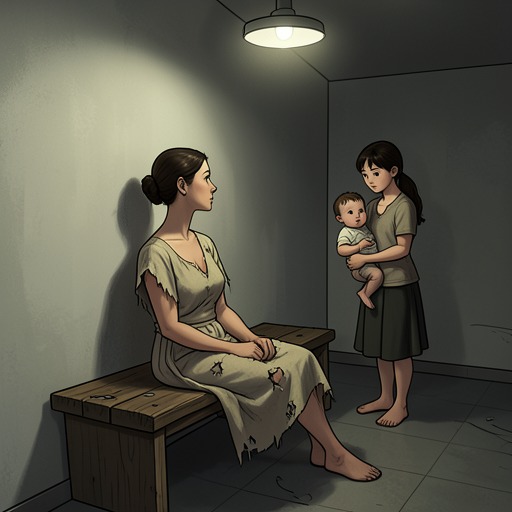
A flashback is marked first by a failure of ordinary communication. Leah’s earlier trauma is associated with a missing voice and an inability to release a proper cry; her distress emerges instead as broken, crippled keening and relentless crying. The state is therefore not represented as a neatly narrated recollection. It arrives through the body, through impaired speech, altered breathing, tears, shaking, and an absence of ordinary response. In the acute episode, Leah sags to her knees behind Tinea with heart-wrenching sobs that are not fully sobs, looking so broken that Tinea’s immediate emotional response is shock and panic.
The condition also distorts recognition. Leah is physically present, but she does not respond when Tinea calls her name, and her silence is described as empty rather than deliberate. Ypsilon identifies the episode as a flashback and warns Tinea that touching someone caught inside one can provoke bad memories. In this instance, existing contact does not appear to worsen the episode, but the warning establishes that care must be cautious rather than instinctive. The flashback makes Leah’s body present while her attention is inaccessible, creating a painful gap between proximity and connection.
The episode’s effects continue after Leah returns. In another occurrence, she wakes with a throbbing injury and blood at the back of her head, unable at first to understand why she is bleeding. Ypsilon explains that she has had a flashback. Leah’s immediate response is recognition rather than surprise: the event has happened before, and its recurrence is distressing precisely because she had believed it was over. The physical injury makes the state materially consequential; it is not merely an inward memory with no external cost.
Triggers, Duration, and Recurrence
Leah’s flashbacks can be prolonged and resistant to interruption. She explains that earlier episodes could last for hours, that nothing could shake her out of them, and that during the worst period she spent more time gone than present. The later episode lasts only a few minutes, a dramatic reduction that signals recovery without implying cure. She remains stressed, tired, and unhappy afterward, but she is no longer panicked or overwhelmed by guilt. Her own comparison between past and present supplies the clearest measure of change: the familiar condition has become shorter, less destructive, and more manageable.
The recurrence is also characterized by delayed recognition. Before the episode, Leah notices shaking hands and flashes of anxiety accompanied by misplaced guilt, but she misreads them as ordinary consequences of the day’s adventure and as emotions appropriate to the immediate situation. Because she believed the flashbacks had ended, she was not watching for their return. The state thus exploits the confidence produced by recovery: the assumption that an old danger has disappeared becomes the reason its warning signs are ignored.
Leah later describes the flashback as being like becoming a different person for a while. Yet the metaphor does not erase continuity. She knows the warning signs, understands that the episode increases the mental burden of every question, and recognizes that responses take much longer to arrive. The state involves temporary displacement, not the permanent destruction of Leah’s identity. Its recurrence exposes a vulnerable layer of her experience while also showing that she can observe and interpret that vulnerability from outside its most intense phase.
Immediate Care and the Ethics of Contact
Tinea’s response illustrates the precarious boundary between intimacy and intervention. When Leah becomes unreachable, Tinea initially wants to hug her, stroke her cheeks, wipe away her tears, and force a response. Tynea instructs her not to change anything or move quickly, but to speak gently, remind Leah that she is having a flashback, and encourage slow, deep breathing. Tinea follows this guidance by remaining near Leah, breathing audibly and steadily, and repeating that Leah may be stuck in a flashback while asking whether she can hear.
The care is collaborative rather than controlling. Tinea keeps Leah physically supported but avoids additional movement, while Tynea and Ypsilon provide an interpretation of what is happening and a practical protocol for responding. The aim is not to extract Leah from the episode through force. It is to preserve safety, reduce stimulation, and offer a bridge back to the present. Tinea’s tears and panic show that emotion moves between the two women even when Leah cannot answer, but the scene insists that Tinea’s distress must not become another pressure placed on Leah.
The flashback also exposes how easily humor can become a trigger. Tinea once jokes that a device only needs to strip some of Leah’s skin; Leah’s apparent amusement vanishes when the joke activates genuine fear and trauma. Tinea immediately deactivates the device, hugs Leah, and apologizes in panic, recognizing that she has treated a serious wound as material for a joke. This earlier mistake gives the later episode a wider context: trauma-informed care requires attention not only during collapse but also to the words, objects, and assumptions that may produce it.
Recovery, Boundaries, and Self-Reliance
Tynea makes the central limitation of caregiving explicit: Tinea cannot guarantee that the flashbacks will never happen again. She can learn Leah’s triggers and avoid presenting them, but she cannot become the solution to Leah’s health. Leah must build herself up until she can rely on her own person; a relationship may provide support, but it must not turn one partner into the other’s entire psychological structure. The warning redirects recovery from romantic rescue toward professional help and personal agency.
Leah’s own account confirms that principle. She tells Tinea that she will not ignore the warning signs again and can warn her when an episode is approaching. Her instructions for the next occurrence are concrete: Tinea should talk to her and try to get her to answer, remain patient because an episode makes every question feel five times heavier, keep her safe and comfortable, and largely allow the episode to run its course. The protocol gives Tinea a role without making her responsible for producing recovery. It also gives Leah choice and advance communication, restoring control where the flashback had removed it.
Their later conversation turns the episode into a shared learning experience. Tinea asks what she needs in order to control her own behavior, and she answers that time and exposure to situations going wrong but ending well should help. Talking through what happened is itself part of the process. Having witnessed Leah recover, Tinea believes she will respond better if another episode occurs. The value of this exchange is not that the trauma disappears; it is that a frightening event becomes knowledge that can guide future action.
Narrative and Thematic Significance
Flashback repeatedly converts the past into a present-tense crisis, making trauma’s delayed return structurally visible. Leah’s guilt over Lily’s death, her inability to speak or breathe normally, and her fixation on the ancient stone altar where she and Lily once played show how memory can bind a current body to an earlier loss. The episode does not arrive as a self-contained explanation that neatly resolves the wound. It interrupts ordinary life, leaves physical and relational consequences, and must later be approached through careful description.
At the same time, the narrative refuses to equate recurrence with total failure. Leah has gone years without an episode; when one returns, it lasts only minutes rather than hours, and she emerges comparatively unshaken. Her statement that the flashback is a familiar devil she knows how to manage gives the condition a double meaning. It is still horrible and unwelcome, but familiarity has produced practical knowledge. Leah’s progress is measured through duration, recognition, communication, and recovery rather than through the unrealistic disappearance of vulnerability.
Flashback therefore becomes a test of the relationship between Leah and Tinea as much as a symptom experienced by Leah alone. Tinea’s instinct is to protect through touch and total devotion, while Tynea’s guidance insists on patience, restraint, professional boundaries, and Leah’s independent personhood. The state reveals both the necessity and the danger of closeness: contact can comfort, but love cannot substitute for selfhood or treatment. Its recurrence ultimately strengthens the possibility of partnership by making care more informed, negotiated, and respectful of Leah’s agency.