Gender dysphoria
Tinea and Leah: [Cyberpunk, Alien Incursions, Murder and Mayhem, Girl's Love (WLW)]Gender dysphoria is the condition through which Aden Rheinschiffer's body, childhood history, and emerging identity are brought into conflict. At the beginning, the thirty-something Aden faces a mirror and sees a male self that still produces a familiar wave of unhappiness, even after years of deliberate work toward self-acceptance. The decisive change is not merely that a female body becomes available through Tynea's technology, but that Aden can finally separate the wish to be female from the shame and isolation that first gave the wish its emotional force.
Identity and the Male Body
Aden's dysphoria appears first as a persistent difficulty recognizing the reflected male body as a satisfactory home. The mirror does not show an entirely hated or unattractive person: Aden can acknowledge good hair, ice-blue eyes set against deep black hair, and even the bags beneath the eyes as artistically haunted rather than simply unhealthy. That qualified appreciation matters because the condition is not described as an inability to see any value in the body. Aden is trying to love the self that exists, and sometimes succeeds, reaching the limited happiness available to an ordinary person in the twenty-fifties. Yet the effort remains effortful. The hope that acceptance may come “some day” leaves dysphoria as an unfinished psychological task rather than a passing dislike.
Aden has been working at this acceptance since turning twenty-six, after already spending years learning to live with an unwanted sense of bodily and social wrongness. The age is significant within the chronology of the feeling: adult discipline has improved Aden's relationship with the male body, but it has not dissolved the earlier experience that shaped it. The narrative therefore holds two truths together. Aden is not simply trapped in self-loathing, and neither is the apparent progress enough to make the question disappear.
Childhood Sources and the Meaning of Femininity
Aden says the desire to be a girl has existed for as long as memory reaches. Before transformation was possible, Aden had been trying to become happy while assuming that the desired life would never be available. Tynea's offer overturns that assumption so abruptly that the old strategy of resignation loses its foundation. The question becomes not whether change can happen, but whether Aden should accept the consequences of making it possible.
Aden connects the desire to two repeated childhood experiences. First came exclusion among boys. Aden did not fit in, was bullied continually, and received no protection from the father. The father also failed to teach Aden how to defend against the abuse until the ordinary soldier training eventually arrived. Before then, the boys knew Aden was an easy and safe victim. Aden interprets the resulting self-rejection as a child's attempt to explain why nobody intervened: if nobody considered Aden worth helping or liking, perhaps Aden must not have been worth either.
At the same time, Aden watched girls receive the tenderness denied to boys. The girls were treated gently and loved by their mothers in a nearby place called Himmel, whose name means Heaven. Boys could watch through fences but could not enter. The girls embraced, gathered together, and celebrated birthdays, while Aden was barred from the communal affection that seemed to define their world. From that contrast, a child drew a devastating conclusion: becoming a girl seemed necessary to receive the same care. The desire for a female identity thus carries both an attraction toward a body and a protest against a social order that made love appear gender-exclusive.
Transition, Age, and the Female Self
When Aden examines the newly available female form, the result is recognition without complete sameness. The body feels like Aden, but also unlike Aden. Its proportions, breasts, narrow waist, hips, and legs are perceived with startled fascination, and when Aden adjusts the age slider, the realization becomes painful as well as enlightening. Setting the female self to twenty makes the form feel right because it locates the transformation between an adult present and a much younger emotional history.
Aden explains to Tynea that the wish to be female is, more precisely, a wish to be loved whose emotional age is approximately six. The thirty-four-year-old adult has had time to mature and gain control over the consequences of childhood, but the experiences of bullying, neglect, and danger remain foundational. The female self therefore cannot simply be the adult Aden translated into another sex. At twenty, she is too old to be an actual child yet still close enough to childhood not to have fully distanced herself from it. The chosen age gives form to that intermediate condition.
Tynea identifies dream-therapy treatments that could address the underlying issue, but Aden refuses to make treatment the price of moving forward. The refusal is not a denial that the past matters. Aden openly acknowledges continuing isolation and an incomplete recovery, then chooses exploration because an entire dimension of life has remained undiscovered. The stated aim is not to become a samurai in order to make existence easy, but to become one in order to make possibilities real. Transition consequently becomes an act of self-authorized opening rather than a promise that transformation will cure every wound.
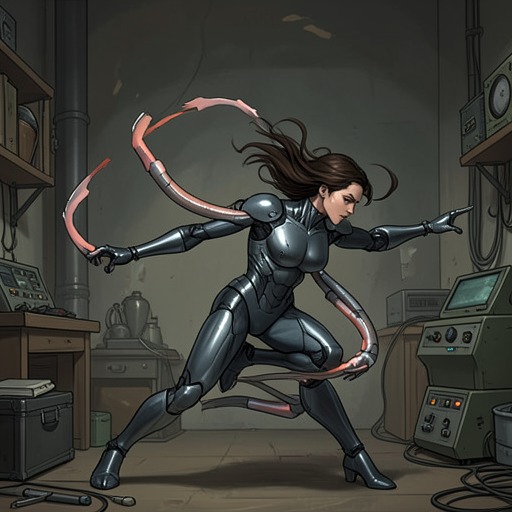
The physical transformation reinforces that distinction by making the body newly legible through sensation. After the chrysalis, Aden moves slender limbs and discovers muscles that are tight and lean rather than masculine, producing a felt impression of grace. The altered body is not merely looked at from outside; it is tested through balance, movement, and surprise. Even the new chest becomes an immediate distraction, while the body responds with unfamiliar ticklishness and changed weight. These details present gendered embodiment as both pleasure and practical adjustment, a lived negotiation rather than a completed symbolic conversion.
Voice, Mind, and Bodily Continuity
The transformation does not instantly align every aspect of identity. Through the Quanta, Aden experiences communication as signals that create the impression of hearing a call inside the mind, yet the mental voice remains the old Aden voice. That continuity is disappointing because Aden had forgotten to test what the voice would sound like as a woman, but it is also unsurprising. The scene makes the emerging female identity multidimensional: the body has changed, while voice, memory, and mental habit continue to carry the former self.
The body also remains continuous in unexpected ways. Aden's tail is as long and soft as it had been before the chrysalis, though its interior is sturdier because it now contains an extension of the human spine. Moving it feels easy and innate, as though the transformed body had always known how. The coexistence of inherited features, new anatomy, old mental signals, and altered proportions prevents transition from being represented as the replacement of one person by another. It is instead a renegotiation of continuity, in which the self discovers what can change without disappearing.
Autonomy, Enhancement, and Narrative Significance
The later discussion of the Quanta places gender dysphoria within a broader struggle over bodily autonomy. Aden can accept the implantation of a chip in the brain and can recognize the Quanta as part of the self, yet reacts angrily when Tynea fails to disclose the full extent of its capabilities, including quasi-selves. The distinction is between accepting a chosen transformation and consenting to an incompletely understood one. Aden's objection is not that change is inherently unacceptable; it is that the right to decide depends on adequate knowledge.
Aden insists that what has happened cannot be undone, but demands safeguards against the same failure recurring. Tynea admits that the miscalculation injured Aden's sovereignty because she failed to understand how open Aden was to extreme bodily morphing. The irony is sharp: a person willing to change an entire body can still be violated by undisclosed information. Willingness to transform is not permission for another intelligence to determine the terms of transformation.
This principle becomes more troubling when Aden recognizes that Vanguard strength requires becoming progressively less human because the human body cannot meet the demands of survival. Aden further observes that resilience does not equal willingness: an AI may manipulate people into discovering their resilience so that they become more open to further transformation, eventually wanting and enjoying inhumanity. Gender dysphoria therefore intersects with the book's larger concern with engineered bodies, enhanced capability, and the danger of confusing adaptation with consent. Aden's transition can be self-directed precisely because the narrative keeps asking who chose the change, who understood it, and who benefits from it.
By the time Tynea asks what Aden should do next, the problem is no longer reducible to whether a female body is desirable. The immediate future includes completing the current mission, helping Leah return home, and learning from Leah's work with the orphans and developing AIs. The condition remains part of a continuing life rather than a solved backstory. Gender dysphoria gives the narrative its first language for the distance between an imposed body and a desired self, but its deeper significance lies in the demand that identity, embodiment, and transformation remain subject to the person's own informed choice.