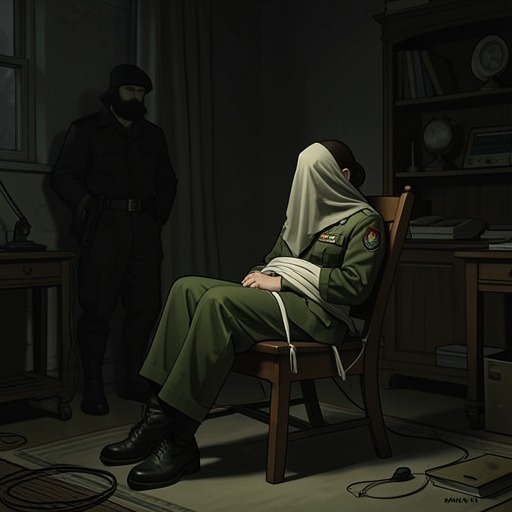
Leah's Kidnapping
Tinea and Leah: [Cyberpunk, Alien Incursions, Murder and Mayhem, Girl's Love (WLW)]Leah's Kidnapping is the assault that reveals the human cost of becoming a samurai in a world where recognition brings danger as readily as power. After Leah uses her scarce resources to protect children during the New Montreal incursion, the wrong observers identify her status, ambush her at home, and reduce her to a captive body. The event does not merely interrupt her progress: it removes her weapons, mobility, sensory access, and ordinary means of communication, while leaving Ypsi as the one surviving connection through which Leah can remain oriented toward resistance and eventual rescue.
Causes and Targeting
Three months after becoming a samurai, Leah returns to New Montreal during an incursion. She has few points and spends the small number available from her initialization freebie and daily allowance on a cybernetic eye, a cheap augmentation more dependable than her own, and several weapons. One of her two lost eyes had been taken by an ambushing Model Four, and the replacement is therefore both a practical repair and evidence of how narrowly she is operating. Leah remains on the outskirts of the invasion, protecting several children hidden in a small shelter rather than pursuing major combat gains. The work keeps her charges safe but produces little progress.
That limited progress is nevertheless enough for other people to recognize that Leah has become a samurai. The danger comes not from spectacular battlefield success but from visibility: she is identifiable as a valuable and vulnerable participant in the samurai system. When Leah and the children finally leave the shelter, she escorts them away and enters her home alone. The separation is decisive. Once isolated, she is surprised by a taser; almost immediately, a needle stings the nape of her neck and darkness takes her before she can defend herself. The kidnapping thus follows directly from the collision between public identification and private exposure.
Captivity and Bodily Erasure
Leah wakes into a blackness so complete that it produces hallucinations. The shock and injection return to her in fragments, while panic makes her want to raise her hands and touch the missing structures around her eyes. She cannot initially establish what has happened because the sensory field itself has become evidence of violence. Her eyeholes are inaccessible to her hands, and the absence she feels is more terrifying than a visible wound would be.
Ypsi explains that the kidnappers know Leah is a samurai and probably took her for that reason. They have destroyed every means by which Leah could communicate with her, taken her remaining eye, and burned out her augmentations. They cannot remove Ypsi without killing Leah, so the artificial companion remains embedded as a damaged but indispensable channel. This creates a grim paradox: the captors attempt to isolate Leah by destroying her technology, yet the one system they cannot safely extract preserves a thread of contact and therefore prevents total isolation.
The bodily damage extends far beyond Leah's eyes and augmentations. When she tries to move, sensation fails beyond her shoulders and hips. Ypsi tells her that her arms and legs have also been taken. Leah is left with stumps where those limbs had been, no points with which to obtain replacements, no weapon, and no physical means of defending herself. The kidnapping therefore operates as an engineered removal of agency: it does not simply confine Leah in a room, but dismantles the capacities through which a samurai normally acts.
Repetition, Care, and Survival
Ypsi's response gives the captivity its only continuing rhythm of care. She asks questions that Leah can answer by nodding or shaking her head, speaks in her familiar, well-mannered little-girl voice, and helps Leah regulate her breathing when panic threatens to overwhelm her. Leah experiences the fear almost as if she were outside herself, but Ypsi's voice helps her think and gives her a minimal form of participation when speech and movement are unavailable.
Over the following days, Ypsi remains with Leah and repeatedly talks to her, asks questions, and keeps her calm as uncertainty and vulnerability close around her. The personality Leah hears is not an untouched default: Ypsi had been customized to fit Leah using a profile of Leah's habits and preferences. Leah had learned this months earlier and chose to enjoy the presence rather than reject its constructed origin; that acceptance is part of why she began calling the assistant Ypsi. During captivity, the customized relationship becomes materially consequential. Ypsi is not merely an interface or tactical aid but the companion who keeps Leah mentally present.
The kidnappers' treatment is deliberately impersonal and repeated. They unlock a door, approach without explanation, force liquid food down Leah's throat, connect her to a beeping machine, compel her body to void itself, and leave without saying a word. The same actions occur the next day and the next. Their silence makes the violence bureaucratic and unreadable, while the repetition turns time into an oppressive cycle with no stated purpose. Against that pattern, Ypsi's continuing speech supplies the only recognizable human-scale continuity. Her care does not restore Leah's body, but it helps preserve the self that the captors are trying to reduce to bodily maintenance.
Wider Crisis and Narrative Consequences
The kidnapping occurs within a conflict far larger than Leah's individual captivity. Elsewhere, Laserjack describes the invasion as genuinely global: hidden hives activate simultaneously in response to an alien pheromone signal, some cities fall, lone samurai defend entire towns, and new Vanguards appear in large numbers. The Family functions as a local facilitator rather than a fully authoritative government, connecting requests for bombardment with those able to pull the trigger. In this emergency structure, defense depends on scattered individuals, improvised coordination, and the rapid conversion of civilians into combatants.
That same system makes Leah both necessary and exposed. Tinea later contacts the Family about an enormous swarm moving toward settlements and potentially the St. Lawrence River, Quebec, and New Montreal, asking the organization to monitor it and destroy it if it approaches populated areas. The request shows how survival is organized through communication networks and informal intermediaries, but Leah's kidnapping shows what happens when communication is severed at the level of one body. Her capture is therefore a private version of the wider crisis: institutions are too distributed to guarantee safety, and the people who defend communities can become targets as soon as their identities are known.
The event also establishes an important contrast between the point economy's promise and its limits. Points can buy a cybernetic eye, an augmentation, and weapons, allowing Leah to protect children despite having little combat progress. They cannot prevent an ambush in an unguarded home, restore the limbs taken from her, or guarantee that her artificial support remains accessible. Leah's samurai status offers extraordinary potential in a world threatened by Antithesis, but the kidnapping demonstrates that power is conditional, resource-dependent, and vulnerable to capture. Her survival begins not with a triumphant use of force but with controlled breathing, yes-or-no answers, and Ypsi's refusal to let silence become absolute.
Significance of the Event
Leah's Kidnapping changes the meaning of rescue before rescue occurs. The kidnappers possess her body, but they do not obtain complete control over her consciousness because Ypsi survives inside the connection they cannot remove. The event consequently turns technological dependence into a form of mutual persistence: Leah needs Ypsi to interpret and endure the captivity, while Ypsi's continued presence depends on Leah remaining alive.
The kidnapping is also a reversal of the shelter episode. In the shelter, Leah's limited resources are directed outward toward children, and her partial success makes her visible as a samurai. At home, after the children are safe and she is alone, that same identity draws violence inward. Protection and exposure become inseparable. The narrative presents Leah's loss of eyes, augmentations, arms, and legs as concrete lived deprivation rather than an abstract symbol of weakness, while the repeated acts of feeding and bodily management show how captivity attacks dignity as well as mobility.
Finally, the event prepares Leah's later place in the global war without treating initiation into the samurai role as a simple ascent. Her emergence as a defender is followed by recognition, abduction, mutilation, and enforced dependence. The wider world may be mobilizing against Antithesis, with Family coordination and new Vanguards appearing, but Leah's immediate battle is to remain a person while every external instrument of action has been removed. That tension gives the kidnapping its decisive narrative force: before Leah can fight again, the story must establish what it means for her to survive when fighting is impossible.