Leah's Vanguard Initialization
Tinea and Leah: [Cyberpunk, Alien Incursions, Murder and Mayhem, Girl's Love (WLW)]Leah's Vanguard Initialization is the decisive threshold at which Leah Neverstrait becomes a Vanguard. The transformation does not begin in ceremony or triumph, but while she is urgently trying to stop an Antithesis Model Three from harming the children in her care and is distracted by the immediate need to find a toilet. Its significance lies in the collision between heroic recognition and humiliating physical circumstance: the system identifies a defender of humanity not after a grand public victory, but through a small, desperate act of protection carried out under pressure.
The Protector Before the Threshold
Leah's defining motive is already visible before the system appears. She pursues the Model Three because it is carrying a teddy bear in its jaw and might hurt the little ones, even though Leah herself desperately needs to urinate. The chase therefore joins bodily urgency to protective responsibility. She is not pursuing an abstract military objective; she is trying to prevent a specific threat from reaching vulnerable children.
Her method is practical rather than spectacular. After an initial attempt nearly makes her lose control of her bladder, Leah hides partly behind a tree and waits for the Antithesis to approach from the angle she has prepared. She holds an ice pick in both hands, aims for the point on the creature's head where the weapon can reach its brain, and strikes when it jumps from two meters away. The blow is forceful enough to flip the Model Three against the tree. Even in this violent moment, the teddy bear remains a strange counter-image to the killing: the creature loses its grip, while the bear's oculars recognize Leah as a human being and wave an arm at her; Leah waves back.
That gesture does not soften the danger, but it gives the encounter an oddly reciprocal surface. Leah has just killed the Antithesis to protect the children, yet the machine's toy-like appendage registers her presence in a manner that resembles social recognition. The scene thus establishes the peculiar moral and tonal ground from which her initialization emerges: protection requires violence, and violence occurs amid absurdity, bodily discomfort, and objects that appear almost domestic.
System Recognition and Transformation
Immediately after the kill, Leah opens the door of a portable toilet, drops her pants, and squats. The resulting relief is described as pure relaxation, but it is interrupted by blackness, vertigo, a splitting headache, and the sensation of a hot poker driven through the hindbrain. The pain, blindness, and dizziness vanish almost as quickly as they arrive. What seems at first like a medical crisis is instead the bodily onset of a new technological identity.
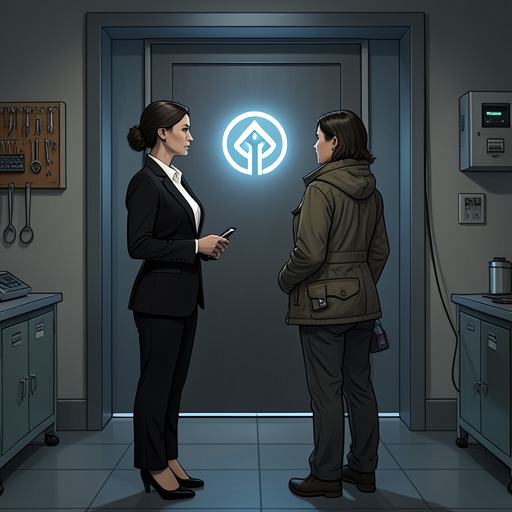
A polite little girl's voice then announces, “System Initialized!” The system congratulates Leah for proving through her actions that she is worthy of becoming one of the Vanguard, a defender of humanity. It identifies itself as Ypsilon and states that it will assist her in uplifting humanity so that she can defend her homeworld from the Antithesis threat. The formal language gives the event the structure of an initiation rite: Leah is named, classified, recruited, and assigned a mission in a single sequence.
Ypsilon's command to rise and become a protector of the weak also reframes what has just happened. Leah has not consciously sought membership in the Vanguard, and she receives the announcement while still trying to keep her balance and holding her head. Her bewildered response, followed by the realization that she has somehow become a samurai while nearly urinating herself, punctures the solemnity of the proclamation. The event makes heroism inseparable from the unglamorous body rather than allowing technological elevation to erase it.
The First Consequences in New Montreal
The initialization does not immediately make Leah a dominant combatant. Three months later, when an incursion occurs in New Montreal, she has only a small number of points and remains on the outskirts of the invasion, protecting a few children hiding in a small shelter. She sees little action. The modest scale of this first post-initialization deployment is important: becoming a Vanguard supplies access to a system, but it does not abolish scarcity, danger, or responsibility.
Leah spends the few hundred points accumulated from that defense, her initialization bonus, and the daily allowance on a cybernetic eye to replace one of the two eyes she lost to an ambushing Antithesis Model Four. She also purchases a cheap augmentation that is more reliable than her own eye and acquires several weapons sufficient to protect herself and the children. Her first use of Vanguard resources is therefore restorative and defensive before it is expansive. The point economy turns survival, bodily repair, and guardianship into calculated expenditures, while Leah's obligations determine what those expenditures are for.
The result is safety without rapid advancement. Leah remains responsible for her charges and does not make much progress. This distinguishes her from Vanguards who are driven to seek increasingly dangerous opportunities. Her initialization opens a path, but her commitment to children constrains how aggressively she can follow it.
A Technological Order of Delegated Action
The initialization also places Leah inside a wider system in which human judgment is repeatedly distributed among AI assistants, weapons, and autonomous tools. In the Vanguard combat interface, the Sentinel can be entrusted with full-automatic fire once its specialized trigger is guided into position. Later, the same logic extends to administrative and tactical labor: Tynea can be asked to handle command debugging during combat, organize the Myriad's dense manufacturing and battle panels, and monitor critical information while the Vanguard remains focused on immediate threats.
The system's feedback makes killing legible as numerical advancement. After one retreat and reload, Tynea reports 420 targets eliminated and records that the Foxteeth fired 33 rounds for 60 kills over 16 seconds. In another lull, Leah's point counter reaches 1,008 while roughly a thousand Antithesis continue flowing into the city. These figures show how the Vanguard framework converts combat into measurable performance, but Leah's own actions keep that arithmetic tied to concrete protective labor: she searches houses and shops for hidden models and keeps children alive rather than treating points as an end in themselves.
The same technological structure offers unlocks such as Class I Dream Therapy at 25 points and Class I Viral Editing at 50. It promises not merely weapons but access to bodily, cognitive, and biological alteration. Leah's initialization therefore marks entry into an economy in which protection, repair, experimentation, and self-transformation are all mediated through earned numerical resources.
The Meaning of Leah's Vanguard Status
Ypsilon's later explanation clarifies why Leah is a distinctive kind of Vanguard. Most chosen individuals rely on intuition when confronted with the system and rarely sit down to discuss its implications. The AI therefore tries to bring them “up to speed” before they commit themselves to choices they cannot survive. Vanguards tend to be go-getters because the system needs people willing to explore frightening and unfamiliar options. Leah, however, is described as duty-bound: she does not necessarily take full advantage of the available technology because her obligations chain her to the people under her care.
That limitation becomes part of her value. Leah is portrayed as a long-term investment in uplifting humanity, a person whose sustained responsibilities make her a channel through which improved technology can reach those she protects. Her initialization thus produces an inversion of the conventional heroic departure. Instead of leaving ordinary life behind to pursue adventure, Leah carries ordinary dependents with her into the technological war.
The event also foreshadows the later depth of her Vanguard existence. The system can expand perception across networked weapons and tools, allowing a Vanguard to sense every Sentinel projectile-programming facility and smart bullet within several kilometers. It can support meteor-scale destruction and coordinated weapon plans; after such a strike, about fifty Antithesis Model Threes, several Fours, and two badly burned Eights remain. Yet the origin of that vast combat consciousness is still Leah in a portable toilet, protecting children with an ice pick. Her Vanguard identity never fully escapes that contradiction. It is built from an act of care, enlarged by a game-like technological apparatus, and continually measured against the bodies and lives for which she accepts responsibility.