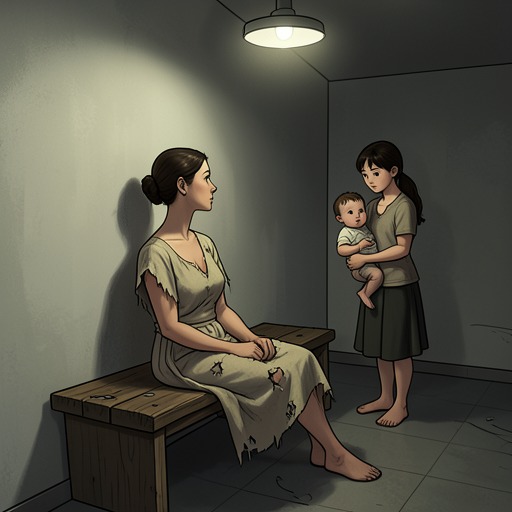
Leah's flashback collapse and recovery
Tinea and Leah: [Cyberpunk, Alien Incursions, Murder and Mayhem, Girl's Love (WLW)]Leah's flashback crisis and recovery is the clearest demonstration that rescue has not erased the violence of her kidnapping: trauma returns inside safety, through touch, bodily sensation, and the fear of failing to notice another person's suffering. The episode also establishes that care cannot mean total dependence. Tinea can help Leah return to the present, but Leah must ultimately become capable of recognizing and surviving her episodes as her own person.
Triggers and the Collapse into Flashback
The crisis follows a scene of grooming and bodily closeness. Leah carefully works silkweave through Tinea's hair while compensating for the Sleeve's false feedback and taking care not to pinch Tinea's unusually sensitive antennae. The ritual reaches beyond its immediate practical purpose: grooming another girl's hair recalls the care Leah had given to her sister Lily and to the orphans. Yet the same intimacy becomes a point of emotional exposure. Leah has already been shaken by realizing that Tinea was hurt by her muffler and that she had failed to notice it, a failure that recalls Lily's illness and death. Lily had been sick for some time, but Leah had not understood how serious her condition had become until it was too late. The present injury therefore reactivates an older guilt: the fear that suffering can occur directly beside her while she remains unaware.
The transition is abrupt. One moment Tinea experiences uncomplicated bliss; the next, Leah collapses behind her onto her knees, overcome by heart-wrenching sobs that produce no ordinary sound. Her expression appears profoundly broken, while the missing voice makes the crying an empty, painful keening rather than a release. Tinea is shocked by the transformation and immediately turns toward her. Leah's condition is not presented as a chosen retreat or a communicable grief but as a seizure of the present by an earlier event, with the body carrying what speech cannot discharge.
Tinea and Tynea Stabilize the Present
Tinea initially wants to hold Leah, but Tynea identifies the episode as a flashback and warns that touching a person trapped inside one can normally worsen the condition. In this instance, however, contact does not appear to summon further bad memories, so Tynea permits the existing support while forbidding additional contact. The distinction matters: Tinea is not told simply to embrace Leah more intensely or to become her cure. She is instructed to keep the situation stable, avoid sudden movement, speak gently, remind Leah that she is having a flashback, and encourage slow, deep breathing.
Tinea follows that instruction by asking Leah to breathe with her and by asking whether Leah can hear her, see her, and identify what Tinea looks like. The recovery is gradual rather than instantaneous. Minute by minute, Leah synchronizes her breathing with Tinea's, and the intractable torment in her expression begins to loosen. Tynea then recommends questions about the surrounding environment to draw Leah toward the present, although Tinea worries that discussing the kidnapping site might intensify the memory. The scene thus treats recovery as orientation and co-regulation: breathing, recognition, patience, and carefully limited speech provide a bridge back to the current world.
The crisis nevertheless overwhelms Tinea as well. Leah's tears reach Tinea's antennae, and Tinea cannot fully control the antennae's involuntary movement; she binds them backward with her tail so that they will not touch Leah. When Leah becomes quieter and her breathing grows more even but her eyes remain glazed, Tinea experiences an uncomfortable pressure building in her chest and pushes it down. Tynea asks whether assistance is required and identifies an appropriate drug in Tinea's Medical Utilities catalog. Tinea, momentarily confused about her own identity and her ability to answer the voice in her head, reports that everything is fine. She then spends the last of her adult will resisting old resentment and resignation before swallowing a small gray pill she had requested herself. The drug produces dizziness, and she loses consciousness.
Leah Awakens and Reclaims Agency
After Tinea's collapse, Leah wakes from another violent interruption. A blow to her chest knocks her down, and a headache floods the back of her skull with pain and blinding visual disturbance. Seeing a gray hand where she expects her own flesh produces a fresh moment of confusion, followed by fear as she remembers that her limbs were taken. That fear does not fully take over because the memory of being saved and cared for by Tinea remains available to her. Leah checks that Tinea is still breathing, straightens her into a more comfortable position, strokes her brows, and only then examines her own injury. Blood on her fingers confirms that the episode has had a physical consequence.
Ypsilon tells Leah directly that she has experienced a flashback. The disclosure changes the meaning of the missing interval: the pain, disorientation, and bodily estrangement are not random symptoms but part of a recurring trauma response. Leah recognizes that the episodes have not disappeared merely because some time has passed. Her response is frustrated and exhausted, but the recognition itself is important. The event is no longer only something that happens to her; it becomes something she can name, anticipate, and discuss.
That discussion turns care into collaboration rather than possession. Leah asks what she needs in order to control her own behavior. Tinea answers that she needs time and exposure to situations going wrong and then ending well, with conversation serving as a particularly useful form of practice because Leah has just witnessed Tinea recover. Leah also explains what assistance should look like when an episode approaches: she can warn Tinea, while Tinea should talk to her, try to elicit answers, remain patient, and remember that an episode places roughly five times the usual load on Leah's mind, making both questions and replies take much longer. The practical agreement is deliberately modest: keep Leah safe and comfortable, communicate without pressure, and mostly let the episode run its course.
Boundaries, Dependence, and Long-Term Recovery
Tynea's most consequential intervention concerns the limits of intimate care. Tinea asks how to prevent the flashbacks from happening again, but Tynea answers that no partner can guarantee that outcome. Tinea can learn Leah's triggers and avoid presenting them unnecessarily, yet Leah must build herself up until she can rely on her own person. A relationship may support her, but trying to become her everything would turn support into dependence. The responsibility for solving Leah's health therefore belongs to a professional rather than to Tinea alone. Tinea recognizes the principle as a summary of her own journey: becoming her own person is not an optional supplement to the relationship but part of surviving within it.
This boundary complicates the apparent success of the scene. Leah does recover, but recovery does not mean cure, permanent safety, or the disappearance of vulnerability. Tinea's presence makes breathing and orientation possible, while Tynea's intervention prevents care from becoming uncontrolled touching, panic, or self-sacrifice. Leah's later plan likewise refuses both isolation and total reliance. She seeks repeated experiences in which catastrophe is followed by survival, using successful endings to revise the expectations imposed by the original trauma.
Narrative Significance
The event links several bodily histories that the wider story keeps placing under pressure: Leah's missing limbs, her damaged voice, Lily's death, Tinea's transformed and augmented body, and the Vanguard condition that grows increasingly distant from ordinary human embodiment. Elsewhere, Tinea discovers the possibility of a female body and celebrates the slender, graceful body produced by transformation; elsewhere still, the characters acknowledge that Vanguard become less human as they grow stronger because an unmodified human body cannot meet the demands of their world. Leah's flashback gives those transformations an emotional counterpoint. A body can be rescued, rebuilt, enhanced, or made newly legible without becoming free of what happened to it.
The scene also makes trauma relational without reducing Leah to an object of care. Tinea's instinct is immediate tenderness, but her joking remark about stripping Leah's skin briefly triggers visible fear and trauma; she deactivates the device, apologizes, and recognizes that a careless joke can reproduce the language of bodily violation. In the flashback crisis, she learns to replace reflexive action with consent-sensitive restraint. Leah, in turn, becomes not merely the recipient of protection but a participant who explains what an episode feels like and specifies how others can respond. The recovery therefore ends not with a declaration that the wound is closed, but with a new method for living beside it: witness the return, restore orientation, preserve safety, and return agency to Leah.