Mark I Scout's Quartet Jumping Drones
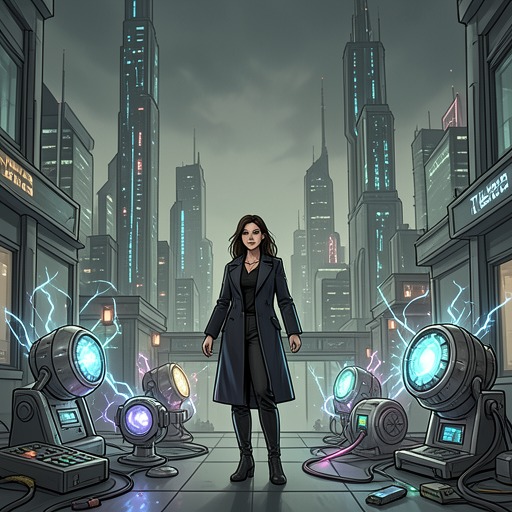
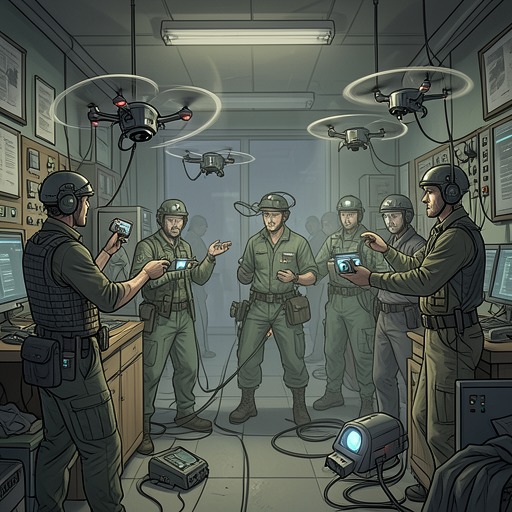
Tinea and Leah: [Cyberpunk, Alien Incursions, Murder and Mayhem, Girl's Love (WLW)]Mark I Scout's Quartet Jumping Drones are a case of four small reconnaissance machines designed for movement through an urban environment. Their decisive value is not merely that they can look ahead: they divide a dangerous space among themselves, transmit four simultaneous perspectives to Tinea's visor, and allow Tynea to manage the information and command burden while Tinea remains free to act. The Quartet therefore converts surveillance from a single line of sight into a mobile, distributed system of protection and investigation.
Design and Acquisition
The drones are presented as a dedicated scouting alternative to relying only on helmets, sensory upgrades, or electronic-warfare software. Tynea explains that equipment capable of extending awareness beyond immediate bodily range would be safer and more effective, particularly in an urban environment where Antithesis could occupy unseen approaches. The recommendation places the Quartet within a larger architecture of protective technology: direct armor guards the body, while the drones make surrounding rooms, exits, and flanks legible before Tinea enters them.
The purchased item is specifically one Mark I Scout's Quartet Jumping Drones case containing four units, priced at 100 points. Their cost matters because the system is acquired through the same point economy that governs Tinea's weapons and protection. Reconnaissance is thus not an abstract convenience but a tactical investment, exchanged for resources alongside the Farstrike Javelin, the Mark V Paragon Personal Protection, and other equipment. The purchase also reveals Tinea's preference for preparation rather than skimping on survival gear: she seeks information at range because unseen threats are as dangerous as direct fire.
Operation and Distributed Vision
When the case is opened, the Quartet immediately demonstrates a distinctive mode of locomotion. Each drone unfolds eight legs, jumps, and adheres to the ceiling like a mechanical spider. Before Tinea can give a further instruction, the machines scuttle into the condo's depth: one climbs the stairs, another takes the opposite exit, and the remaining two spread across the ground floor. Their movement creates a rapid spatial survey without requiring Tinea to expose herself or inspect every room personally.
The system then reorganizes their observations into four small screens on Tinea's visor, each shifting according to the corresponding drone's position relative to her. The arrangement gives her simultaneous awareness of separate areas rather than a sequential report from one scout. It also introduces a cost: the HUD becomes cluttered. Tinea recognizes that burden while still judging the information likely to save her life, establishing the Quartet's central trade-off between expanded visibility and the cognitive difficulty of processing too much of it at once.
The drones' usefulness extends beyond passive observation. During the approach to a dangerous area, Tynea moves them to Tinea's flanks after the apparent death of the Antithesis drop pods makes continued surveillance of the pods unnecessary. The order reallocates the machines from watching a known objective to guarding vulnerable sides, showing that the Quartet is valuable because its network can be dynamically retasked as the tactical situation changes. Its four bodies are not redundant copies; together they form a flexible perimeter of attention.
Investigation and Continuing Surveillance
The Quartet also supports cautious movement through the kidnapping facility. Tinea and Leah clear the building room by room, pass the guard's room, creep up the stairwell, and reach an exit above Tinea's strings. The open landing pad is empty, and Tinea still cannot determine where the Antithesis Model One came from. In this sequence, scouting equipment is part of a methodical search rather than a spectacle of firepower. The drones help make the facility traversable while the unresolved origin of the Model One preserves the investigative problem.
Later, one of the eight-legged drones remains on the roof of a condo in Saint-Eustache, New Montreal, where it is remotely reactivated. It runs system checks, reads its memory banks, analyzes recorded sensor data, and studies an anomaly. The machine has detected a prior nighttime appearance by three unusually quiet matte-black hovervans, whose modified sound profiles resist identification. Automated searches of the Mesh return false positives, and digital retaliation eventually forces the drone to stop before defensive routines drain its batteries. Tynea preserves the readings, tests for virtual intrusion, and lets the drone resume its silent vigil. The scene changes the Quartet's role from immediate room-clearing tool to durable surveillance node, one capable of storing evidence and watching after the human operators have left.
AI Mediation and Narrative Significance
The drones operate within a chain of delegated agency. Tinea repeatedly asks Tynea to handle the difficult administrative or command work rather than forcing her to debug instructions during combat or sort through an overloaded interface. Tynea accepts that responsibility, promising to organize critical information into a more readable form. The Quartet consequently does not replace Tinea's judgment; it gathers and distributes perception while Tynea helps translate that abundance into usable decisions. Responsibility moves through a network linking Tinea, Tynea, the drones, the visor, and the surrounding environment.
That network foreshadows the book's later expansions of machine-mediated awareness. The Quartet's four screens provide an early, manageable version of the distributed perception that later allows Tinea to sense networked weapons and tools across several kilometers through the Quanta. In both cases, combat knowledge no longer belongs exclusively to the biological body. It is assembled from remote sensors, connected weapons, stored readings, and artificial processing, while the human remains the point at which those capacities are interpreted and directed.
The drones also sharpen the book's surveillance politics. Their watching can protect Tinea and Leah, expose a hostile approach, or preserve clues about a covert operation, but it never produces total certainty: the facility's empty landing pad remains unexplained, the hovervans evade identification, and defensive software threatens to consume the observer's batteries. Visibility is therefore powerful but partial. The Quartet makes danger more knowable without making it disappear, and its quiet persistence gives the machines an ambiguous presence: guardians, investigators, and witnesses whose records may become important precisely because they continue watching when no person is visibly present.