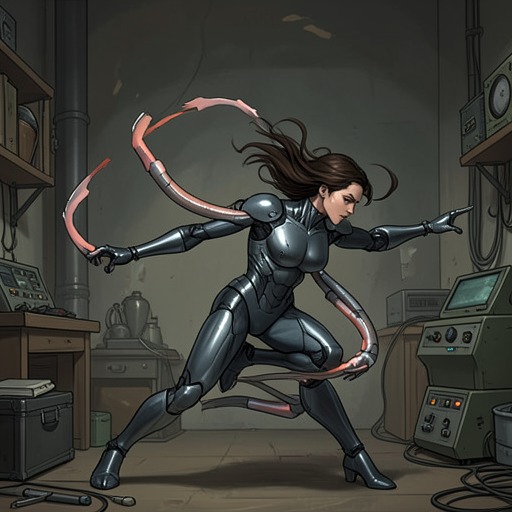
Mark IV Mimicry Battle Skin
Tinea and Leah: [Cyberpunk, Alien Incursions, Murder and Mayhem, Girl's Love (WLW)]Mark IV Mimicry Battle Skin is an adaptive combat technology that replaces the ordinary distinction between body and equipment with a responsive living surface. Purchased for 1200 points, it gives Tinea protection that is lighter in practical use than her discarded Mark II Armored Overall while also allowing her skin to alter its appearance, structure, and attachment properties. The result is not simple armor but a bodily toolkit for movement, survival, deception, and improvisation.
Design and Protective Functions
Mark IV Mimicry Battle Skin is presented as a particularly suitable answer to Tinea’s priorities during her biological reconstruction. She wants resistance to stabbing and other puncture damage, along with protection from temperature extremes associated with flight. The system supplies both: its subdermal hardening plates and shock-absorbing gels absorb blunt impacts more effectively than the Mark II Armored Overall, while its insulating properties protect against temperatures ranging from negative one hundred to two hundred degrees Celsius. The skin therefore improves on the weaknesses of a silk cocoon and on the bulk of conventional armor at the same time.
Its defensive value is broader than simple toughness. The adaptive surface can respond to different threats by producing structures that repel toxic enzymes and chemicals, and the technology is described as capable of supporting many forms of material adaptation. This makes the Battle Skin an active interface between Tinea and her environment. It does not merely endure damage after contact; it can alter the conditions of contact itself, whether by hardening, changing its surface chemistry, or modifying the way it grips another material.
Appearance, Texture, and Camouflage
The Battle Skin allows Tinea to change the color of her hair and skin and to alter the coloration of the scales on her wings. It can also grow keratin or chitin setae in forms including hair, fur, fuzz, spines, quills, and scales. These options give her control over more than cosmetic presentation: they let her adjust the visible and tactile character of her body to suit a situation, while providing additional possibilities for adaptation and protection.
Its most striking feature is the ability to change cellular surface structure. Tinea can match the texture of an object or surrounding surface, producing a limited form of visual stealth when she remains still. During a demonstration for Leah, she fades into the background over several seconds. Leah can still detect her through the cybereye, but without heat vision she would have difficulty locating her. The scene establishes both the power and the limit of the effect: the Battle Skin can make Tinea visually difficult to distinguish, but it is not a complete stealth system. Heat, sound, air disturbance, weight, smell, and movement remain detectable, and the skin cannot change quickly enough to keep pace with every motion.
The camouflage is therefore described as incidental rather than the system’s primary purpose. Its deeper function is adaptability to threats, including chemical resistance and controlled adhesion. The visual disguise is a useful consequence of that adaptability, not a replacement for specialized stealth equipment. This distinction prevents the Battle Skin from becoming an all-purpose invisibility device while still making it valuable for ambushes, concealment, and careful positioning.
Adhesion and Silk Interaction
The surface-control function becomes especially important because Tinea also produces silk. The Battle Skin can tune itself to match a protein key programmed into her silk, allowing her to glue herself securely to sticky silk and then release instantly by changing the relevant surface structure. Without that capability, she would generally require a different silk gland to achieve the same result. The system thus extends the usefulness of her biological equipment by coordinating with it rather than operating as an isolated armor layer.
This relationship between skin and silk is already foreshadowed by Tinea’s early experiments with the silk spinneret. She wraps her equipment into a bundle, uses a dissolving spray to cut apart a failed arrangement, and gradually gains better control over the movements of her new appendage. The Battle Skin belongs to the same larger process of learning to treat bodily structures as manipulable tools. Silk is no longer simply something she produces; it becomes a material whose adhesion, arrangement, and release can be coordinated with the engineered surface of her body.
Integration with Tinea’s New Body
The Battle Skin is selected alongside Class I Combat Grafts, with the lower grafting tier judged sufficient because most Class II organic modifications do not exceed what tier-one adapters can handle. Tinea also receives NutriPacks to provide the energy required to construct the cocoon and undergo the transformation. The purchase therefore forms part of a larger package of bodily reconstruction rather than a standalone equipment choice.
After the transformation, the Mark II Armored Overall is too large for Tinea’s altered female body, and the helmet no longer fits. Although their weight is manageable, both garments are too bulky, while her own skin is now tougher than the external protection they once supplied. She leaves them behind and creates silk pockets for her Foxteeth and ammunition instead. The decision marks a practical transfer of defensive responsibility from manufactured clothing to the body itself: external gear becomes cumbersome, whereas the Battle Skin remains integrated, responsive, and available at every moment.
Narrative and Material Significance
Mark IV Mimicry Battle Skin embodies the book’s recurring movement from equipment toward organic augmentation. It is a purchased technology, but its effects are expressed through living tissue: hardened plates lie beneath the skin, gels absorb impact, surface cells alter their structure, and new keratin or chitin formations emerge as needed. The object’s apparent boundary is therefore unstable. It is armor, camouflage, chemical defense, climbing aid, and bodily interface at once.
That material flexibility also places limits on the idea of control. Tinea can choose colors, textures, adhesion settings, and defensive responses, but the changes are neither magical nor unlimited. Visual concealment takes time, movement exposes her, and stronger stealth would require specialized systems. The Battle Skin consequently gives her expanded agency without abolishing vulnerability. Its significance lies in that balance: it makes Tinea more capable by teaching her body to negotiate with matter, while ensuring that survival still depends on timing, stillness, judgment, and the physical properties of the world around her.