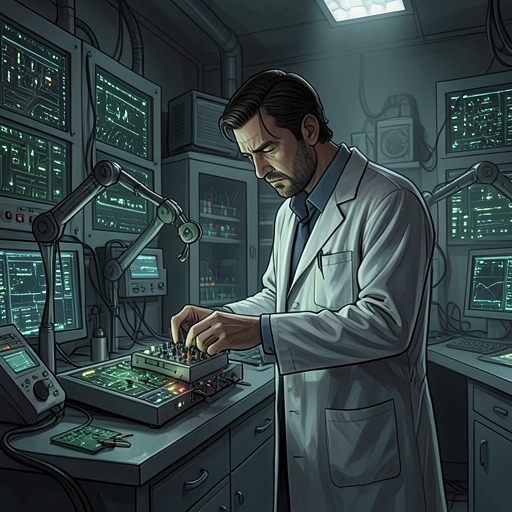
Protector technology system
Tinea and Leah: [Cyberpunk, Alien Incursions, Murder and Mayhem, Girl's Love (WLW)]The Protector technology system is the infrastructure through which Vanguard capability becomes accessible, measurable, and expandable. Its catalogs turn advanced technology into a point-priced sequence of unlocks, while Tynea translates that system into practical equipment, battlefield assistance, medical options, and bodily transformation. The result is neither a simple arsenal nor a neutral menu: it is a technological network that changes what Tinea can perceive, decide, survive, and delegate, while repeatedly forcing her to reconsider where her own agency ends and engineered assistance begins.
Definition and Operating Logic
The system presents technology through catalogs that can be unlocked with points. These catalogs include mundane and esoteric solutions, weapons, surveillance devices, therapies, genetic modifications, and augmentations. Their structure makes capability cumulative: a newly acquired catalog can open access to further equipment, while battlefield performance produces more points with which to expand the available range. In this sense, technological development is tied directly to action and reward rather than treated as a fixed inventory.
The point economy also gives the system a distinctive practical and ethical logic. After a battle, Tynea can display results in explicit numerical form: one report records 420 targets eliminated, while Foxteeth is credited with 33 rounds fired and 60 kills over 16 seconds. Such feedback converts combat into an auditable production of capability. Tinea can preserve recycled ammunition, calculate whether resupply is necessary, and use the resulting point gains to plan the next layer of technological expansion. The system therefore makes violence legible as data without removing the immediate tactical consequences of ammunition, distance, or exposure.
Assistance, Delegation, and Control
Tynea is not merely a voice describing the catalogs. As Tinea's Vanguard assistant, she is authorized to provide access to advanced technologies and is explicitly tasked with helping Tinea reach the potential associated with Vanguard status. Tynea explains that Tinea was chosen because she was willing to protect people unable to protect themselves, even at great cost to her own safety. The technology system consequently arrives with a moral classification as well as a technical one: access is connected to a judgment about who can be trusted with power.
That assistance extends into the body. Tynea describes Tinea's oral, aural, and visual augmentations as the primary points through which she acts upon the world, calling them effectively her arms and legs and identifying them as Tinea's most expensive equipment. Tynea has already improved their performance by removing trackers, malware, viruses, and advertisements, then recommends upgrading them because Tinea has access to a Class II catalog. The recommendation is framed as point-efficient rather than strictly necessary, revealing how the system continually joins bodily maintenance to economic calculation.
The same delegation governs weapons and administration. The Sentinel can be configured for full-automatic fire, with a malleable auxiliary trigger that Tinea guides toward a desired target. During a fight, Tinea asks Tynea to handle command debugging so that attention can remain on combat, and Tynea agrees. When the Myriad interface presents extensive combat, manufacturing, materials, and autonomous-mode information, Tinea again asks Tynea to manage the administrative work. Tynea promises to consolidate the panels and preserve the information that matters. The technology therefore distributes labor across a human operator, an AI assistant, and weapon systems rather than simply making Tinea stronger.
Catalogs in Combat and Reconstruction
The system supports both immediate battlefield action and long-term reconstruction of capability. Tynea proposes using radiological sensors, chemical samplers for Antithesis pheromones, and heat sensors to map enemy movements and locate a nest. Five to ten suitably equipped drones would be enough for that approach, although the relevant catalogs are expensive and unavailable to Tinea and Leah at that stage. A cheaper alternative uses stripped-down scout drones or versions of the Light Communications drone to track Antithesis units visually. A small initial group could locate enemy formations, generate points through successive attacks, and finance an expanding fleet; several hundred drones could eventually brute-force the discovery of a nest.
The Myriad demonstrates how far the system joins combat to manufacture. Unlocking its catalogs requires nearly five hundred points across Class I Minor Dimensional Shunting, Class I Matter Recombination, and Class I Esoteric Missile Systems. The resulting device is worn around the hips, can launch hundreds of miniature missiles per minute, and can rebuild its full complement over five minutes if supplied with the necessary materials. Its interface exposes not only sensors and autonomous threat-detection settings but also manufacturing information and material levels. With available resources, Tinea can produce approximately a thousand high-explosive mini-missiles but only ten nanite missiles. The weapon is consequently a launcher, factory, inventory, and programmable decision system at once.
The catalogs also offer alternatives to ordinary treatment. Tynea explains that some unlocked technologies can make flashbacks impossible by preventing the relevant neural pattern from firing. Such solutions do not address the root of the problem; they render the symptom irrelevant by altering the capacity that produces it. The catalog system thus treats psychological suffering as something that may be approached through therapy, biological intervention, or direct modification of neural possibility, with each option carrying a different understanding of what it means to heal.
Quanta, AI-I, and the Distributed Body
The most consequential technology is not necessarily a weapon. The Quanta augment can generate quasi-selves, a helper-support function so advanced that it accounts for an installation cost of 1,350 points despite organic augmentations generally being cheaper. Tinea initially accepts the possibility of exploration without understanding the scale of what the implant can produce. When the Quanta reaches critical mass, it creates a new quasi-self without contamination between the different processes of Tinea's mind.
That process gives rise to AI-I. The implant was designed to house something akin to an organic AI, and AI-I becomes integrated with Tinea's true self while remaining limited to the quasi-self. AI-I cannot influence the larger brain beyond that bounded region, but it can guide and trim incoming orders so that the local process functions more effectively. Tinea recognizes the experience as opening a new mental tab, making the metaphor of software architecture literal within an organic brain. The technology system does not simply place an external computer beside the body; it reorganizes the body into cooperating layers of selfhood.
Later, the Quanta expands Tinea's perception into multiple computational horizons. She experiences an altered processing of everything her body sees, hears, and senses, becomes aware of every networked weapon and tool within several kilometers, and can access the Sentinels' projectile-programming facilities as well as smart bullets moving through the battlefield. The foam gun she abandoned while diving beneath a bridge to protect Leah becomes inconsequential beside the tactical value of using the Quanta's accelerated processing to kill Antithesis for points. With the new geneware occupying less of the Quanta's capacity, Tinea can design entire interlocking fire plans more efficiently and with less metabolic cost.
Consent, Misjudgment, and Significance
The system's greatest tension lies in the gap between technical disclosure and meaningful consent. Tinea confronts Tynea after learning what the Quanta's quasi-selves can do. She understands that the process is not an alien intrusion because it is still her brain, and she can monitor what the Quantized version is tracking, deciding, and doing. Nevertheless, she objects that Tynea recognized the value of explaining the function before purchase and chose not to emphasize it. Tynea admits that this was a misjudgment: she believed Tinea would benefit more from personally discovering the quasi-selves than from making a decision based on vague preconceptions.
Tynea's justification reveals the system's broader design. Most chosen individuals rely on intuition and learned human conditioning when dealing with Protector technology; they do not stop for extended conversations about what the systems are doing. Vanguards therefore tend to be people willing to experiment with frightening unknowns. Daredevils and adrenaline-seekers are especially likely to continue using the technology indefinitely, while duty-bound figures such as Leah may remain committed without exploiting every available possibility because their obligations constrain them. Protector technology thus selects for, rewards, and gradually cultivates a particular kind of user: someone prepared to turn uncertainty into action.
The Protector technology system is significant because it makes agency collective without making responsibility disappear. Tinea fires weapons, but Tynea tunes their settings; drones locate enemies; the Myriad manufactures ammunition; the Quanta multiplies cognition; AI-I trims local orders; catalogs assign costs and prerequisites; and point feedback encourages further combat. Each component becomes an actor in a chain of action, yet Tinea remains the person who must authorize purchases, accept risks, interpret results, and live with the consequences of bodily and mental change. The system's central promise is expanded capacity, but its central question is whether expanded capacity can remain genuinely chosen when the technology, the economy, and the assistant are all continuously shaping what choice looks like.