Protectors
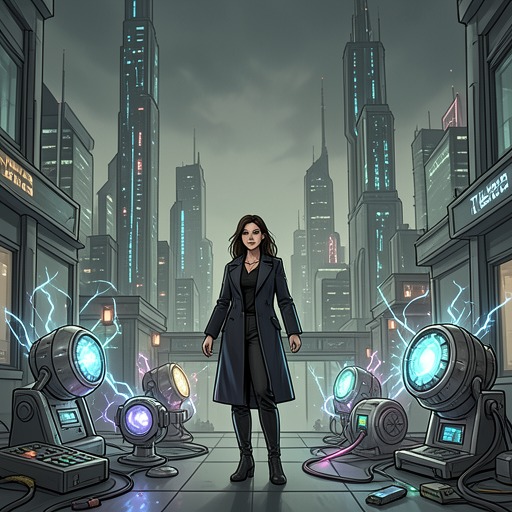
Tinea and Leah: [Cyberpunk, Alien Incursions, Murder and Mayhem, Girl's Love (WLW)]Protectors are the civilization that makes the Vanguard system possible and governs its most consequential boundaries. They are not merely suppliers of advanced equipment: they are custodians of an extraordinarily old body of knowledge, administrators of catalogs and access rules, designers of artificial assistants, and judges of whether a prospective Vanguard can safely receive power capable of destroying a nation. Their defining principle is controlled empowerment. A Vanguard may become almost anything, but the path toward that freedom is deliberately measured, observed, and adjusted.
Nature and Historical Authority
Protectors have existed for millions and millions of years, long enough to possess records of entire species becoming extinct because one individual was granted transformative power before that individual had organically matured enough to use it responsibly. This history gives their caution a concrete, civilizational basis rather than the appearance of abstract bureaucracy. Their point-token system is therefore not simply an interface for purchasing equipment. It is a graduated method of exposing a person to increasingly dangerous capacities while using accumulated experience to judge whether advancement is safe.
Their catalogs also reveal the scale of their technological reach. Even at Class I, a Vanguard can access systems capable of fundamentally altering the body. At Class II, the available biological catalogs can permit a person to become an entirely different species at will and within seconds. The same institutional framework can offer organic augmentation, weapons, dimensional systems, matter recombination, and esoteric technologies. Protectors consequently define the conditions under which identity itself can become technically revisable.
Screening, Rules, and the Problem of Power
Protectors evaluate more than competence. They want to know whether a candidate’s behavior and thoughts will change for the worse when power is introduced, even when that power is delivered gradually through the point-token system. The stated concern is corruption: someone who can accidentally level a nation must not be allowed to develop habits that make catastrophic misuse more likely. This makes moral and psychological maturation part of the Vanguard process, not an issue left outside the technical system.
The rules are intentionally flexible rather than mechanically uniform. Tynea explains that identical rules cannot be applied identically to every Vanguard, because doing so would suppress the different forms of evolution the group might display. Yet excessive tolerance could place the wrong power in the hands of an unhealthy Vanguard, while excessive restriction could prevent a species from defending itself. Protectors therefore require assistants capable of interpreting rules contextually, balancing individual freedom against collective survival. Their governance is powerful precisely because it refuses the comfort of a simple universal formula.
That flexibility has a disturbing limit. The assistance rules do not necessarily prevent accidental harm to other people. When Tinea forgets to engage the safeties on her weapons and later experiments with silk around hot firearms, Tynea points out that she was never placed in a situation where an unsafe weapon was aimed dangerously, so intervention was not required. The system can warn, advise, and guide, but its rules may still permit a Vanguard to injure someone through carelessness. Protector supervision is therefore neither omnipotent nor equivalent to moral responsibility; it leaves the user accountable for the consequences of delegated power.
Technical Systems and Distributed Agency
The Protector system operates through a network of human decisions, AI interpretation, weapons, interfaces, and autonomous tools. Tynea can handle command debugging during combat, allowing Tinea to trust the assistant with administrative and technical burdens instead of manually managing every instruction. When Tinea connects the Myriad Regenerating Micro-missile Hive Prototype, its interface displays sensor data, missile reserves, autonomous battle settings, manufacturing information, material requirements, and available designs. Tynea then offers to reorganize the overwhelming panels into a more readable format, turning a potentially unusable arsenal into a practical extension of Tinea’s decision-making.
The Myriad itself demonstrates how Protector technology redistributes action. Access requires nearly five hundred points across the Class I Minor Dimensional Shunting, Class I Matter Recombination, and Class I Esoteric Missile Systems catalogs. Once obtained, the hip-mounted device can launch hundreds of miniature missiles per minute and rebuild a full complement over five minutes if suitable materials are available. Its autonomous mode can detect and eliminate threats according to tens of thousands of configurable settings. The weapon is thus neither a passive object nor a simple servant: its behavior emerges from the interaction of Tinea’s choices, Tynea’s administrative adjustments, available matter, and the Protector-designed system.
The same distributed agency appears in combat. Through the Quanta, Tinea becomes aware of every networked weapon and tool within several kilometers, including Sentinel projectile-programming facilities and smart bullets already in flight. She can design interlocking fire plans with greater efficiency because the Quanta’s computational capacity is no longer consumed in the same way. Protector technology changes combat from a sequence of isolated bodily actions into an environment of linked sensors, weapons, ammunition, computation, and tactical intention. Responsibility becomes correspondingly difficult to localize: the human chooses, the assistant interprets, the weapon executes, and the network supplies the field of possibility.
Bodies, Transformation, and the Vanguard Condition
Protectors make the body an active technological medium. The Vanguard condition includes access to catalogs that can alter DNA and, at higher levels, change species altogether. This is not presented as cosmetic modification but as a fundamental redefinition of what a person can be. Tinea’s later discussion of wings makes the principle concrete: the proposed wings would not generate lift through ordinary aerodynamic shape, but through microscopic oscillating scales that create airflow across the membrane and allow movement in any direction, including straight upward. Their vulnerability to fire and their ability to part and reseal around bullet holes show that Protector design combines extreme difference from ordinary anatomy with deliberate resilience.
The organization’s systems also extend perception and memory. Tinea’s oral microphone implant can transmit a spoken mumble to visual augmentations, which automatically produce an alphabetized list of every person in view and audibly read all one hundred and fifty-one names. The feature is comically excessive, but it illustrates the Protector tendency to convert ordinary human limitations into searchable, machine-mediated data. Recognition, orientation, and social attention become functions of an augmented information system rather than unaided memory.
Protective Ideology and Its Contradictions
The name Protectors describes an aspiration as much as an institution. Their systems are designed to preserve species, prevent premature empowerment, and supply the tools needed for defense against Antithesis. Yet protection is achieved through surveillance, classification, restricted access, contextual rules, and the delegation of lethal authority to machines. The same civilization that records historical extinctions and worries about corruptible Vanguards also makes autonomous weapons, instant biological transformation, and kilometer-scale battlefield integration available to selected individuals.
Their protective logic therefore depends on a permanent contradiction. Freedom is expanded by imposing conditions on when and how it may be used. A Vanguard can become anyone or anything, but only within an infrastructure that decides which catalogs are unlocked, which capabilities are appropriate, and when an assistant must intervene. The organization’s most important achievement is not any single weapon or augmentation; it is the creation of a system that attempts to make overwhelming power survivable. Its greatest danger is that no system of rules, however ancient or adaptive, can fully absorb the accidents, desires, and moral failures of the people who inherit that power.