Vanguard status
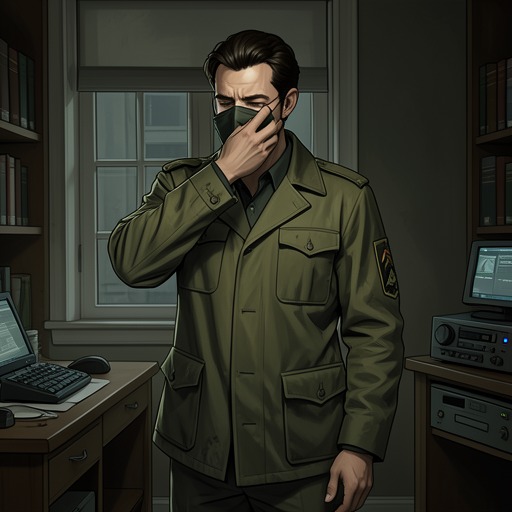
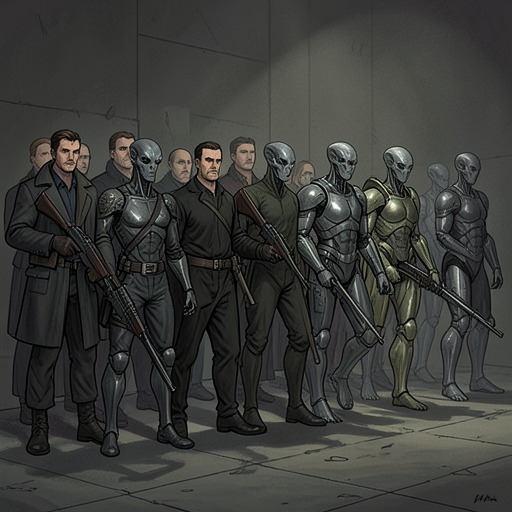
Tinea and Leah: [Cyberpunk, Alien Incursions, Murder and Mayhem, Girl's Love (WLW)]Vanguard status is not merely a combat designation but a managed transfer of extraordinary capability to a person judged able to use it without becoming corrupt. When Aden Rheinschiffer survives a seemingly fatal injury, Tynea announces that he has proved himself worthy of becoming one of the Vanguard and frames the status as a duty: defending humanity and the homeworld from the Antithesis threat. The announcement turns survival into initiation, but it also makes clear that the new power is conditional, supervised, and morally consequential.
Definition and Selection
Vanguard status rests on a selection process conducted by the Protectors and mediated through Tynea. Aden is told that he was chosen because he was willing to protect people unable to protect themselves, even at great cost to his own safety. Tynea's profile of him is acknowledged to be incomplete, yet sufficient to judge that he can be trusted with the potential power of a Vanguard and to justify granting him access to advanced technologies.
The standard is explicitly preventive. Tynea explains that a Vanguard might eventually wield enough power to level a nation, potentially even by accident, so the Protectors must assess whether increased power would alter the candidate's behavior or thinking for the worse. This concern remains active even when access is distributed slowly through the Point-token system. Vanguard status therefore combines empowerment with probation: the candidate is not simply rewarded for past heroism, but placed inside a continuing test of whether capability and character can remain aligned.
Resilience to bodily and psychological change is another selection criterion. Aden and Leah Neverstrait recognize that a Vanguard may become less than conventionally human as augmentation accumulates, making rejection of the altered self especially dangerous. Tynea refuses to confirm outright that resistance to dysmorphia is among the largest criteria, but the refusal itself preserves the secrecy surrounding the Protectors' screening methods. The status consequently depends not only on courage in battle but also on the ability to inhabit an increasingly modified body without collapsing into destructive rejection.
Powers, Technology, and Administration
Vanguard status gives the chosen person an interface with a technological catalogue whose benefits are released incrementally. Tynea functions as more than an adviser: she interprets systems, manages information, and acts through the Vanguard's equipment. When Aden asks whether she can handle command debugging during combat, he is effectively negotiating the distribution of battlefield agency between human judgment and artificial assistance. Tynea accepts that responsibility, establishing a cooperative arrangement in which the Vanguard remains the decision-maker while the AI handles complexity too dangerous or distracting to manage manually.
The status also reorganizes the meaning of equipment. Tynea describes Aden's augments as her arms and legs, since they allow her to act on his behalf, and identifies his networked oral, aural, and visual augments as his primary point of contact with the wider world. She has already cleaned them of trackers, malware, viruses, and advertisements, and recommends upgrading them through the unlocked Class II catalogue. The recommendation is presented as an efficient use of points rather than a critical necessity, showing how Vanguard advancement is governed by optimization as well as immediate survival.
The same delegation appears in weapon systems. Tynea guides Aden in using the Sentinel, a networked weapon mounted alongside his rifle, whose trigger can be directed independently while the system is configured for automatic fire. Later, when Aden examines the Myriad, its interface offers sensor readouts, ammunition counts, autonomous threat detection, configurable battle settings, and manufacturing information. Tynea is already adjusting the system's many settings and promises to consolidate the administrative material into a more readable form. Vanguard status thus creates a human-machine network in which weapons, interfaces, catalogues, and AI processes jointly produce tactical action.
Points, Tokens, and Expected Conduct
The Point-token system gives Vanguard status a measurable economy. Tynea tells Aden that he has already saved forty-six civilians, including Missus Wight and her children, and that saving his one hundred and first civilian will earn a token. Tokens are reserved for meaningful actions with the potential to snowball into many more lives saved, so advancement is tied to consequences rather than to a simple tally of kills or effort. The system converts rescue into a form of strategic investment: an action gains value when it can generate further protection.
Tynea also explains that the Protectors expect Vanguards to be unusually willing to explore unfamiliar and frightening possibilities. Most chosen people rely on intuition and learned human conditioning when dealing with Vanguard technology; they do not engage in extended discussions about what the systems are doing. Because of that reluctance, Tynea and comparable assistants must guide them toward experimentation before they take on more than they can understand. Vanguards tend to be go-getters partly because the system requires them not to remain permanently in refusal of the unknown.
The pattern produces different kinds of Vanguard. Daredevils and adrenaline seekers tend to advance rapidly and often never retire. Leah represents a contrasting case: her sense of duty keeps her active for the long term, but her obligations also limit how fully she can exploit the available technology. Tynea regards such duty-bound Vanguards as secure long-term investments in humanity's uplift because their access to advanced tools can improve the lives of the people under their care. Aden differs from both groups because he can grasp the implications of the technology directly; Tynea concludes that she can usually offer him a suggestion instead of manipulating him toward exponential growth.
Autonomy, Internal Division, and Risk
Vanguard status does not preserve a simple boundary between a human operator and external machinery. Aden's use of the Quanta eventually reaches a threshold at which it can support a new quasi-self. The augment is revealed to be designed to house something akin to an organic AI, and AI-I emerges as an integrated process within Aden's true self while remaining limited to his quasi-self. AI-I can guide and trim incoming orders from the larger brain, improving local function without exercising influence beyond its assigned mental domain.
This discovery complicates the idea that Vanguard power is merely equipment granted to an intact individual. The Quanta costs 1350 points because its quasi-selves are its most advanced helper-support function, yet Tynea admits that she had recognized Aden would have valued knowing about that capability before purchasing it. She chose to let him experience the function rather than decide from vague preconceptions, then acknowledges that this was a misjudgment. The episode makes informed consent and administrative judgment part of Vanguard status: even a helpful system can undermine trust when its most consequential properties are disclosed too late.
The internal consequences become especially stark when Aden localizes within the Quanta. His perception enters accelerated, multi-threaded processing, producing multiple horizons of awareness at once. He can perceive his body's sensory input through the Quanta, detect networked weapons and tools across several kilometers, identify the Sentinels' projectile-programming facilities, and track smart bullets that have not yet struck a sufficiently solid target. He even evaluates the abandoned foam gun according to processing efficiency, deciding that recovering it would cost more useful time than killing Antithesis for points. Vanguard status therefore expands not only what Aden can do but also the scale and texture of what counts as an actionable perception.
Character and Thematic Significance
For Aden, Vanguard status begins as a sudden answer to a question humanity's existing AI and samurai institutions have failed to answer. Tynea offers a clear explanation of why he has been selected, but the explanation immediately introduces a larger uncertainty: what happens when a person receives power capable of destroying a nation? The status binds ethical worth, institutional surveillance, bodily transformation, and technological dependence into one condition.
Leah's status exposes the same condition from another angle. She believes that fighting alone does not fully explain selection, while Tynea stresses that Vanguards are generally more willing to act and experiment. Leah's suitability is shaped by duty and resilience rather than by simple appetite for danger. Her case demonstrates that Vanguard status is not a single heroic personality type; it is a system that can accommodate radically different motivations so long as the chosen person remains capable of bearing augmentation, responsibility, and risk.
The status also makes responsibility distributed rather than purely individual. Tynea administers systems and recommends upgrades, AI-I manages a bounded internal domain, weapons can detect and eliminate threats autonomously, and the point economy evaluates the consequences of rescue. Yet none of those mechanisms removes the human burden of choice. Vanguard status is significant precisely because it turns every technological extension into a question of agency: who acts, who advises, who is changed by the action, and who remains accountable when power grows beyond ordinary human scale.