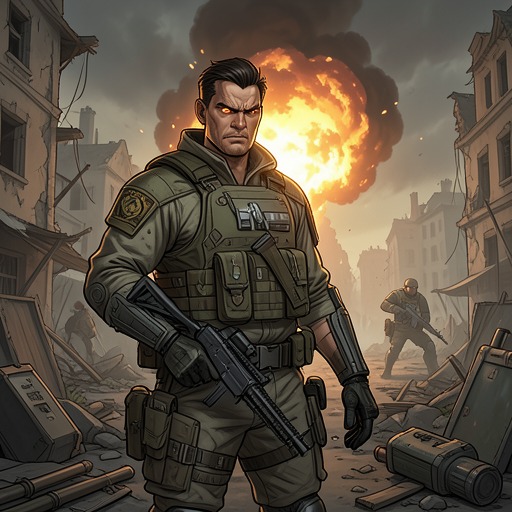
“Hello darkness, my old friend”
Tinea and Leah: [Cyberpunk, Alien Incursions, Murder and Mayhem, Girl's Love (WLW)]“Hello darkness, my old friend” is the narrator’s darkly familiar greeting to an immediate crisis, spoken at the instant when a fall, bodily collapse, and panic become a focused act of violence against Antithesis Model Three. Its significance lies less in explanation than in the abrupt change it names: darkness is no longer merely the surrounding danger, but the threshold through which fear becomes purpose.
Context and Trigger
The expression occurs during a desperate physical confrontation. The narrator has stepped forward, but the other knee suddenly weakens and collapses, leaving the narrator already over the edge and falling. A strange, panicked wheezing shout escapes, and Antithesis Model Three looks up at the sound. The bodily situation appears lost: the narrator is dropping, injured, and unable to rely on ordinary balance or strength.
That crisis produces a perceptual reversal. Something crosses the narrator’s mind, after which the world becomes silent, slow, and exceptionally clear. The phrase arrives inside this altered interval, between panic and action. It therefore functions as a verbal marker of the moment when the scene stops being experienced as uncontrolled disaster and becomes a comprehensible field containing one immediate objective.
Meaning in the Scene
Immediately after the utterance, the narrator states that there is nothing left to lose and that little else matters except the death of the opposing creature. That death becomes everything; existence itself is reduced to accomplishing it. The expression consequently carries an inward recognition of extremity rather than a casual literary reference. Its “old friend” is the darkness already associated with fear, falling, pain, and possible death, but the greeting also suggests familiarity with that state.
The phrase’s calm familiarity contrasts with the surrounding physical panic. The narrator does not become safe, composed, or physically restored. Instead, perception sharpens while the body continues to fail. This contrast gives the expression its force: darkness is greeted at the exact point where ordinary control disappears, and the narrator’s remaining agency is concentrated into one retaliatory purpose.
From Recognition to Attack
The utterance is immediately followed by deliberate positioning. The narrator lines up both feet and crashes heels-first into Antithesis Model Three’s head while screaming wordlessly. The sequence turns the phrase into a hinge between mental transformation and physical action. The narrator’s thought has narrowed to the enemy’s death, and the body is then used as the instrument of that decision despite the fall.
The attack succeeds with extreme violence: Antithesis Model Three’s head is crushed. The success does not restore the narrator’s body. The feet shatter, and before the pain can fully register, the legs change shape as the narrator slips and falls backward across the body of Antithesis Model Three. The expression thus belongs to a victory that is inseparable from mutilation. It announces not escape from darkness, but action carried through darkness at a cost the body immediately records.
Narrative and Thematic Function
As a compact expression, “Hello darkness, my old friend” compresses a complete value shift. The scene moves from helplessness and imminent death to clarity and purposeful violence, then moves again into bodily devastation after the enemy is killed. The wording makes the reversal memorable because it is understated: a familiar greeting appears where a cry of terror might be expected, giving the narrator’s extremity the shape of recognition rather than surprise.
The expression also links consciousness to physical transformation. The narrator’s mind becomes silent, slow, and clear before the legs change shape and the body collapses across the defeated opponent. Darkness therefore accompanies both psychological focus and altered embodiment. It is not presented as a solution or moral purification; it is the condition in which the narrator can act when ordinary interests have fallen away. The line’s lasting significance comes from that contradiction: it sounds almost companionable, yet it precedes an attack that kills Antithesis Model Three and leaves the narrator catastrophically injured.