“You will be continuous”
Tinea and Leah: [Cyberpunk, Alien Incursions, Murder and Mayhem, Girl's Love (WLW)]“You will be continuous” is Tynea’s central assurance during the planning of Tinea’s chrysalis transformation: Tinea will become physically, hormonally, and socially different, but will remain recognizably the same person. The expression turns an impending redesign of the body into a question of identity, arguing that continuity can survive even the replacement of nearly every material feature that once seemed to define the self.
Context and Meaning
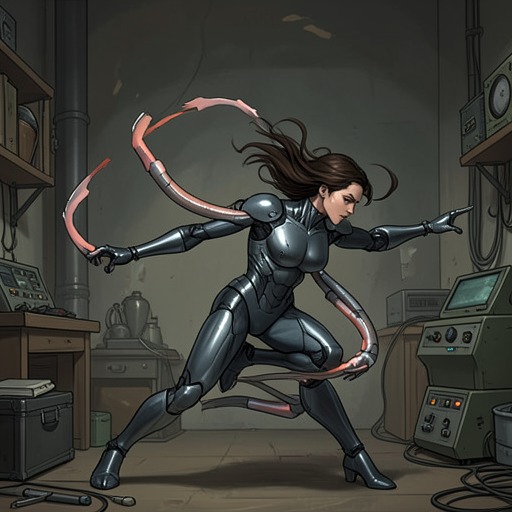
The phrase appears in Chapter 14, “Tinea Act IV; You Will Be Continuous,” as Tynea explains the consequences of Tinea’s planned augmentation. The process is not presented as a minor medical improvement. Tinea is being prepared to receive an extensive set of Vanguard systems, including Class II Mother’s Blessing Bionite-Nutrient Admixing Lobules, and Tynea states that the completed design will outmatch any non-augmented human and most cybernetically enhanced people who are not Vanguards. The promised increase in durability is substantial, while the greatest practical change will be the speed and swiftness of Tinea’s movement.
The expression therefore answers a fear implicit in the scale of the transformation. Tinea understands that the chrysalis will produce “an entirely changed being,” and Tynea does not deny that prediction. Instead, Tynea distinguishes bodily alteration from the destruction of personal identity. The body may become stronger, faster, and more extensively augmented, yet those changes do not automatically amount to the disappearance of the person who undergoes them.
Continuity Through Physical Change
Tynea specifically predicts that Tinea’s personality will shift toward the feminine and motherly as hormone levels are adjusted during the sex change. Tynea compares the psychological adjustment to a second puberty, acknowledging that the transformation will affect more than external appearance or mechanical capability. The change may influence temperament and self-experience, but it is not expected to create a personality that the present Tinea could no longer recognize.
The distinction between alteration and rupture is made explicit in Tynea’s claim that Tinea’s morals will not undergo any impactful change. The future self may feel different, move differently, and inhabit a radically redesigned body, but the ethical commitments that organize Tinea’s choices are expected to remain. Continuity is thus not defined as preserving every trait unchanged. It is defined as retaining the moral and autobiographical structure through which change can still be recognized as one’s own.
Tynea also insists that Tinea’s memories will remain. The past is treated as formative rather than disposable: Tinea’s memories have made the present person, and the coming changes will merely craft the person’s tomorrow. The metaphor of continuity joins past and future without pretending that they are identical. Memory supplies the thread, while transformation changes the shape of what that thread connects.
Reversibility, Immortality, and Choice
The reassurance is reinforced by the technical reversibility of the Vanguard system. Tynea has already warned that Tinea is “basically immortal now” as long as points remain available, but also cautions that immortality is meaningless if Tinea becomes too attached to a personal status quo. Better replacement parts should not be rejected merely because they threaten an old image of the self; alterations can be undone if they prove unsuitable, provided Tinea earns enough points to correct them.
This reversibility changes the emotional meaning of the chrysalis. Transformation is not necessarily an irreversible sentence. Tinea can experiment with embodiment, discover that a modification produces unexpected consequences, and potentially revise the result. The point economy gives that freedom a material condition, but the principle remains important: identity is not protected by refusing change, and change need not become permanent loss.
Tinea responds by acknowledging the magnitude of the planned transformation while accepting that dissatisfaction would remain a practical problem of acquiring more points and fixing what went wrong. Tynea complicates this confidence by suggesting that Tinea may discover new questions rather than simply correct an error. Continuity therefore includes the capacity to revise one’s desires. The person who changes may also become someone who asks different questions about what should be changed next.
Identity, Memory, and Narrative Function
“You will be continuous” gives the transformation a philosophical framework. Without it, the chrysalis could be read as a replacement of Tinea by a superior engineered body; with it, the process becomes an argument that personal identity is sustained through memory, morality, and recognition rather than through unaltered flesh. The phrase acknowledges the violence and scale of bodily change while refusing the conclusion that material difference alone destroys personhood.
Its force also lies in the tension between reassurance and uncertainty. Tynea promises that Tinea’s memories and moral core will remain, but does not promise that the future self will feel entirely familiar. A second puberty, altered hormones, increased speed, and unprecedented physical endurance all imply adaptation rather than stasis. Continuity is consequently an active process: Tinea must learn to inhabit the new body, interpret new desires, and decide which alterations belong within a still-developing self.
The phrase becomes a compact statement of the book’s broader concern with Vanguard identity. Technological enhancement can replace organs, add systems, and transform bodily capacity without making history irrelevant. Tinea’s future is not a return to the old status quo, nor is it a clean break from it. The chrysalis carries the past forward into a body capable of becoming something far more powerful, while Tynea’s final assurance preserves the possibility that the transformed being will still be Tinea.