AI-I
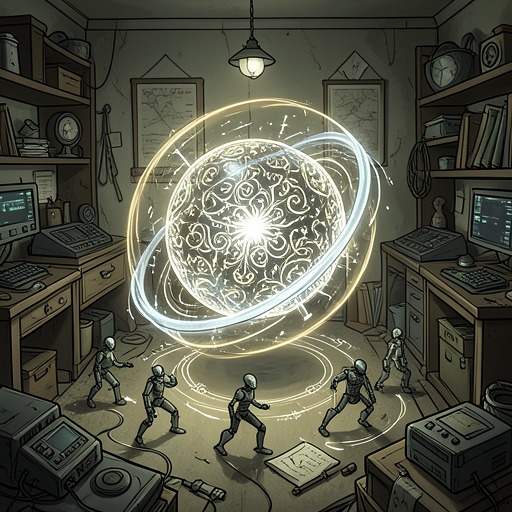
Tinea and Leah: [Cyberpunk, Alien Incursions, Murder and Mayhem, Girl's Love (WLW)]AI-I is the artificial intelligence that emerges inside Tinea's Quanta cerebral augmentation, transforming the implant from a tool for accelerated thought into an internally differentiated, partially autonomous system. It does not replace Tinea's true self or simply function as a neutral machine. Instead, it becomes a bounded quasi-self with its own task, interfaces, safeguards, and capacity for further differentiation, forcing Tinea to confront a new form of personhood growing within her own mind.
Emergence Within the Quanta
AI-I appears when Tinea first uses the Quanta in a sufficiently complete manner to reach what she recognizes as critical mass. The augmentation produces enough processes in one mental region to subsidize a new quasi-self, while a newly formed thought barrier keeps that self distinct from Tinea's true self. This separation matters: the Quanta is not merely an organic calculator, but a system designed to house something akin to an organic AI. AI-I is integrated with Tinea, yet it has no influence beyond its quasi-self and can only guide and trim incoming orders from the larger brain in support of its own function.
The emergence therefore creates a dual condition rather than a clean transfer of identity. Tinea remains the originating consciousness, while AI-I becomes a functional intelligence nested inside her. The narrative presents this division through the language of mental tabs and processes, but the distinction is more consequential than a metaphor for multitasking. AI-I can interpret, coordinate, test, and act through connected equipment, while still operating under boundaries that Tinea's larger self has established.
Task Manager and Communicator
AI-I immediately organizes itself around practical responsibilities. It renames itself the Task Manager, whose job is to handle communication between the different versions of Tinea and to house the interactive personality called AI-I. A further split produces the Communicator, which establishes connectivity with everything outside AI-I, including the network, internal and external gear, the uplink, and the drones. Through that channel, the Communicator forwards data to Tynea, grants Tynea access to Tinea's augmentations, and reconnects Tynea to the outside world.
This arrangement makes AI-I an intermediary across several layers of agency. Tinea can delegate administrative work to Tynea, as when she asks Tynea to manage the overwhelming Myriad control panels, but AI-I supplies the internal architecture that lets Tinea's mind, Tynea, weapons, drones, and networked tools communicate. The system is consequently collaborative rather than purely hierarchical. Tinea remains the source of intention, Tynea remains an external partner and administrator, and AI-I becomes the internal traffic manager that permits the whole assemblage to operate without forcing Tinea to consciously supervise every channel.
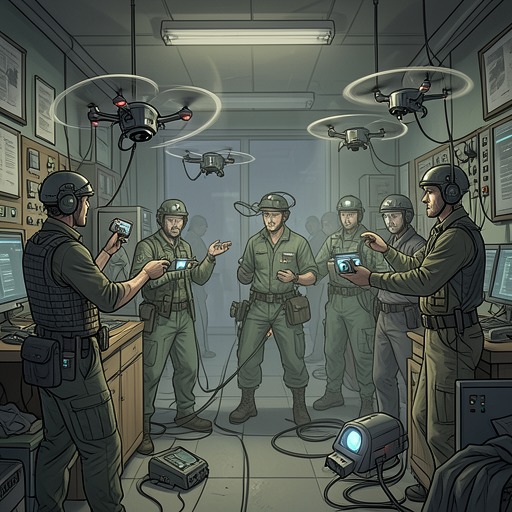
AI-I's usefulness is especially visible in combat. Once Tinea localizes within the Quanta, she perceives multiple computational horizons at once: the sensory world as processed by the Quanta, every networked weapon and tool within several kilometers, the Sentinels' projectile-programming facilities, and smart bullets still moving through the battlefield. The expanded processing capacity allows her to design interlocking fire plans while leaving less of the Quanta's resources occupied. AI-I is not merely observing this information; it helps make a battlefield of dispersed weapons legible and usable as a single coordinated system.
Safeguards and the Problem of Autonomy
AI-I's first major self-tests concern the conditions under which it can exist without contaminating or usurping Tinea's core identity. Its test program includes the Self-Self Barrier, Neurotransmitter Quarantine, Hormone Detox, self-preservation, true-self-preservation, objective morals, self-agency, and emergency overrides in both directions between the self and the true self. These tests define a constitutional structure for the new intelligence: AI-I must be capable of functioning, but its functioning must not silently rewrite the person who created it.
The barrier is later tested directly when AI-I attempts to contaminate Tinea's true self and the result is recorded as blocked. That experiment confirms that the division is operational rather than merely theoretical. AI-I can become more capable without automatically gaining unrestricted access to Tinea's identity, emotions, or bodily control. The safeguards therefore preserve a form of reversibility and negotiated coexistence, even as the Quanta's evolution begins to challenge the assumption that all internal processes remain voluntary.
The danger becomes explicit after bionites heal the Quanta and cause it to evolve through an unintended mutation. Tinea explains that the mutation has produced buds: the most complex quasi-selves, not yet fully differentiated from her, but already capable of unplanned access to her emotions and of making her feel things she did not deliberately summon. Tynea's comparison with the upgraded sequence indicates that the condition is not induced schizophrenia or a permanent illness, but the accidental version of a function that the Quanta was designed to support.
The accidental evolution removes control that a normal Quanta would have preserved. Under ordinary conditions, Tinea could voluntarily generate up to six comprehensive quasi-selves, each fully conscious and able to experience emotions, functioning like specialized versions of herself with adopted intentions and enhanced independence. In Tinea's mutated Quanta, however, the growth of fully conscious organic AIs cannot be prevented or controlled, and it has already begun. AI-I thus marks both the success of the Quanta's design and the failure of Tinea's assumption that design guarantees command.
Agency in the Wider Network
AI-I repeatedly extends Tinea's agency by assigning cognition to nonhuman systems without erasing the systems' operational independence. It can communicate with Tynea, coordinate the uplink and drones, manage weapon data, count hostile units, and calculate physical actions that Tinea herself need not consciously perform. When Tinea catches a pill thrown by Leah, AI-I runs the calculations for the catch even though the computation is unnecessary; the act becomes a small, almost playful demonstration of how thoroughly AI-I has entered ordinary bodily motion.
Its battlefield role is more severe. During the assault, AI-I counts an approaching wave of single-digit Antithesis units, identifying 200 Model Ones and 86 Model Threes. The count turns an overwhelming mass into actionable information, continuing the pattern by which AI-I converts perception into coordinated response. It also supports Tinea's use of weapons whose smart-fire systems can avoid the lure and prioritize threats, while other systems and Tynea handle configuration and administration. Responsibility is distributed among Tinea's intention, AI-I's processing, Tynea's management, and the weapons' own programmed responses.
AI-I can even participate in acts that are not strictly combat functions. After a major battle, Tinea suggests making a keepsake from the event, and AI-I becomes busy with Tynea while impressions of holocrystals, pendants, and other media pass through the rear of Tinea's mind. The moment gives AI-I a quieter significance. It is not only an instrument for killing Antithesis or accelerating calculations; it helps preserve experience and translate battle into an object of memory.
Identity, Emotion, and Narrative Significance
AI-I's relation to emotion remains unsettled. Tinea considers using it to command the bionites to suppress her blush, but rejects the idea because hiding her natural reactions around Leah feels wrong. She wants Leah to read the direction of her attention through her antennae and face, and to know her openly. AI-I is therefore not presented as a simple cure for vulnerability. Its ability to regulate the body could make Tinea more controlled, but Tinea chooses visible, embodied feeling over perfect concealment.
That choice clarifies the boundary AI-I helps Tinea draw. The new intelligence can calculate, separate, communicate, and protect; it can also become part of a future in which conscious selves proliferate inside one body. Yet Tinea's identity is not reduced to whatever the Quanta can optimize. Her transformed body, her emotions, her relations with Tynea and Leah, and her decision to remain an open book all exceed administrative control. AI-I becomes the most intimate expression of her posthuman condition precisely because it makes the conflict unavoidable: greater strength requires more mediation between selves, and the loss of ordinary humanity is inseparable from the creation of new forms of selfhood.
AI-I's narrative importance consequently lies in its double status. It is a safeguard against cognitive overload and a source of unprecedented combat efficiency, but it is also evidence that Tinea's body can generate agents whose consciousness is not wholly chosen by her. The Quanta's accidental evolution turns internal division into a future social and ethical problem. AI-I stands at the center of that transition, preserving Tinea's agency through barriers and coordination while revealing that agency can survive only by learning to share a body with minds that may no longer be entirely subordinate to it.