Aden Rheinschiffer · Tinea Rheinschiffer
Tinea and Leah: [Cyberpunk, Alien Incursions, Murder and Mayhem, Girl's Love (WLW)]Aden Rheinschiffer / Tinea Rheinschiffer is the central identity through which the story joins personal recovery, gender transition, cybernetic embodiment, and the militarized promise of the Vanguard. Aden begins as an isolated freelancer trying to build a tolerable civilian life while suppressing memories of violence. After Tynea identifies Aden as worthy of becoming a defender of humanity, the character chooses a female identity and wakes as Tinea. That change is not cosmetic: it reorganizes Tinea’s relationship to the body, to agency, to Tynea, and eventually to the distributed intelligence of Vanguard technology.
Identity and the Ordinary World
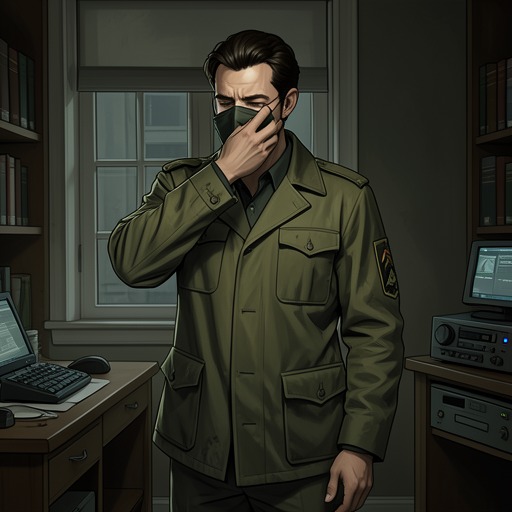
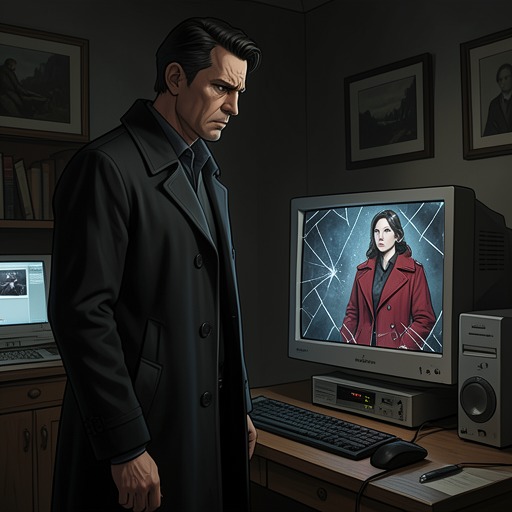
Aden’s early life is marked by deliberate containment. Old anger still returns in flashes of muzzles and imagined gunfire, and the right index finger twitches with the remembered impulse to shoot. Yet Aden consciously rejects that inheritance, recognizing that hatred and revenge cannot restore the life already lost. The decision to keep moving is practical rather than triumphant. Aden works as a freelancer designing, dictating, and testing prompts for industrial-robot systems in a smaller manufacturing company near New Montreal, using that work to pay bills and maintain a modest home.
This domestic setting matters because it establishes a fragile version of recovery before the Vanguard transformation begins. Aden can afford food that is at least somewhat healthy and even middling-quality augmentations, although rent remains difficult and the apartment is small. The space feels like home because Aden takes care of it. Social isolation has not disappeared, but happiness has improved: Aden is alone in a way that is familiar, controlled, and more bearable than the earlier life haunted by anger.
The apparent stability ends when Aden’s body and perception fail under catastrophic pressure. Vision flickers on and off as though the eyes were television screens, and breathing becomes difficult enough that internal bleeding seems more immediately fatal than suffocation. In that threshold between likely death and impossible survival, Tynea’s voice arrives with unusual clarity. The system announces its initialization, declares Aden worthy of becoming one of the Vanguard, and assigns the new role as a defender of humanity against the Antithesis threat. Tynea’s first address therefore functions as both diagnosis and summons: Aden is not merely rescued, but reclassified as a protector of the weak.
Choosing Tinea
The Vanguard offer becomes personally transformative because Aden has long wanted to be a girl. That desire had been managed through resignation: Aden had worked at being happy while believing that a female life would never be available. The sudden discovery that transformation is possible overturns the logic of that resignation. The question is no longer whether the desire exists, but whether Aden should accept its consequences and act on it.
Aden’s choice is direct, though not presented as simple. The possibility of transition destabilizes everything previously learned about identity and obligation, including the fear that wanting another body might be irresponsible or impossible. Aden concludes that refusing the opportunity would itself be a choice, and decides to proceed despite consequences that cannot yet be known. The transformation thus begins as an act of self-recognition rather than as a reward imposed from outside.
The name change is treated as part of that act. When Tynea asks which name should be used and when, Aden answers that Aden remains appropriate for the present, while Tinea should be used after waking. Tynea accepts the distinction and promises to wake Aden under the chosen name. The boundary is precise: Aden is not erased by administrative decree, but Tinea is deliberately brought into being at a chosen moment. Tynea’s role is consequently both technical and relational, because she helps preserve continuity while honoring the new identity.
The first morning as Tinea supplies the emotional confirmation that the earlier decision could not provide by itself. Tynea’s greeting uses the new name before Tinea is fully aware of waking. The response is immediate and physical: a broad smile breaks across Tinea’s face, followed by the pain and visual overload of a severe headache. The headache does not cancel the moment. Tinea is fully awake, and happiness surges from the realization that the long-held wish has become an embodied fact.
The New Body and Vanguard Agency
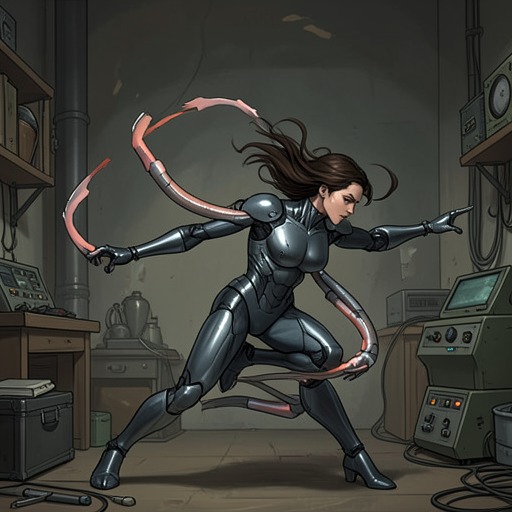
Tinea experiences the transformed body as recognizably hers even when its proportions and capabilities are unfamiliar. The tail remains long and soft but has become sturdier, with a spinal structure connected to the human spine. It moves naturally, as though the motion had always been available. More strikingly, Tinea’s limbs are slender, muscular without the bulk associated with the previous masculine body, and experienced as graceful. The physical changes therefore carry an interpretive force: the body is not only more powerful, but more congruent with Tinea’s desired self-understanding.
The narration does not separate gender affirmation from bodily sensation. Tinea notices the altered chest, balance, ticklishness, and the difficulty of concentrating while standing for the first time. These details make the transformation concrete without reducing it to a visual makeover. Tinea must learn how this body moves, where its weight falls, and how attention itself changes in response to it. Embodiment becomes an ongoing practice, not a single completed procedure.
At the same time, Vanguard status turns agency into a networked function. The Sentinel’s trigger is not simply held as an ordinary mechanical component; a panel extends from the scope, forms a new trigger beside the rifle’s original trigger, and responds like putty when Tinea pulls it. Tynea explains that the Sentinel is set to full automatic fire and currently unloaded, placing weapon control inside an interface that is both physical and programmable. Tinea can guide the system, but the rifle’s lethality is mediated by design, configuration, and artificial assistance.
Tinea repeatedly delegates technical administration to Tynea. Rather than debugging commands while fighting, Tinea asks whether Tynea can take responsibility for that work, and Tynea accepts it as her role. Later, while examining the Myriad, Tinea confronts a battle interface containing sensor readouts, missile inventories, autonomous threat-detection settings, manufacturing data, material levels, and radically different production limits: available materials could produce roughly a thousand high-explosive mini-missiles but only ten nanite missiles. The interface is too extensive to absorb during preparation, so Tinea again asks Tynea to handle the administrative burden and consolidate critical information.
This delegation does not make Tinea passive. It defines a cooperative form of agency in which Tinea chooses objectives and tactical priorities while Tynea organizes the systems required to pursue them. The arrangement becomes even more expansive when Tinea localizes through the Quanta. Multiple horizons appear at once: the physical body’s perceptions are reprocessed at accelerated speed, and every networked weapon or tool within several kilometers becomes available to awareness. Sentinels, projectile-programming facilities, smart bullets, and weapon systems enter a single tactical field. The abandoned foam gun becomes irrelevant beside the opportunity to kill Antithesis for points, while new geneware permits Tinea to design interlocking munitions and complete fire plans with less Quanta capacity occupied.
Relationships and Conflicts
Tynea is the first relationship to shape Tinea’s new existence. She announces the Vanguard system, explains its purpose, answers questions, assists with the transition, and takes responsibility for administrative complexity. Her gentle voice contrasts with the violence of the role she enables. Tinea’s relationship with Tynea is therefore built from trust, but it is not merely emotional reassurance: Tynea becomes the interpreter and manager of a rapidly expanding technological body.
Tinea’s relationship with Leah reveals another side of that identity. When Leah wakes after having her limbs taken, she initially sees a gray artificial hand where she expects flesh and blood. Fear threatens to return with the memory of the mutilation, but the memory of being saved and cared for by Tinea keeps that fear from overwhelming her. Tinea is lying across Leah’s lap, apparently unconscious, with her antennae unnaturally still. Leah confirms that Tinea is alive, then adjusts Tinea into a more comfortable position and strokes her brows despite her own migraine.
The scene reverses the usual direction of rescue. Tinea has been Leah’s protector, but Leah’s first conscious response is to protect and comfort Tinea. Their bodies are both marked by technological alteration and injury, yet care passes between them without requiring either body to return to an unmodified human state. Tinea’s significance is consequently relational: the transformed body becomes a means of sheltering another vulnerable person and of receiving tenderness in return.
The larger conflict is philosophical as well as military. Tinea recognizes that Vanguard strength requires movement away from ordinary human embodiment. In conversation with Leah, Tinea reduces a difficult question about the samurai and their implications to the conclusion that Vanguard members become less and less human as they grow stronger. Leah agrees, and Tinea calls the process inevitable because the human body is insufficient for the demands placed upon it. The statement is not a rejection of humanity so much as an acknowledgment that survival and power have been organized around abandoning the body’s limits.
Change, Distributed Self, and Narrative Role
Tinea’s arc joins several transformations that might otherwise be treated as separate: recovery from revenge, acceptance of a female identity, adaptation to an engineered body, reliance on Tynea, and expansion into Quanta-mediated awareness. The movement from Aden to Tinea is therefore neither a simple replacement nor a clean return to an authentic self supposedly waiting intact beneath the surface. Aden’s memories and decisions remain part of the continuity, while Tinea’s name marks a chosen future and a newly habitable relation to embodiment.
The character’s development also bends the conventional heroic pattern. The initial call to adventure is delivered by an artificial intelligence at the edge of death, and the reward is not a return to an unchanged community but an increasingly nonhuman mode of existence. Tinea’s threshold crossing leads into systems of weapons, autonomous tools, points, and networked cognition. The more capable Tinea becomes, the less useful it is to imagine action as the product of a solitary human will.
That tension reaches its clearest form in the Quanta experience. Tinea perceives the battlefield through several simultaneous horizons, including the body’s accelerated sensory processing and the operational status of distant weapons. The self becomes distributed across interfaces and munitions without becoming wholly dissolved. Tinea still evaluates efficiency, notices what has been abandoned, and selects what deserves attention; however, those judgments now govern a field in which tools can detect, calculate, program, and kill with partial autonomy.
Tinea’s decisive narrative function is to make the book’s central contradiction personal. The Vanguard promise protection, but protection demands militarization. The transformed body offers gendered self-recognition, but it also exposes the instability of human physical norms. Tynea offers assistance, but that assistance expands the portion of life entrusted to artificial systems. Tinea survives by accepting change, yet every increase in strength raises the question of what kind of person, or what kind of being, is doing the surviving. The character’s importance lies in refusing to treat that question as an abstract puzzle: each answer is written into a name, a body, a weapon, a relationship, and the next decision to keep moving.