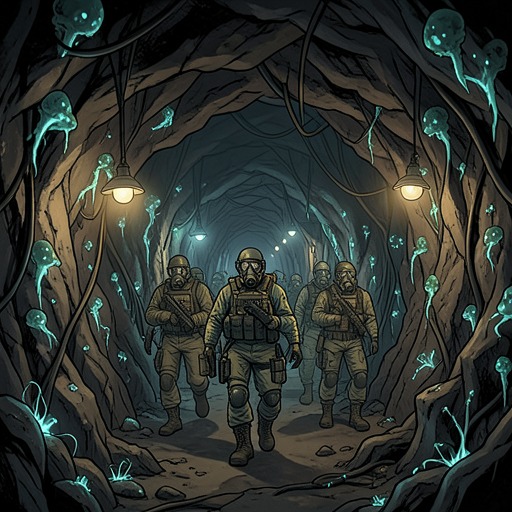
Antithesis Nest
Tinea and Leah: [Cyberpunk, Alien Incursions, Murder and Mayhem, Girl's Love (WLW)]Antithesis Nest is the underground hive created when an Antithesis Model Twenty-Two roots itself and converts gathered biomass into a permanent reproductive base. It is not merely a shelter or concentration of enemy units: it is an ecological and military transformation. Once a nest exists, Antithesis units can feed, reproduce, raise new units, and expand their strength without remaining dependent on the original mobile group. The nest therefore marks the point at which a local threat becomes an incursion capable of generating its own future forces.
Definition and Formation
Antithesis Nest begins as an uncertain possibility after several Antithesis units disappear into a cave system beneath Saint-Eustache, New Montreal. Tynea reports that a drone entered partway before being destroyed and found no visible existing nest. The missing units may have been feeding a small hidden nest so that it could grow faster, or they may have been preparing to root and spawn an entirely new one. In either case, the danger lies in delay: an underground colony can accumulate strength before it becomes visible, and Tynea recommends destroying it immediately.
The later appearance of a nest confirms the second stage of this process. Leah encounters numerous Antithesis units, including fifty Antithesis Model Tens, small monkey-like creatures with six five-fingered arms, no legs, and no head. Their physical weakness does not make them unimportant. They are caretakers that manage feeding pools and inspect growth sacs, and their presence proves that a proper hive has formed. Leah consequently infers that the Antithesis Model Twenty-Two has rooted and become a nest, a conclusion Tynea confirms.
Internal Ecology
The nest is organized around nonhuman sensory and reproductive systems rather than human architecture. In the Antithesis viewpoint, food is identified through smell, carried back to the home-place, and marked along the trails with glandular signals. At the nest, newly emerged units fall from opened birth-fluid sacks near the birth-wood. Other units approach and smell them; those whose scent matches the colony are accepted, while a sick or badly formed unit is killed and rapidly torn apart by the others.
This sequence reveals the nest as both nursery and immune system. Reproduction does not produce individuals that are treated as autonomous members of a society; it produces bodies that must be recognized by colony scent and judged for fitness. Feeding, birth, inspection, and elimination are continuous operations. The nest’s social order is therefore expressed through pheromonal recognition and collective action, with the boundary between organism and group made deliberately unstable.
Detection and Military Threat
The nest changes the tactical meaning of the Antithesis forces around it. An isolated unit can be hunted as a target, but a rooted Model Twenty-Two establishes a source of continuing growth. The caretaking Model Tens openly attack Leah because she has come close enough to threaten the reproductive center. Their attack is less dangerous because of their own strength than because it identifies what they are protecting.
The nest is dug only about one or two meters underground, yet that shallow burial still complicates conventional attack. Leah can see the six deep, meter-wide furrows left by the rooted unit, with rainwater and mud collected in them, but her towed cannon is positioned on a hill and is initially better suited to striking exposed targets than something beneath the ground. She considers whether a sufficiently large crater could expose the hive. The physical traces of the nest thus turn the landscape into evidence: ruts, mud, feeding routes, and surface disturbance disclose an underground life that remains concealed from direct fire.
Weapons, Networks, and Destruction
The struggle against a nest depends on a network of delegated nonhuman agents. Tinea can assign combat administration to Tynea, while Tynea configures autonomous systems such as the Sentinel intelligent rifle and the Myriad regenerative missile hive. The Sentinel is set for full automatic fire and can be guided through a projected trigger, allowing its targeting and firing functions to operate as extensions of Tinea’s body. The Myriad provides a battle panel for autonomous threat detection and can manufacture roughly a thousand high-explosive miniature missiles from available materials, though only ten nanite missiles are possible with the loaded resources.
The weapons are designed to cooperate with the transformed body and with one another. Smart-fire missiles can avoid the lure rather than destroying it accidentally, and their launch batteries can be mounted without preventing the use of wings; the missiles are magnetically catapulted through membranes built to withstand that sort of injury before their motors engage at a safe distance. Tinea’s fabrication system likewise turns powdered ferrite, carbon, oxygen, water, copper, napalm-like material, and concrete held in stasis into threads and battlefield substances. Against a nest, the relevant weapon is therefore not a single gun but an assemblage of bodies, artificial intelligence, ammunition, fabrication, sensors, and terrain.
The later campaign shows the scale of force required after a nest has matured. A localized meteor storm leaves approximately fifty Antithesis Model Threes, several Model Fours, and two badly burned Antithesis Model Eights still moving. Tinea proposes loading nanite ammunition into the surviving Eights to prevent future nests in the area. The purpose is not only to kill the visible units; nanite payloads are used to remove the possibility that damaged survivors might preserve or restart the reproductive threat.
Narrative and Ecological Significance
Antithesis Nest expands the Antithesis from an enemy army into an alien ecology with its own sensory language, reproductive infrastructure, and standards of collective health. The scene in Saint-Eustache presents the hive through smell, food trails, birth fluids, growth sacs, and the killing of a malformed offspring, granting the colony a viewpoint that does not depend on human interpretation. Its behavior is horrifying because it is not chaotic: it is coherent, efficient, and adapted to the conditions of its world.
At the same time, the nest mirrors the book’s broader interest in distributed agency. Antithesis units act through pheromone trails and collective responses; Tinea acts through Tynea, Sentinels, missiles, drones, and the Quanta brain augmentation. Both sides make individuality porous. The nest is the most literal expression of that principle, because a rooted Model Twenty-Two becomes the center of a system in which breeding, feeding, defense, and selection belong to the colony as a whole rather than to any one body.
Its significance is ultimately strategic and temporal. A mobile Antithesis group threatens the present, but an Antithesis Nest manufactures the future. That is why the cave report treats the uncertain possibility of rooting as an emergency and why Leah’s recognition of the Model Twenty-Two’s transformation changes the battle’s stakes. Destroying exposed units can win a fight; eliminating the nest prevents the fight from reproducing itself.