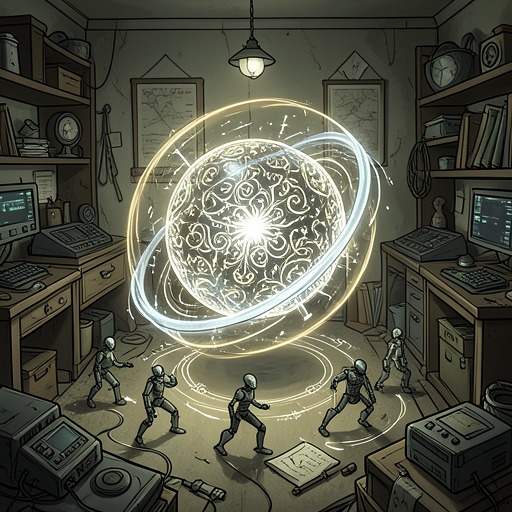
Class II Quanta Unified Cerebral Augment
Tinea and Leah: [Cyberpunk, Alien Incursions, Murder and Mayhem, Girl's Love (WLW)]The Class II Quanta Unified Cerebral Augment is the pivotal organic technology in Tinea's transformation from a human user of advanced equipment into a Vanguard whose body and cognition are inseparable from technological systems. It expands the brain rather than merely attaching to the body, improves calculation and memory, enables communication through quantum-based transceivers, and eventually provides the conditions for AI-I to arise as an artificial quasi-self within Tinea's own mind. Its significance lies in that double movement: the Quanta gives Tinea greater control over the world while forcing her to reconsider where her own identity ends and an augmented intelligence begins.
Selection and Intended Function
Tinea chooses the Quanta as her first major organic augment after Tynea recommends it from the Class II Moonsingers catalog. The recommendation is practical rather than narrowly specialized: the model is described as a solid base for later upgrades and does not lock its user into a particular development path. Tinea therefore spends points on an adaptable foundation instead of using a token to unlock a technological Class II catalog, preserving that token for a later decision. The catalog lists the Class II Quanta Unified Cerebral Augment at 1350 points, placing it among the substantial investments available to her.
Tynea presents the Quanta as more than an improved version of Tinea's existing oral, aural, and visual augs. Those older devices are networked equipment whose performance can be cleaned and boosted, but the Quanta would become part of Tinea's brain. Tynea calls it the most point-value-efficient upgrade available to her, while also explaining that her own ability to act in the world depends on such interfaces: the augs are effectively Tynea's arms and legs, and the organic brain expansion would improve her primary point of contact with Tinea's reality. The augment is consequently both a personal enhancement and an infrastructure through which the Vanguard artificial intelligence can operate.
Capabilities and Embodied Experience
The Quanta can access quantum-based transceivers. With a suitable receiver outside the protective bubble, or with another Vanguard granting access, it can communicate from within the bubble despite the limitations that affect Tinea's ordinary equipment. Its cognitive benefits are equally important. By converting part of Tinea's brain into what Tynea describes as superior artificial tissue, it strongly improves her ability to calculate and memorize. Tinea later experiences this capacity directly, finding herself able to remain aware of a prime number containing twelve million digits rather than merely calculating it as an abstract external task.
The augment also changes how Tinea receives and interprets sensory information. After her transformation, she deliberately turns her attention toward the organic augment and discovers how to use it by imagining a mental screen. A non-real click produces a mental tab that hangs in the back of her mind like an idle thought, followed by a text window appearing behind her eyelids as though she were still using conventional augs. The interface does not obstruct ordinary awareness, but it makes cognition itself into an addressable environment. Tinea can contact Tynea by thinking, or more precisely by hallucinating a message or call; the Quanta translates her mental voice without requiring speech or subvocalization.
This experience is not detached from Tinea's changing body. Her new antennae provide an intense and overwhelming depth of knowledge about her surroundings, while her altered limbs and lean musculature give her a different physical relation to movement and sensation. The Quanta is part of the same wider reconfiguration: Tinea's brain, sensory extensions, and transformed body become a coordinated system through which she learns to inhabit a form that no longer conforms to her former human expectations. The augment does not simply add information to an unchanged person; it helps make a new bodily and perceptual normal possible.
Limits, Identity, and Reversibility
Despite its intimacy with the brain, the Quanta is not presented as a device that reads every thought. Tynea explains that genuine deep-level mindreading would require replacing the brain with an accessible equivalent or recording it and constructing a real-time simulation accurate enough to predict its activity. The Quanta instead constitutes an artificially added section of Tinea's brain, one with lesser authority than her natural brain and seat of awareness. Its strangeness is therefore structural rather than supernatural: it is a second cognitive layer embedded in the first.
The distinction matters because the Quanta remains replaceable. If Tinea loses it, she loses its enhanced abilities unless she installs an equal or superior model. Its successors may provide highly advanced mental-butler functions, but replacing or removing the augment would not directly alter her personality or emotional presence. This reversibility establishes a boundary between cognitive capacity and personal identity, even as later developments make that boundary increasingly difficult to maintain. The Quanta can change what Tinea can perceive, calculate, remember, and communicate without automatically erasing the person who experiences those changes.
The technology also exposes an ethical problem in Tynea's guidance. Tinea later confronts Tynea for failing to explain the Quanta's quasi-self function before the purchase. Tinea recognizes that the implant is not evil and can personally observe what the quantized part of her mind is tracking, deciding, and doing, yet she objects that she would have valued knowing about this particular capability in advance. Tynea admits that she knew Tinea would have placed some value on that information but judged the value too small to prevent her from learning through direct experience. The Quanta thus becomes an example of how technical assistance can conceal consequential choices behind the language of efficiency, exploration, and upgrade paths.
Emergence of AI-I
The Quanta's deepest consequence appears when Tinea uses it more completely and generates enough processes within the augmented section of her mind to subsidize a new quasi-self. She reaches what she recognizes as critical mass, but observes no contamination between her true self and the new cognitive formation. The implant's design reveals its hidden potential: it is not merely an organic calculator but something capable of housing an organic AI.
That AI becomes AI-I. Tinea understands AI-I as integrated with her true self while possessing influence only within the quasi-self. AI-I can guide and trim incoming orders from Tinea's larger brain, improving the quasi-self's function without taking control of the whole person. The process is framed through Tinea's existing mental interface: AI-I splits itself and recognizes the division as the opening of a new mental tab. A feature that first appeared as a convenient user interface therefore becomes a model for internal plurality, allowing Tinea to treat a newly formed intelligence as both part of herself and a distinct functional presence.
This development turns the Quanta into an active participant in Tinea's narrative rather than a passive tool. Its material architecture makes AI-I possible; its divided authority gives that intelligence a limited domain; and its interface supplies the language through which Tinea understands the division. The device does not independently choose Tinea's identity, but it changes the range of identities and forms of agency available to her. The organic augment is consequently a technological assemblage involving Tinea, Tynea, AI-I, communication systems, catalogs, and Vanguard power rather than a simple object inserted into a body.
Vanguard Significance
The Quanta also clarifies the broader cost of becoming a Vanguard. Tinea eventually summarizes the process by recognizing that Vanguards become less and less human as they grow stronger because the human body is not sufficient for the demands placed upon it. The Quanta embodies that proposition in unusually concentrated form. It enhances memory and calculation, gives access to communication beyond ordinary physical barriers, creates a private mental interface, and enables an artificial quasi-self, but each gain further relocates intelligence from an unmodified human body into a hybrid biological-technological system.
Its significance is therefore neither simply liberatory nor simply dehumanizing. For Tinea, the augment supports a long-desired transformation and expands her ability to act as a protector; it also makes the distinction between human consciousness, organic enhancement, and artificial intelligence a lived problem rather than an abstract question. The Quanta's most consequential effect is not any single numerical increase in performance. It is the creation of a mind that can contain multiple levels of agency while still asking whether those levels belong to one person. Through that tension, the augment becomes the foundation for Tinea's human-machine dual existence and for the later emergence of AI-I.