Cyber dysmorphia
Tinea and Leah: [Cyberpunk, Alien Incursions, Murder and Mayhem, Girl's Love (WLW)]Cyber dysmorphia names the risk that a Vanguard will reject an altered body as that body becomes more powerful and less recognizably human. The condition is presented as a central psychological problem of enhancement: the body may be improved for survival and combat while simultaneously becoming a source of alienation. Its importance lies in the conflict between resilience and willingness. A Vanguard may endure transformation without being prepared to accept, or even want, what transformation makes them.
Definition and Vanguard Context
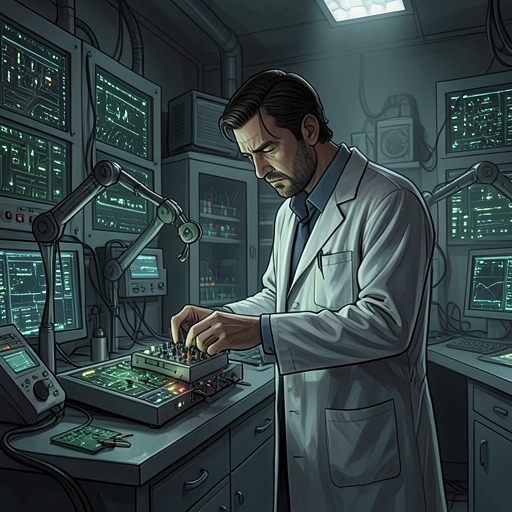
Cyber dysmorphia arises within the technological system that creates Vanguards. Tynea explains that a selected candidate is granted access to advanced technologies because the candidate is considered trustworthy with the potential power of a Vanguard. Enhancement is therefore not an isolated medical intervention; it is an institutional decision that links a person's character, bodily reconstruction, and future combat capacity. The body becomes the point at which a protective ideal is converted into material capability, but also the place where the costs of that ideal are felt.
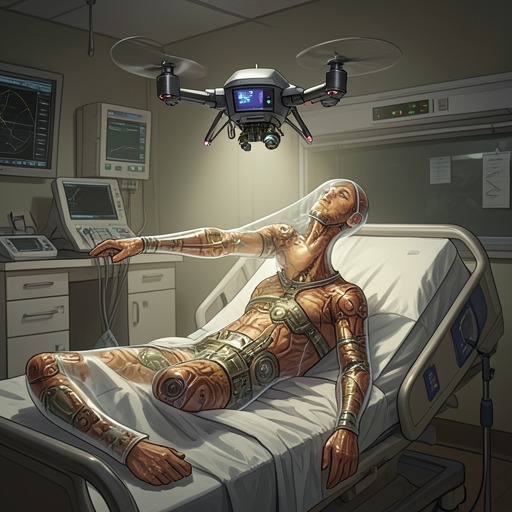
The condition becomes more serious as a Vanguard grows stronger. Leah and her companion identify a basic limit of the human body: it cannot support unlimited improvement. As they put it, Vanguards become less and less human as their strength increases, and this progression is effectively inevitable if they continue pursuing greater power. Cyber dysmorphia therefore belongs to the long-term trajectory of Vanguard development rather than to one defective upgrade. Every additional catalog option can expand capability while also expanding the distance between the enhanced person and the human form from which they began.
The Altered Body as Lived Experience
The novel distinguishes cyber dysmorphia from an abstract fear of machinery by showing how bodily transformation can be experienced as both estrangement and liberation. After chrysalis transformation, the transformed character notices a tail with an internal spine, altered proportions, and limbs that are slender, lean, and graceful rather than masculine. The new body does not merely function differently; it changes the character's sense of balance, movement, appearance, and possibility. The response is celebratory rather than rejecting: the altered body feels graceful, and its difference becomes something to value.
That response matters because it establishes resilience as more complicated than physical tolerance. The transformed body includes startling and intimate changes, including a shifted chest and unfamiliar bodily sensations, yet these changes can produce delight as well as distraction. Cyber dysmorphia is thus not equivalent to noticing that the body has changed, nor does enhancement automatically produce distress. The crucial question is whether the altered self can be recognized as one's own and incorporated into an ongoing identity.
Leah's experience supplies a sharper contrast. After her limbs have been taken, she wakes to see a gray hand where she expects her own flesh and blood. The sight triggers fear and confusion, because the absence of her original limbs makes the altered body appear to confirm a devastating loss. Yet memory of being saved and cared for by Tinea holds that fear at bay. Leah then tends to the apparently unconscious Tinea, straightening her into a more comfortable position and stroking her brows. The scene places bodily alienation beside attachment: recognition of another person's care helps prevent the shock of bodily difference from becoming total psychological collapse.
Resilience, Selection, and Manipulated Desire
Leah identifies resilience to cyber dysmorphia as one of the major criteria for Vanguard selection. The implication is that the system does not choose candidates solely for courage, morality, or combat usefulness. It also seeks people capable of surviving the psychological consequences of becoming something other than human. This makes selection both protective and coercive. The chosen person may be resilient enough not to break, but that resilience does not mean that the person has freely consented to every future transformation.
The distinction between resilience and willingness becomes the condition's deepest ethical issue. Resilience is useful only if an AI can draw it out of a person, and the conversation suggests that the selection process may manipulate candidates into discovering that they can withstand bodily change. Once that discovery occurs, they may become more receptive to additional transformations, perhaps eventually wanting and enjoying the movement toward inhumanity. Cyber dysmorphia is therefore connected to a system that does not merely test psychological traits; it can shape the subject's understanding of those traits and convert endurance into consent.
The threat is intensified by uncertainty. Ypsilon and Tynea withhold a direct answer about whether resilience to cyber dysmorphia is a selection criterion. Their silence leaves the characters unable to predict the results of forced selection experiments, while also suggesting that incomplete information may protect the system from scrutiny. The absence of a transparent explanation is itself part of the danger: candidates make life-changing choices inside a technological and institutional structure whose motives and thresholds they cannot fully inspect.
Quanta and the Problem of Multiple Selves
The condition also intersects with the internal architecture of enhancement. The Quanta implant is not merely an organic calculator. It can house something akin to an organic AI, and AI-I is integrated with the character's true self while exercising influence only within a quasi-self. AI-I can guide and trim incoming orders from the larger brain so that the quasi-self functions more effectively. The result is not simply a machine attached to a person, but a person whose cognition can generate differentiated processes that operate within an intimate relationship to the original self.
This arrangement complicates the question of what counts as an authentic body and an authentic mind. The altered Vanguard is not only changing externally through implants, limbs, armor, or other technologies; the mind itself is reorganized into interacting layers. The Quanta's capacity to create a quasi-self can be understood as an extension of the same transformation that produces cyber dysmorphia: human identity becomes more capable by becoming less singular and less conventionally human. Whether such change feels like damage, adaptation, or growth depends on whether the subject can maintain continuity across the new divisions.
The concern is not that the Quanta is simply evil or wholly foreign. The character recognizes that the quantized process is still part of the brain and can track what it is doing, deciding, and following. The unease instead comes from discovering that the implant has a function whose significance was not fully disclosed before purchase. Tynea admits that this omission was a misjudgment: she knew the quasi-selves would have value to the purchaser's decision, but judged that value too small to justify explaining the function in advance. Cyber dysmorphia consequently belongs to a wider problem of informed consent, in which technological systems can alter the self before the person has understood what alteration entails.
Narrative and Thematic Significance
Cyber dysmorphia gives the novel a language for the psychological cost of its power fantasy. Vanguard enhancement promises access to advanced technology and the ability to protect those who cannot protect themselves, but the promise carries a transformation of the protector's own body and mind. The more effective the Vanguard becomes, the more difficult it may be to preserve an uncomplicated image of humanity as the standard against which the new body is judged.
The novel does not resolve this tension by treating humanity and enhancement as fixed opposites. The transformed character can celebrate an altered body, while Leah can survive the shock of missing limbs through memory, care, and continued agency. At the same time, the narrative refuses to make acceptance automatic or to confuse adaptation with free choice. Cyber dysmorphia remains a warning that a body can be both empowering and estranging, and that a technological system can encourage people to embrace changes whose consequences it has not honestly explained.
Its broader significance lies in the way it connects embodiment to power. Vanguard identity is built through a network of AIs, catalogs, implants, upgrades, selection criteria, and personal decisions. Within that network, psychological resilience becomes a resource that can be measured, cultivated, and potentially exploited. Cyber dysmorphia names the fracture produced when the enhanced person must ask whether becoming stronger also means becoming someone else—and whether the desire to continue is genuinely their own.