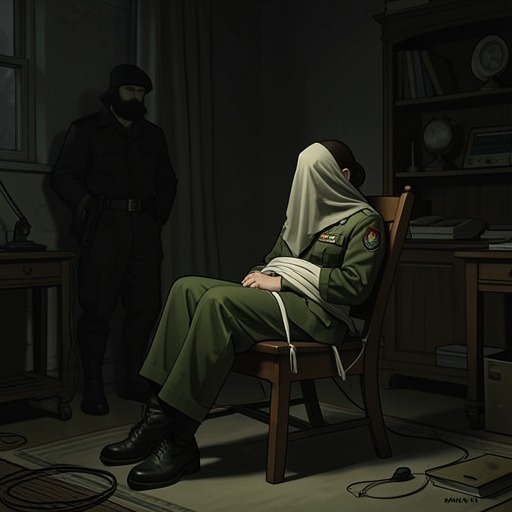
Leah's Rescue
Tinea and Leah: [Cyberpunk, Alien Incursions, Murder and Mayhem, Girl's Love (WLW)]Leah's Rescue is the decisive reversal of Leah's six-day captivity: a nearly voiceless prisoner turns a resource system into a rescue signal, and Tinea converts that signal into physical protection. The event joins a calculated act of survival to an intensely bodily encounter, moving Leah from confinement, uncertainty, and dependence on Ypsilon's voice toward contact with an ally who can actually enter the room and take her away.
Causes and Conditions
Leah's rescue becomes possible because Ypsilon helps her treat the point economy as a practical survival system rather than an abstract catalog. Ypsilon describes the Highlight Self-Launching Self-Displacing Flare as a device that can teleport above the point from which it launches, escaping even a mountain or the basement of a skyscraper. Its fuel, altitude, and defenses make it expensive, however: the catalog costs fifty points and the flare itself costs thirty. Cheaper alternatives could be used sooner, but they offered less certainty and might destabilize Leah, so the choice is framed as a trade between speed, reliability, and her fragile condition.
By the sixth day, Leah is increasingly unbound, unsteady, delirious, and faint. She has lost her voice and must communicate through gestures, including a moment in which she first nods and then urgently shakes her head. The flare therefore represents more than equipment. It is a way to convert accumulated points into a chance to be located, while Ypsilon's continuous conversation keeps Leah mentally engaged through the captivity. The system's game-like interface is placed against a body that can barely endure the waiting, making every purchase a material decision about whether Leah will remain isolated or become findable.
The Signal and the Reversal
Ypsilon counts down the final minute before Leah authorizes the launch. At zero, the flare produces only a quiet whoosh, but the result is immense: Class I Search and Rescue Utilities unlock, the points fall to forty, and the Highlight Self-Launching Self-Displacing Flare is purchased for another reduction to ten. A Garbage Disposal is also purchased, leaving nine points. The numerical reductions record the cost of the rescue with unusual precision, while the signal itself marks the narrative's shift from passive waiting to active intervention.
The flare shows exactly where Leah and Ypsilon are. The plan is no longer merely to wait for rescue; the signal creates the possibility that someone will come, or that Leah and her allies will escape by other means. The outside world responds within minutes. Someone lurches into the room and calls for another person, and Leah reacts with a shock intensified by isolation: a voice other than Ypsilon's has become foreign and uncanny. The rescue begins not with recognition or reassurance, but with the disturbing proof that the signal has brought unknown people into the facility.
Tinea's Intervention
The first arrivals do not provide safety. After an aborted scream and two heavy thuds, the room falls silent. Then quick, light steps approach Leah. A shocked breath, a small cry, sniffling, wet drops on Leah's face, and feathery things brushing against her announce the rescuer before Leah can understand her identity. The scene makes rescue a sensory event before it becomes an explanation: movement, touch, tears, and wings or wing-like appendages reach Leah before language can restore order.
Tinea introduces herself as a samurai and promises to help Leah with her eyes and the rest of her condition. Her first gesture is deliberately small: she offers her hand, cups Leah's cheek, and strokes the cheekbone with her thumb. The touch is gentle against Leah's thirst-burned skin and disarms her defenses. Leah begins sobbing without a voice, while Tinea cradles her against her chest, hugs her tightly, and strokes her hair. The rescue thus answers captivity's sensory deprivation with contact. Tinea does not first demand an explanation from Leah or require coherent speech; she makes safety legible through touch.
Violence at the Facility
The danger does not end when Tinea reaches Leah. Danielle recognizes that the facility and its prisoner may soon be lost if another intruder arrives, and proposes taking Leah's brain, cutting off her head, and extracting the chip later. Hearing this, Tinea experiences a violent moral reversal. She had not killed humans in a long while, but Danielle's proposal makes the speakers, in Tinea's judgment, no longer human in any meaningful ethical sense. She attacks them as monsters.
This threat clarifies what Tinea's tenderness is defending. Leah is not simply an object to be extracted from a room; she is a person whose body and consciousness are being contested by captors willing to dismantle her for a chip. The same rescuer who moves quietly, shushes Leah, and comforts her must also act decisively against those who would reduce Leah to salvageable machinery. The event's value shift is therefore double: Leah moves from hidden captivity toward possible freedom, while the facility's apparent human custodians are exposed as a more immediate danger than the rescuers entering it.
Repetition, Consequence, and Significance
Tinea's first words to Leah recur later when Tinea remembers the encounter. In that recollection, old and new instincts combine as she makes gentle shushing noises, introduces herself as Tinea, identifies herself as a samurai, offers her hand, and strokes the cheekbone of the silent woman. The repetition preserves the rescue as both an external action and a formative memory. Leah experiences the touch as the beginning of relief; Tinea experiences the same gesture as an awakening of maternal instincts.
The event is consequently more than a successful signal launch. It binds Ypsilon's technological assistance to Tinea's physical presence and gives Leah a path out of a captivity in which her voice, bodily stability, and sense of time have been steadily eroded. It also anticipates the later logic of Vanguard life: people are encouraged to explore frightening possibilities, but the most consequential transformation can begin with a simple, carefully offered hand. Leah's rescue makes survival calculable long enough for help to arrive, then makes survival human through the manner in which that help is given.