New Montreal
Tinea and Leah: [Cyberpunk, Alien Incursions, Murder and Mayhem, Girl's Love (WLW)]New Montreal is the principal urban setting of the opening Antithesis crisis and a recurring point of reference for the characters’ lives. It begins as a modest suburban city where Aden Rheinschiffer rents a small but comfortable home, works freelance jobs, and watches the city from a five-story condominium; it then becomes the site of a rapidly expanding incursion, a defended military zone, and a community trying to preserve ordinary life behind new fortifications. The city’s decisive significance lies in that transformation: New Montreal makes the global threat concrete by forcing alien biology, civilian architecture, commercial routine, and Samurai warfare into the same streets.
Setting and Ordinary Life
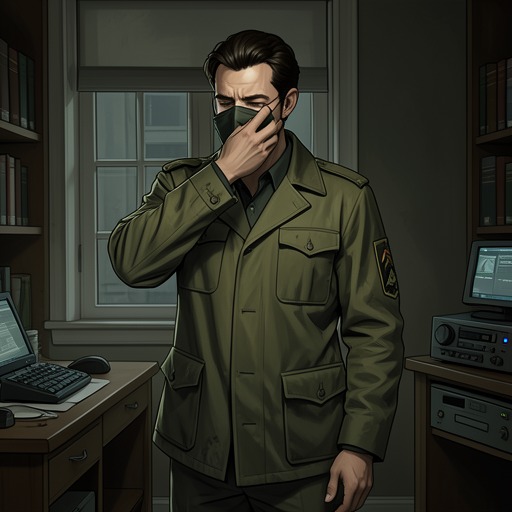
New Montreal first appears through Aden Rheinschiffer’s domestic perspective. His apartment is small and expensive enough that rent remains a constant burden, but it feels like home. He keeps it clean, can afford reasonably healthy food and middling-quality augmentations, and supports himself as a freelancer designing, dictating, and testing prompts for the artificial intelligence that controls industrial robots at a nearby manufacturing company. The work is not heroic, yet it establishes New Montreal as a place where technical labor and precarious independence remain possible after the wider historical disasters of the setting.
Aden’s home also gives the city a carefully chosen vantage point. His condominium is one of the taller buildings in the suburbs, although it rises only five floors. It stands beside the end of a broad shopping strip, with a road on the opposite side, allowing him to move between views and watch both approaches. From the roof, he can protect shoppers who are unprepared for violence. The location therefore converts private property into an improvised defensive post: the apartment remains a refuge, but its height, position, and visibility give it public obligations.
The Incursion Reaches the City
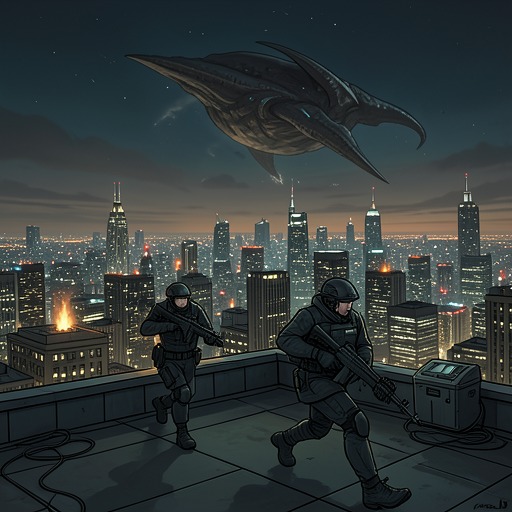
The first sight of the crisis changes New Montreal from a familiar urban environment into a landscape of invasion. The sky above the city is crimson, with its deepest color concentrated over New Montreal. Giant fleshy ropes descend across the megacity, tall buildings burn, and distant explosions flicker beyond the range of clear sound. At first the incursion covers only several kilometers and is centered along the nearby edge of New Montreal rather than consuming the entire city, but its limited initial footprint is precisely what makes the danger legible: the city is not already lost, yet the direction of events is unmistakable.
The Antithesis attack penetrates recognizable civic spaces. A rope bursts against the new museum under construction, a building begun roughly six months earlier, and splatters fleshy pods over its surface. Small Antithesis figures climb out through broken windows and enter the museum, while others lose their grip and fall from the building. The museum becomes an early emblem of the city’s inversion. A site associated with future public culture is transformed into a biological landing point, and unfinished architecture becomes an access route for the invaders.
The threat spreads through the city’s commercial spaces as well. Nearer to New Montreal, the ropes swell with fruiting blisters while dog-like Model Three units sniff around doors. Some rush toward shop windows as civilians crouch beneath tables or hide behind bars. A few people carry pistols and attempt to work out how to use them against the attackers. Aden’s reaction emphasizes the gap between possession and readiness: weapons exist in the city, but most civilians have not practiced enough to use them effectively under pressure. The shopping strip’s everyday design—doors, windows, counters, tables, and advertising—therefore becomes a series of improvised positions in a battle for survival.
Military Response and Samurai Warfare
New Montreal quickly develops a visible military perimeter. Temporary military bases are established to stem and redirect the Antithesis tides, funneling them back against themselves and creating a cordon. From Aden’s perspective, the city resembles a vast tactical display: hordes move through the streets like traffic, even maintaining long, orderly rows that follow road rules, while older and stronger Samurai destroy them by the thousands. The apparent order of the invasion contrasts with its scale and persistence. Antithesis units can move through the city with mechanical regularity, but destruction does not stop their advance; they continue deeper into New Montreal.
The city’s new museum becomes one of the most heavily contested structures. A large Samurai-tech railgun emplacement is installed on its roof and fires repeatedly into waves of Model One units and occasional larger Model Eleven units. A girl Vanguard fights beside it, concentrating on the land-bound single-digit models as they climb the museum’s walls and reach the roof. Her equipment includes grenades, guns, and two shoulder-mounted mini-railguns. The museum thus changes again: from construction site, to invasion entrance, to fortified artillery position and battlefield. Its unfinished public purpose is displaced by immediate military utility.
New Montreal also becomes the setting in which advanced weapon systems are delegated beyond direct human control. The Sentinel is configured for full-automatic fire and can be guided through a secondary trigger that responds to the user’s movements. During preparation for combat, Aden considers whether AI assistance can handle command debugging while he fights, and Tynea agrees to manage that administrative burden. Later, Tynea is similarly entrusted with the administrative panels of the Myriad, including its combat settings, sensor information, missile production, and autonomous threat-detection options. These systems make the city’s defense a network of human judgment, AI management, weapons, ammunition, and hostile organisms rather than a simple contest between individual fighters.
Civilians, Shelters, and the Fortified City
For civilians, New Montreal’s invasion produces a geography of hiding and protection. Three months after an earlier crisis, Leah Neverstrait returns to the city during another incursion and has only a few points available. She spends the initial resources from her initialization allowance and daily income on a cybernetic eye to replace one lost to an ambushing Model Four, a cheap but dependable augmentation, and enough weapons to protect several children sheltering near the outskirts of the invasion. The children see little action because their shelter lies at the edge of the attack, but Leah’s limited resources reveal how unevenly safety is distributed. Protection depends on equipment, points, location, and the presence of someone willing to stand between vulnerable people and the Antithesis.
The city’s social response continues even while the invasion remains a threat. Later reports describe a substantial wall rising around New Montreal and a surprisingly positive public mood. Sun explains that the children are safe from the incursions, suggesting that the city is not merely enduring destruction but organizing forms of collective protection. Yet this apparent stability remains conditional. Leah’s absence is noticed when Jem checks her residence, detects damage from tampering on the door, and finds no sign of her. Her home is closed and watched, while those who care for her remain uncertain whether she left willingly.
That uncertainty links New Montreal’s public emergency to a more private danger. Leah reports that she and another new Samurai were kidnapped, probably by a corporation with the resources to steal a Samurai but enough greed and stupidity to attempt it. The city is therefore threatened from two directions: Antithesis forces attack openly, while powerful human institutions operate through abduction, property damage, and concealment. Leah warns her companions to stay safe, avoid traveling alone, and report anything suspicious immediately. The growing wall can protect the population from an external incursion, but it cannot by itself eliminate covert violence within the city.
A Networked Urban Battlefield
New Montreal ultimately becomes more than a backdrop for combat. It is a dense assemblage of streets, buildings, shelters, windows, doors, military bases, railguns, AI systems, and biological invaders, with each material element redirecting what people can do. Aden’s five-story condominium gives him a roof from which to survey two routes; the museum’s unfinished structure provides both entry points for Antithesis and a platform for a railgun; shop windows and bars become cover; the wall turns collective anxiety into a defensive boundary; and networked weapons allow a Samurai to perceive and coordinate tools spread across kilometers.
This expanded perception is revealed when Tinea Rheinschiffer localizes within the Quanta. The city’s weapons and tools become available as a distributed field of awareness: Sentinels, projectile-programming facilities, smart bullets, and even ammunition fired in directions where no solid target was struck. The Quanta’s accelerated, multithreaded processing changes the meaning of distance in the urban battle. Weapons are no longer isolated objects held by separate combatants; they form a connected tactical environment whose capacities can be sensed, programmed, and recombined.
New Montreal’s narrative role is consequently defined by repeated conversion. A home becomes an observation post. A shopping strip becomes a civilian kill zone and a defensive sector. A museum becomes an alien entry point and then an artillery emplacement. A shelter becomes a temporary sanctuary for children. A damaged apartment door becomes evidence of an unseen kidnapping. Finally, the city becomes a node in a larger weapon network. Its importance lies in showing how an invasion is experienced not as an abstract global event but as a transformation of ordinary infrastructure, where survival depends on learning what the built environment can permit, conceal, or empower.