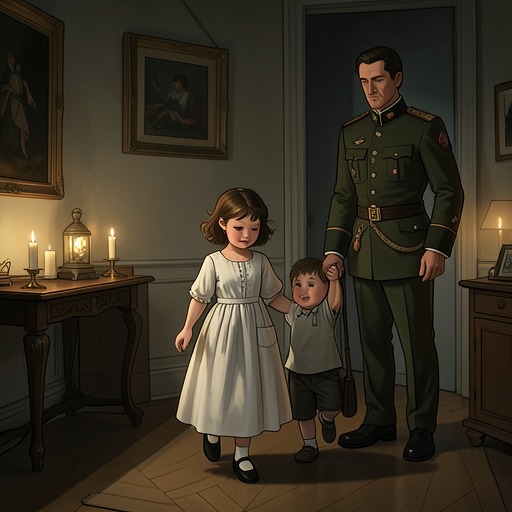
Sam
Tinea and Leah: [Cyberpunk, Alien Incursions, Murder and Mayhem, Girl's Love (WLW)]Sam is a six-year-old African North American orphan at Saint Viktor Orphanage in New Montreal whose closest bond is with Jora, his same-aged Scandinavian Canadian “girlfriend.” His appearances are brief, but they establish him as one of Leah’s “littles,” a child whose ordinary games, fierce attachment, and premature knowledge of orphanhood give emotional shape to the home Leah longs to return to.
Identity and Place in Saint Viktor
Sam belongs to the small community of children cared for at Saint Viktor, where Leah acts as an affectionate older-sister figure and Sister Lana serves as the primary caretaker. During Leah’s remote contact with home, Sam is among the familiar faces who crowd around the camera, waving and calling for her to return. His presence in that call is not merely a name on a roster: he is part of the noisy, affectionate domestic world that Leah has left behind while fighting hundreds of miles to the north.
The children’s greetings make Sam’s position within the group clear. Leah has to mute the children briefly so that she can speak to the adults, then tells them goodbye before continuing her dangerous journey. Sam is therefore connected to Leah through both dependence and distance: he is one of the children who wants her home, while Leah’s promise to keep moving is partly framed by the hope of returning to them.
Bond with Jora
Sam’s defining relationship is with Jora. The two children are described as a pair who call each other boyfriend and girlfriend, and their attachment is presented through cooperation rather than adult romance. When Jora recounts an overwhelming experience involving red and green imagery, Sam is initially lost, but Jora takes his hand and helps him get out. Later, when Jora becomes lost among blue-yellow walls, Sam is already holding her hand. Each child possesses a different visual capacity, and together they compensate for one another: Jora can see colors Sam cannot, while Sam can see colors Jora cannot.
Their handholding turns difference into mutual security. Sam does not rescue Jora by becoming superior to her; instead, the children remain vulnerable in complementary ways, and their survival depends on staying together. Jora explains their logic plainly: they must remain connected because each can perceive what the other cannot. The relationship consequently functions as a miniature ethic of interdependence, built from trust, touch, and practical mutual aid.
Childhood Promises and Orphanhood
Sam and Jora announce that they have decided to marry because they are both seven now, although their counting is comically inaccurate. When Leah explains that marriage requires adulthood, Sam supplies an answer that reveals how closely adulthood is tied to institutional displacement in his imagination: an adult is someone too old to remain at Saint Viktor. The joke becomes painful because it exposes the children’s awareness that growing up means eventually leaving the orphanage.
Sam then proposes that he and Jora wait until that distant point. He treats the delay as a way to make the eventual marriage more special, while Leah recognizes the uncertainty beneath the promise. The children have already learned that possessions may disappear if they are not used immediately, so Leah has taught them to store things in her locker and discover the pleasure of saving something for later. Sam’s willingness to wait transforms that lesson into an emotional promise: some things can be protected through patience rather than consumed at once.
His statement also gives the scene its quiet ache. Sam imagines eleven years as a manageable interval, even though it is longer than either child has been alive and may lead them to entirely different futures. The promise is therefore both innocent and precarious. It expresses the children’s desire for continuity in a life structured by loss, while Leah’s reaction recognizes that orphaned children are forced to think about separation long before they can understand its full consequences.
Narrative Significance
Sam’s importance lies in the contrast between the violence surrounding Leah and the small, concrete forms of care that make Saint Viktor a home. The wider narrative repeatedly places intelligence, weapons, autonomous systems, and battlefield coordination under pressure, but Sam’s scenes return to hands, cameras, lockers, childish counting, and the promise to wait. His world is not free from danger: the children mention injuries and frightening experiences, and their orphanhood remains an active condition rather than a resolved backstory. Yet Sam continues to interpret survival through companionship.
His bond with Jora also mirrors the book’s broader concern with dependence and selfhood. Elsewhere, Leah and her companions discuss the danger of making one person into another’s entire support system; Sam and Jora offer a younger, gentler version of the same question. Their closeness does not erase their separate limitations. It makes those limitations livable by distributing perception, fear, and action between them. Sam’s hand in Jora’s is thus both a child’s gesture and a compact image of the protective relationships Leah is fighting to preserve.
Sam remains a secondary figure rather than an independent combatant or plot driver. The available scenes do not give him a separate mission, later transformation, or definitive ending. What they do give him is a precise emotional function: he embodies the children waiting at home, the ordinary future Leah wants to recover, and the possibility that loyalty can survive even when childhood, place, and family are all threatened with change.