The Family
Tinea and Leah: [Cyberpunk, Alien Incursions, Murder and Mayhem, Girl's Love (WLW)]The Family is the local organizational infrastructure through which samurai coordinate defense against the Antithesis. It does not command them as a conventional army. Instead, it links independent fighters to information, bombardment requests, regional defenders, and one another, making it a crucial intermediary between personal initiative and collective emergency response. Its importance becomes clearest during the global incursion, when cities, suburbs, shelters, roads, communications, and military cordons all become parts of the same rapidly changing defensive network.
Nature and Position
The Family occupies an intentionally ambiguous position in the samurai order. Tinea identifies it as the local authority for samurai operations, but immediately qualifies that description: it is a “sort-of-but-not-really-authority,” functioning more as a facilitator than a regulator. The distinction matters because samurai retain substantial autonomy. They choose where to fight, what risks to accept, and which targets to pursue, while The Family helps make their requests actionable within a broader defense system.
That limited authority does not make The Family unimportant. During Aden Rheinschiffer’s first major encounter with the Antithesis, Tynea explains that the pod-grown Model Three units are weaker and slower than mature examples and that the unusually favorable engagement has produced an exceptionally good source of points. Her warning places Aden’s success within The Family’s wider operational context: an individual samurai may achieve a remarkable result, but regional survival depends on understanding the limits of that result and coordinating forces beyond one fighter’s immediate field of view.
Coordination During the Incursion
The organization’s operational role becomes concrete when Tinea observes an Antithesis swarm moving eastward toward the St. Lawrence River and, potentially, Quebec and New Montreal. The swarm is already large enough to take another day merely to pass the surrounding area, and its continued growth could bring it to hundreds of thousands or even more than a million units. Rather than treating the threat as a private hunting opportunity alone, Tinea contacts The Family’s support service, recognizing it as the mechanism responsible for connecting bombardment requests with the people who can trigger them.
The exchange is highly procedural. Tinea sends the swarm’s location and states an intention to kill as many Antithesis as possible over the following days, while asking The Family to monitor the swarm and destroy it if it approaches settlements. The automated system requires a priority level: low when no danger is expected within twenty-four hours, medium for engagement as soon as possible, and high when immediate action is required. Tinea selects low priority because the swarm is not yet close enough to threaten human settlements. The Family acknowledges the request and states that it will be reviewed within twelve hours. The sequence shows an organization attempting to convert individual judgment into a triaged, resource-sensitive response rather than indiscriminately escalating every report.
The Family also provides access to heavy weapons. When Tinea and Leah decline evacuation but request long-range support, the response makes orbital strikes, missiles, and ballistic bombardment available through the app. The warning that strikes require minutes of scanning, recalibration, and travel time, and that fighters should remain in unpopulated areas so the heavy weapons can operate, reveals a defense system governed by logistical constraints as much as by firepower. The Family does not simply promise rescue; it offers a channel through which samurai can request force while preserving the conditions needed to use that force safely.
Communication and Trust
The Family’s network combines automated interfaces with personal human contacts. During the global incursion, Laserjack identifies himself through Tinea’s augmentation as the person managing the defense of the region against the Antithesis. His manner is gruff and stressed, and he demands to know who is speaking quickly. Tinea hesitates because another samurai could potentially overpower her and because she lacks the points needed to defend herself, but Laserjack’s association with The Family makes him appear safe enough to trust. The organization therefore functions not only as a technical service but also as a social guarantee: affiliation can make an unknown armed individual seem less dangerous.
The Family app remains part of ordinary tactical decision-making. Leah confirms that Ypsilon installed it for her and has already seen Tinea’s low-priority alert. When Tinea and Leah reassess the swarm, they decide not to upgrade the alert because it is still moving slowly and is not expected to reach humans that day or the next. This second judgment shows that The Family’s system does not replace field knowledge. Its alerts and categories are interpreted by fighters who combine the organization’s information channels with direct observation of terrain, weather, enemy movement, and available equipment.
The wider communications network also supports personal safety. Sun reports that New Montreal is building a substantial wall and that the mood remains surprisingly positive despite the incursions. The community’s children are safe, but Jem has discovered evidence that Tinea’s door was tampered with after Tinea disappeared. Tinea explains that another new samurai was kidnapped with her, probably by a corporation, and tells the community to remain cautious and report anything suspicious immediately. Ypsilon is expected to preserve rapid contact as long as the internet connection remains available. In this context, The Family’s communications model exists alongside family, friendship, and caretaker networks rather than replacing them; survival depends on all of these channels continuing to function.
Limits, Contrasts, and Significance
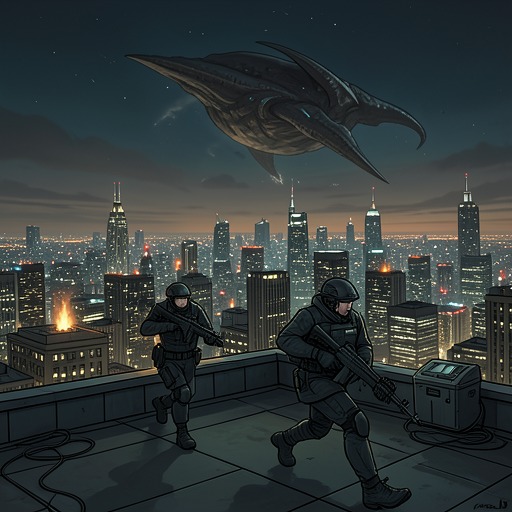
The Family’s decentralized facilitation contrasts sharply with more coercive military and mercenary structures elsewhere in the story. During the Antithesis invasion of New Montreal, temporary military bases form a cordon and funnel the incoming tides back upon themselves, while older and stronger samurai destroy thousands of units without stopping the flow. A samurai-tech railgun emplacement on a museum roof fires into waves of Model Ones and larger units, supported by a girl Vanguard using grenades, guns, and shoulder-mounted mini-railguns. The Family is not presented as the sole source of this defense. Rather, it is the connective tissue that allows requests, information, independently operated weapons, and regional responses to meet.
Its model also exposes the risks of privatized and distributed violence. The system gives individual samurai access to extraordinary destructive power, yet The Family’s role is primarily to facilitate rather than regulate them. Safety therefore depends on judgment, communication, and procedural categories. Tynea’s warning that Aden’s unusually successful battle should not be mistaken for normal conditions reinforces the danger of confusing a favorable tactical circumstance with reliable institutional protection. The organization can supply coordination and escalation routes, but it cannot make every fighter equally experienced or every battlefield predictable.
The Family’s significance lies in this tension. It is neither a conventional state authority nor a simple community group: it is an adaptive emergency network that translates private combat capacity into collective defense while preserving the autonomy that makes samurai difficult to govern. Its app, priority system, bombardment links, regional managers, and trusted social reputation create a form of resilience suited to a world where Antithesis hordes can appear across continents at once. At the same time, its limited regulatory power leaves moral and practical responsibility close to the individual. The Family can watch, connect, warn, and summon force; the decision to act, and the consequences of acting, remain distributed among the people and systems tied into it.