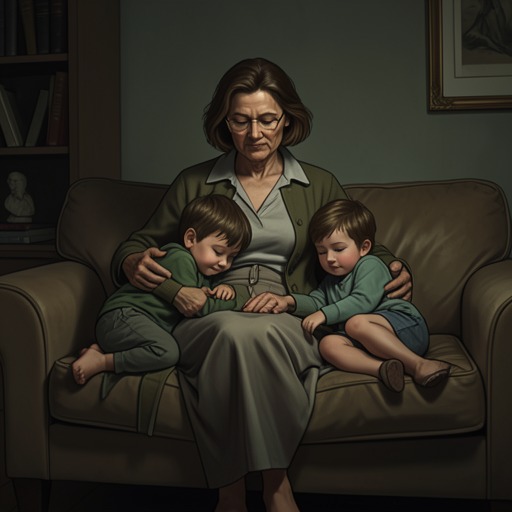
The Ordinary Miraculous
Tiny Beautiful Things: Advice on Love and Life from Dear SugarThe Ordinary Miraculous describes how an ordinary object can acquire extraordinary meaning through the unforeseen meeting of grief, memory, and new life. In Sugar’s account, a red velvet dress bought by her mother for a granddaughter she would never know first becomes a secret keepsake, then a material link between generations. Its significance is not present all at once: it takes the mother’s death, the daughter’s birth, and the passage of years for the dress to disclose what it means.
The dress and its delayed history
Sugar’s mother bought the dress at a yard sale for the granddaughter she would never meet. The fact is at once simple and painful: the garment was an ordinary purchase, but its intended future could not include the person who made it. Sugar kept it in a box inside a cedar chest that had belonged to her mother. The chest accompanied her through her twenties and into her thirties, while the dress remained a secret among her mother’s best things.
That long interval matters. Sugar had a son and then a daughter before she finally unearthed the dress and held it again. The object had not changed into something rare or supernatural; what changed was the life around it. Its meaning accumulated through the years in which it remained stored, and the delay between purchase and rediscovery made the past newly present. The dress connects an earlier act of maternal care to a child not yet born when that care was offered.
When Sugar found it again, she describes the response as both a slap and a kiss, and as a volume turned up and down at once. These opposing sensations express the dress’s double charge: it makes absence tangible while also carrying affection forward. The object does not resolve that contradiction. It holds both sides together, so that tenderness does not cancel grief and grief does not erase tenderness.
Loss, birth, and inherited love
Sugar states that the dress’s meaning was made by her mother’s death and her daughter’s birth. Neither event alone accounts for its force. The mother’s death makes the garment evidence of a loss; the daughter’s arrival gives the dress a future-facing use and a recipient. In this conjunction, the object becomes material evidence not only of what Sugar has lost, but of how her mother’s love continued beyond her mother’s life.
The account is careful not to make the daughter the sole link between Sugar and her mother. Sugar says her mother lives as brightly in her boy child as in her girl. The distinction is important: the dress has a particular connection to the granddaughter for whom it was bought, but the love it represents is not confined to a daughter or to a single line of inheritance. The garment gives one relationship a visible form without defining the full reach of the family bond.
Seeing her daughter wear the dress on the second Christmas of the child’s life brings back the earlier shock of rediscovery, now transformed by the scene of the dress being worn. The grandmother could not know the granddaughter, yet her purchase is present in the child’s life. The passage does not suggest that the mother foresaw this precise future; instead, it shows how an act can outlast the circumstances and knowledge of the person who performed it.
The ordinary made extraordinary
The scene’s emotional scale depends on how ordinary its central fact appears: Sugar’s daughter is wearing a dress her grandmother bought for her at a yard sale. For many families, a grandmother buying a child’s dress would be unremarkable. For Sugar, the same fact is extraordinary because the grandmother is dead and the dress survived years in storage before reaching the granddaughter. Its significance arises from the specific history behind an otherwise familiar act.
That contrast resists the idea that meaning belongs only to dramatic or exceptional events. The dress remains a small, usable object, and the child wearing it is part of an ordinary family occasion. Yet the everyday scene gathers several times at once: the mother’s purchase, Sugar’s years of keeping the dress, the mother’s absence, and the daughter’s life. The ordinary is not discarded in favor of a grander symbol; its very ordinariness makes the accumulated history legible.
The dress’s significance is also personal rather than automatic. Sugar acknowledges that the same circumstance would mean little to many people, while for her it is heartbreaking and beautiful. The essay locates meaning in the relationship between an object and the life that has come to surround it, not in any universal property of red velvet or inherited clothing. The dress matters because this mother bought it, this daughter wears it, and Sugar can now see the connection between those facts.
Waiting for meaning to appear
From the dress, Sugar draws a broader account of how people understand their lives. People have experiences, lose loved ones, and encounter people they did not expect to enter their lives; those once imagined as permanent may be absent. The meaning of an experience, she suggests, often becomes clear only later, when a line can be drawn between events that once seemed separate. The dress makes that belated recognition concrete: its purchase and its eventual appearance on the granddaughter acquire their full relation only across time.
Sugar describes the task as keeping faith with what cannot yet be understood: to “put it in a box and wait,” trusting that the meaning may become visible in time. The image returns to the physical box that held the dress, but it also becomes a way of living with uncertainty. Waiting is not proof that every loss will be repaired or that every stored object will yield a revelation. In this episode, it means leaving room for significance to emerge without being able to dictate when or how.
The Ordinary Miraculous thus names neither a supernatural intervention nor a simple consolation. It is the recognition, in an everyday scene, that love can extend into a future its giver never witnessed, and that grief can coexist with gratitude. The final image is deliberately modest: Sugar standing before her daughter in the dress, grateful for what had once seemed only a small thing. Its force comes from the life and loss that time has gathered around it.